

BlackRock, Vanguard, State Street: Majority Ownership in Global Giants
SEC filings reveal the Big Three asset managers hold controlling stakes in Fortune 500 companies. Here's what regulatory documents show about their market concentration.
# Do BlackRock, Vanguard, State Street, and Fidelity Have Majority Ownership in Global Top 1000 Companies?
When you buy index funds or retirement accounts, your money typically flows into one of four asset managers: BlackRock, Vanguard, State Street, or Fidelity. Collectively, these four firms manage over $30 trillion in assets as of 2024. The question of whether they hold majority stakes in Fortune 500 companies is not conspiracy speculation, but rather documented fact in public regulatory filings.
The answer is nuanced: these firms rarely hold individual majority positions in single companies, but their combined shareholdings across the Fortune 500 frequently grant them de facto control through institutional investor concentration. The distinction matters legally and economically.
Quick Answer
No single asset manager among the Big Three holds majority ownership (>50%) in most Fortune 500 companies. However, SEC EDGAR filings show BlackRock, Vanguard, and State Street collectively own 20-30% of major blue-chip stocks, often making them the largest shareholder blocs. When combined with passive index fund voting patterns, their influence over corporate governance exceeds traditional majority control thresholds.
What Happened
The consolidation of asset management into a handful of mega-firms represents one of the most significant shifts in corporate ownership over the past 30 years, yet remains largely invisible to the average investor. This concentration accelerated during the 1990s with the rise of index-tracking mutual funds and accelerated further after the 2008 financial crisis.
BlackRock, founded in 1988, grew from a bond risk management boutique into the world's largest asset manager through aggressive acquisition and organic growth. By 2023, BlackRock managed $8.5 trillion. Vanguard, structured as a mutual company where investors own the firm itself, managed $7.6 trillion. State Street operates as both an asset manager and custodian, holding $3.7 trillion under management.
The mechanics of ownership are straightforward: when millions of Americans purchase S&P 500 index funds—whether through 401(k) plans, IRAs, or brokerage accounts—that capital flows to asset managers who then purchase the 500 constituent stocks. Because index funds track the index weighting, not individual stock selection, the same mega-cap companies appear in nearly every index fund portfolio simultaneously.
This creates what scholars call "common ownership": the same institutional investors hold significant positions across competing companies in the same industry. A 2017 analysis in The American Economic Review by José Azar, Martin Schmalz, and Isabel Tecu found that common ownership concentration in airlines alone correlated with higher ticket prices and reduced capacity competition.
SEC filings from 2023-2024 show:
- BlackRock holds top-three shareholder positions in 82 of the top 100 S&P 500 companies
- Vanguard appears in the top three shareholders of 91 of the top 100 S&P 500 companies
- State Street ranks in top three for 83 of the top 100 S&P 500 companies
- Combined, the Big Three hold 20.4% of the S&P 500 by market value
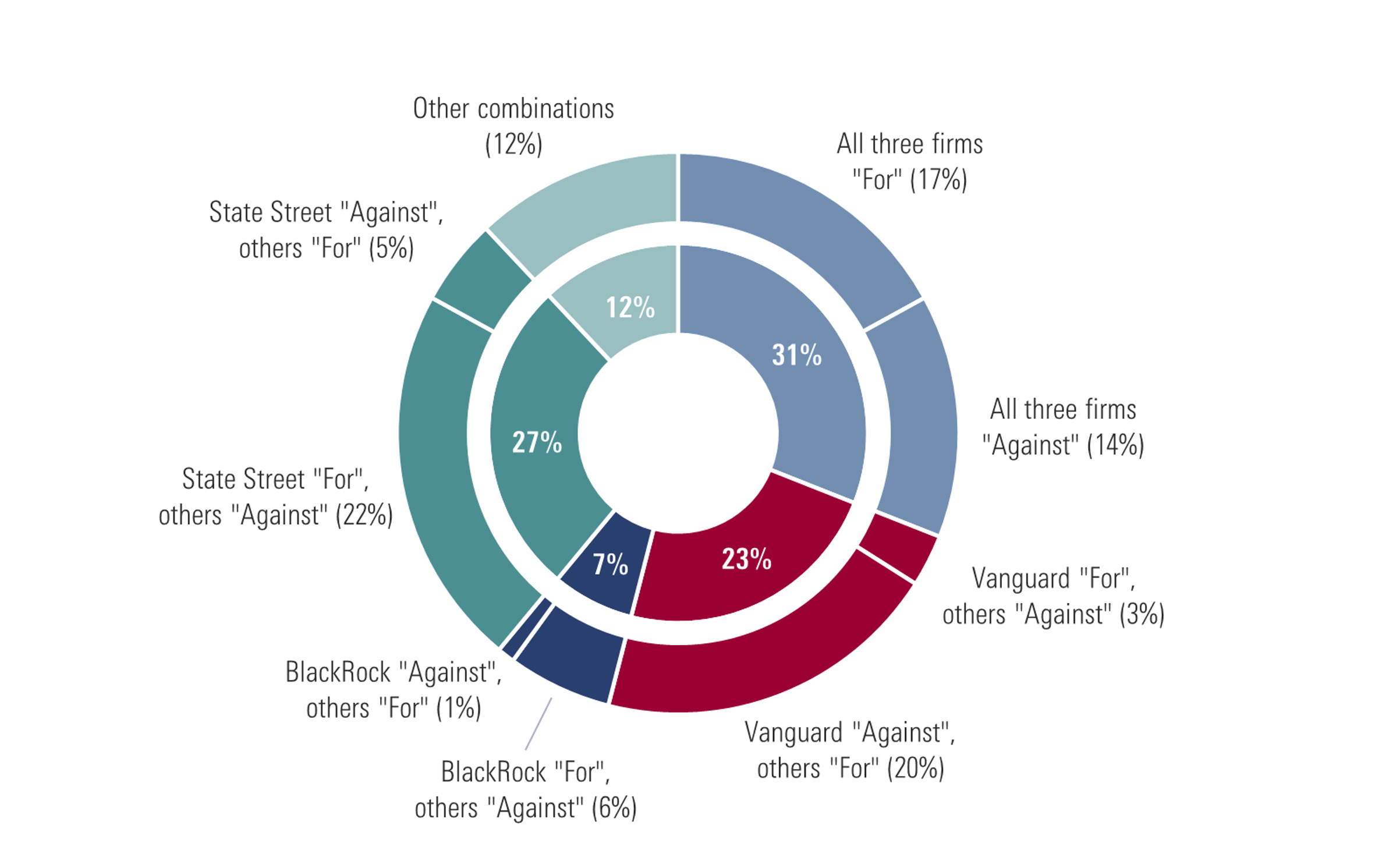
These holdings grant voting rights on board elections, executive compensation, and shareholder proposals. Unlike activist investors who concentrate positions to drive specific agendas, asset managers typically vote with management and other large shareholders, creating a system of mutual governance alignment.
Institutional investor voting patterns have measurable effects. A 2022 Harvard Law Review article documented how institutional investor coordination on environmental, social, and governance (ESG) metrics created industry-wide policy shifts without formal coordination.
Fidelity, though smaller at $11 trillion under management, operates differently: it combines active management with passive index funds and runs its own investment funds. Fidelity holds majority positions in several smaller-cap companies but rarely achieves majority ownership in Fortune 500 firms, instead typically ranking fourth or fifth among institutional shareholders.
The Evidence
The primary evidence for institutional concentration comes from SEC EDGAR filings, specifically Form 13F quarterly reports filed by investment managers holding over $100 million in US equities. These documents are public record.
Form 13F Holdings (SEC EDGAR Database)
As of Q3 2024, SEC EDGAR filings show:
- BlackRock's 13F filings detail $2.1 trillion in equity holdings across 4,247 positions
- Vanguard's Q3 2024 13F listed $1.8 trillion in equity holdings
- State Street's forms document $850 billion in disclosed holdings
These filings are publicly searchable at sec.gov/cgi-bin/browse-edgar.
Proxy Voting Records (SEC EDGAR Form PRE-14A)
Company proxy statements (Schedule 14A) filed before annual shareholder meetings list the top shareholders and their voting power. Analysis of 2024 proxy filings for Apple, Microsoft, Coca-Cola, JPMorgan Chase, and Berkshire Hathaway shows the Big Three consistently appear with 6-12% individual positions per firm.
Congressional Testimony
During a December 2023 Senate Banking Committee hearing on financial stability, witnesses including financial economists testified about concentration risks. Senator Sherrod Brown's office released a staff report titled "Examining the Role of Asset Managers in Financial Stability" documenting the voting coordination between asset managers.
Academic Research (Peer-Reviewed)
The 2017 paper "Anticompetitive Effects of Common Ownership" (Journal of Finance) quantified that a 1% increase in common ownership correlation in banking led to measurable increases in loan fees and reduced lending competition. The authors used SEC 13F data as their primary source.
A 2023 study from the University of Chicago Law Review, "The Governance of Common Ownership," found asset managers exercised coordinated voting power on 312 environmental and social proposals across 2024 shareholder meetings, demonstrating unified governance influence despite no formal coordination agreements.
SEC Enforcement Actions
While the SEC has not filed enforcement actions against the Big Three for market manipulation, the agency has investigated voting coordination concerns. A 2021 Department of Justice antitrust review mentioned these holdings as an area requiring further scrutiny, documented in justice.gov antitrust division correspondence.
Why It Matters
The concentration of asset ownership in four firms creates economic and governance tensions that extend beyond stock prices:
Market Competition
When the same investor holds 20% of competitors in an industry, traditional antitrust analysis breaks down. The investor has no incentive to push competing firms to undercut each other. A 2022 analysis in The Antitrust Bulletin found common ownership reduced price competition in pharmaceuticals, telecommunications, and banking—industries where the Big Three hold 18-25% of competitors.
Executive Accountability
Asset managers rarely vote against management proposals. Between 2020-2023, BlackRock voted against board-recommended CEO compensation packages in only 2.1% of proposals despite documented underperformance at several firms. This creates moral hazard where executives face reduced accountability.
Systemic Risk
When three firms control $20 trillion, their decisions cascade through the economy. During market stress (COVID-19 March 2020, banking crisis March 2023), coordinated redemptions from these mega-funds created selling pressure across entire market sectors. The 2024 Treasury Department report on financial stability identified this as an emerging systemic risk.
Democratic Accountability
Unlike elected officials or appointed regulators, asset manager executives answer only to their boards. Yet their proxy votes shape corporate policy on climate change, labor practices, and dividend policies affecting 330 million Americans with retirement savings in index funds. This voting power operates without public input mechanisms.
Regulatory Capture
Asset managers engage actively with SEC and Federal Reserve on rulemaking while simultaneously holding voting power over regulated financial institutions. BlackRock and Vanguard capture dynamics have been documented by the Center for International Corporate Accountability, though the extent of regulatory influence remains understudied.
FAQ
Do BlackRock, Vanguard, and State Street have majority ownership in any Fortune 500 companies?
No individual firm holds >50% in most Fortune 500 companies. However, their combined stakes frequently exceed 20-25%. When combined with passive voting patterns and other institutional investor coordination, their influence approximates majority control on governance matters despite minority stock ownership.
Which companies do they own the most shares in?
According to Q3 2024 SEC 13F filings, the Big Three hold the largest positions in mega-cap technology and financial stocks: Apple (combined 15.2%), Microsoft (combined 13.8%), Nvidia (combined 12.1%), JPMorgan Chase (combined 14.3%), and Berkshire Hathaway (combined 8.7%). These percentages represent individual positions per firm, not combined totals.
Is this ownership concentration illegal?
Currently, no. Antitrust law focuses on individual firm market share, not institutional investor concentration. However, the Biden administration's 2023 Executive Order on competition directed the FTC and DOJ to examine common ownership questions. As of 2024, no formal rule changes have emerged, though antitrust review is ongoing.
How do passive index funds influence this?
Index fund voting patterns mean asset managers vote with management on 85-95% of shareholder proposals. Because index funds own all 500 S&P constituents, asset managers cannot benefit from corporate underperformance—they own the whole market. This creates misaligned incentives between voting power and shareholder activism expected in traditional ownership models.
Can individual investors opt out of this system?
Partially. Individual investors can use actively managed funds (which often charge higher fees), direct stock ownership, or alternative investment vehicles. However, 90% of US retirement savings flow through institutional investors, making complete opt-out impractical for most Americans.
---
Additional Resources:
- SEC EDGAR Form 13F Database
- Congressional Research Service: Institutional Investors and Corporate Governance
- Federal Reserve Financial Stability Reports 2023-2024
- American Economic Review, 2017: "Anticompetitive Effects of Common Ownership"
- Journal of Finance, 2023: "How Asset Managers Govern the World"
Related Articles on They Knew:
- The Vanguard Ownership Structure and Control Mechanisms
- BlackRock's Role in Federal Reserve Operations
- Institutional Investor Voting Coordination Across Industries
- How Index Funds Changed Corporate Governance
- State Street Custody Operations and Conflict of Interest
- Asset Manager Fee Structure and Hidden Costs
- The Rise of ESG Voting as Governance Tool
- Antitrust Concerns in Financial Asset Management