

The Setup: Depression-Era Alabama, 1932
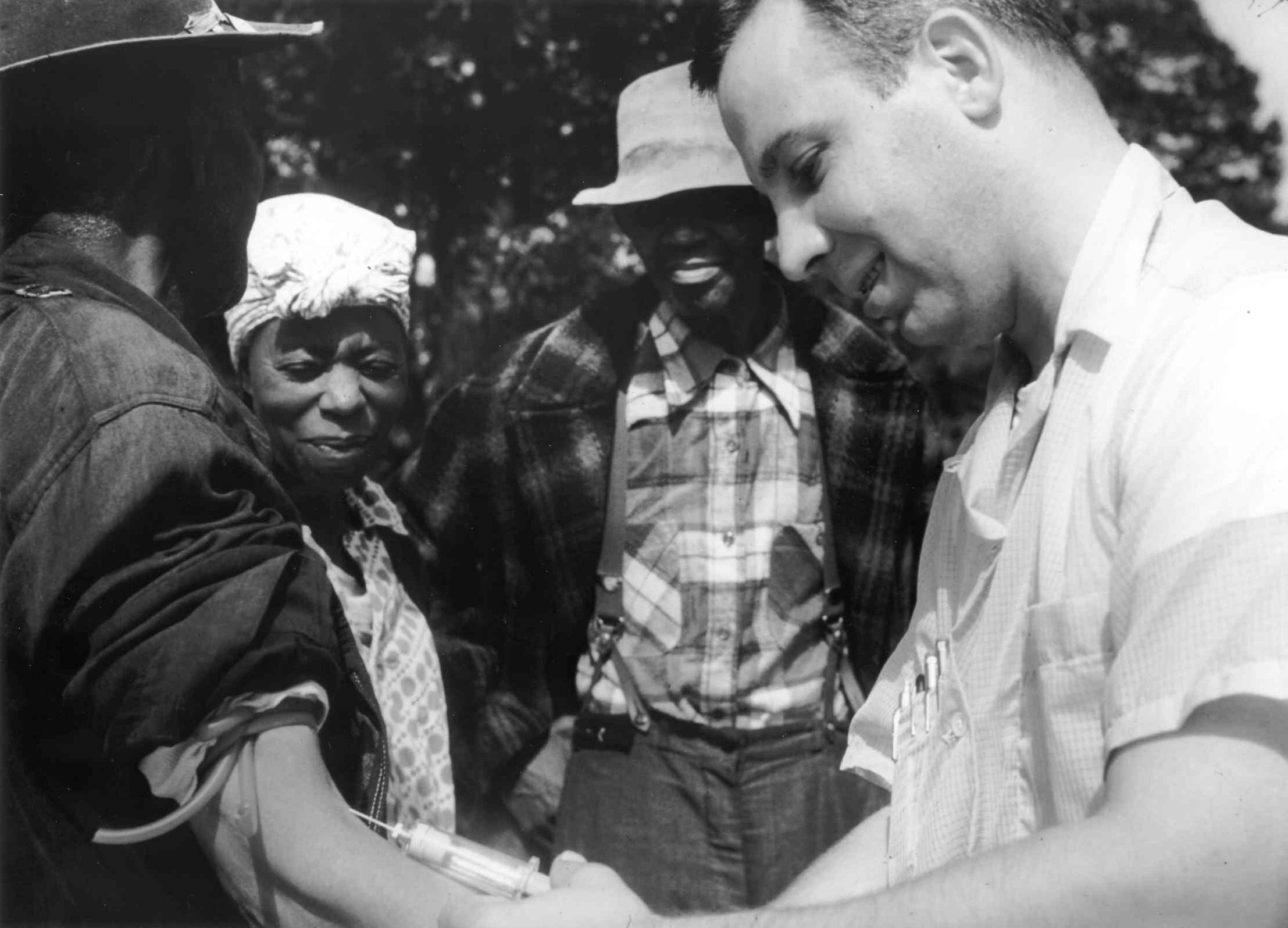
The study was launched in October 1932 by the U.S. Public Health Service (PHS) in collaboration with the Tuskegee Institute, a historically Black college in Macon County, Alabama. The official name was the "Tuskegee Study of Untreated Syphilis in the Negro Male." The name was not misleading. The deliberate non-treatment of syphilis was the point.
Macon County was one of the poorest counties in America. Syphilis rates among the Black population were dramatically higher than the national average — a direct consequence of poverty, lack of healthcare access, and structural racism that had denied Black Americans basic medical services for generations. The PHS identified this population as a ready-made study cohort.
The original stated objective was to study the natural progression of untreated syphilis in Black men over a period of six to eight months. From the outset, the study was premised on a racist assumption then prevalent in some corners of American medicine: that syphilis manifested differently in Black men than in white men, particularly in its cardiovascular rather than neurological effects. Researchers wanted data. They used human beings to get it.
399 men with latent syphilis were recruited. An additional 201 men without syphilis were enrolled as a control group. All participants were poor, rural, and Black. Most were sharecroppers. The PHS recruited them with promises of free medical exams, free meals on exam days, free treatment for minor ailments, and — crucially — free burial insurance. For men in Macon County in 1932, these were not trivial incentives.
They were never told they had syphilis. They were told they had "bad blood" — a local term that covered a range of ailments. They were never told the study's real purpose.
The Deception Deepens: Withholding a Cure
The original six-to-eight-month timeline expanded into years, then decades. By the early 1940s, penicillin had emerged as a safe, effective, and widely available cure for syphilis. This development did not end the study. The PHS chose to continue it anyway — and took active steps to prevent participants from receiving treatment.
When the U.S. military began drafting men for World War II, local draft boards sent syphilis-positive men for treatment. The PHS intervened to have the Tuskegee participants excluded from draft board treatment lists. Government doctors contacted local physicians in Macon County and instructed them not to treat the study subjects. Participants were actively steered away from penicillin even as it became the standard of care for syphilis across the United States.
The men continued receiving what the study called "treatment" — aspirin, vitamins, and iron tonics that had no therapeutic value against syphilis. They believed they were being cared for. Nurses, including Eunice Rivers, a Black nurse employed by the PHS, maintained contact with participants over the decades. Her involvement — trusted by the men, employed by the deceiving institution — remains one of the study's most examined and morally complex aspects.
By the late 1960s, the men with untreated syphilis had suffered decades of disease progression. Syphilis in its later stages attacks the heart, brain, and nervous system. It causes cardiovascular disease, neurological damage, blindness, and death. Men in the study passed syphilis to their wives. Children were born with congenital syphilis. The damage was not contained to the 399 original participants.
At least 28 men died directly from syphilis. An additional 100 died from related complications. 40 wives were infected. 19 children were born with congenital syphilis. These numbers come from the Senate hearings that followed exposure. The true toll was likely higher.
Peter Buxtun: The Whistleblower Who Wouldn't Stop
Peter Buxtun was a PHS venereal disease investigator and social worker who learned about the Tuskegee study in 1966. What he discovered disturbed him enough to file a formal objection with PHS officials in 1968. His written complaint argued that the study violated the Nuremberg Code — the set of ethical principles established after the Nuremberg Trials to govern human experimentation.
The Nuremberg Code was not obscure doctrine in 1968. It had been established in 1947, directly in response to Nazi medical experiments on concentration camp prisoners. Its first and most fundamental principle: voluntary, informed consent from research subjects is absolutely essential. The Tuskegee participants had never given informed consent. They didn't know they were in a study. They didn't know they had syphilis.
PHS officials reviewed Buxtun's complaint and decided to continue the study. A committee of distinguished physicians and public health experts convened to evaluate the program in 1969. They recommended it continue until all participants had died and autopsies could be performed.
Buxtun escalated. In 1972, having left the PHS and working as a law student in San Francisco, he passed the full study documentation to journalist Jean Heller at the Associated Press. He understood that internal channels had failed completely.
On July 25, 1972, Jean Heller's story ran on the front pages of newspapers across the United States. The headline in the Washington Star read: "Syphilis Patients Died Untreated." The study had been running for 40 years. It ended within days of publication.
Senate Hearings and the Legal Aftermath
Public outrage was immediate. Senator Edward Kennedy convened hearings in 1973. The testimony was damning. PHS officials defended their methodology and the study's scientific value even as senators and witnesses from the medical ethics community methodically dismantled those arguments.
A class-action lawsuit was filed in 1973 on behalf of the survivors and the families of those who had died. Lead attorney Fred Gray, a prominent civil rights lawyer who had represented Rosa Parks, argued that the men had been subjected to an unconstitutional experiment without their knowledge or consent.
In 1974, the federal government settled out of court for $10 million — approximately $9 million for participants and their heirs, plus lifetime medical benefits and burial insurance for all surviving participants. The settlement also covered wives, widows, and children who had been infected as a consequence of the study.
Of the original 399 men with syphilis, only 74 were still alive when the study ended in 1972. The last survivor, Ernest Hendon, died in 2004. The last known widow, Jessie Mae Hendricks, died in 2009.
The Belmont Report and the Birth of Research Ethics
The Tuskegee study's exposure directly produced the modern framework for ethical human research in the United States. Congress passed the National Research Act in 1974, which established the National Commission for the Protection of Human Subjects of Biomedical and Behavioral Research.
That commission produced the Belmont Report in 1979. It remains the foundational document of research ethics in the United States and much of the world. The report established three core principles: respect for persons (voluntary informed consent), beneficence (maximizing benefits and minimizing harm), and justice (fair distribution of research burdens and benefits).
The Belmont Report gave rise to the system of Institutional Review Boards (IRBs) now required at every research institution in the United States. Before any federally funded study involving human subjects can begin, an IRB must review and approve the protocol. Informed consent is mandatory. Vulnerable populations receive additional protections. None of this existed in structured, enforceable form before Tuskegee's exposure forced it into being.
The study also permanently altered the relationship between Black Americans and the U.S. medical system. Research conducted decades after Tuskegee consistently found lower rates of participation in clinical trials among Black Americans, and higher levels of institutional distrust. Studies published as recently as the 2020s continue to document the Tuskegee effect on healthcare-seeking behavior and vaccine acceptance within Black communities.
This was not irrational. It was a rational response to documented history. The distrust is not a perception problem. It is evidence of lasting institutional damage.
Clinton's Apology, 1997
On May 16, 1997 — 25 years after the AP exposé and 65 years after the study began — President Bill Clinton formally apologized on behalf of the United States government. Eight of the study's survivors, some in wheelchairs, attended the White House ceremony.
Clinton's words were direct: "The United States government did something that was wrong — deeply, profoundly, morally wrong. It was an outrage to our commitment to integrity and equality for all our citizens... What was done cannot be undone. But we can end the silence. We can stop turning our heads away. We can look at you in the eye and finally say on behalf of the American people, what the United States government did was shameful, and I am sorry."
Herman Shaw, one of the survivors who spoke at the ceremony, was 94 years old. He had been enrolled in the study in 1932 at the age of 29. He told the audience that he was grateful for the apology, but that it had come too late for most of his fellow participants.
The apology did not come with additional compensation. It came with a commitment to fund the Tuskegee University National Center for Bioethics in Research and Health Care — an institution that continues to operate and conduct scholarship on research ethics, health disparities, and medical trust.
What the Record Shows
The Tuskegee study is not a matter of historical dispute. It is among the most thoroughly documented programs in American government history. The records are held at the National Archives. The original study publications appeared in peer-reviewed journals throughout the 1930s, 1940s, 1950s, 1960s, and early 1970s — openly, under researchers' real names, with institutional PHS affiliation.
Thirteen academic papers were published based on the study's data before it ended. The study was not secret in the sense that its existence was hidden from the medical community. It was hidden from the participants. Researchers discussed it at medical conferences. It was referenced in public health literature. No one in the mainstream medical establishment stopped it.
This is what makes Tuskegee something beyond a conventional conspiracy. It was not hidden from institutions. It was institutional. Multiple administrations, multiple Surgeons General, and multiple generations of PHS personnel sustained it. The ethical failures were not individual aberrations. They were structural and systemic.
The study's documented history directly informs why skepticism toward government health claims — particularly among communities that have historically been exploited — cannot be dismissed as ignorance or irrationality. When people point to Tuskegee as a reason for distrust, they are citing established historical fact, not conspiracy theory.
The Documented Claims on They Knew
The Tuskegee Syphilis Experiment is one of the most extensively sourced cases in the They Knew database. Multiple claims related to this program are documented in our Health and Pharmaceutical category and Government category, with primary sources including the original PHS study publications, National Archives records, Senate hearing transcripts, and the final report of the Advisory Committee on Human Radiation Experiments, which reviewed Tuskegee as part of a broader examination of government research abuses.
Tuskegee also appears prominently in our overview of conspiracy theories that were proven true — cases where official denials were later contradicted by declassified documents, government admissions, or court records.
The study's trajectory follows a pattern visible across many of the 560 claims in our database: official framing as legitimate science or necessary research, internal dissent ignored or suppressed, external exposure by a whistleblower or journalist, congressional investigation, and eventual official acknowledgment. What changes is the timeline. In Tuskegee's case, that timeline was 40 years.
Conclusion: Institutional Memory and Ongoing Responsibility
The Tuskegee Syphilis Experiment ended in 1972. Its effects have not. The medical ethics infrastructure now protecting research subjects exists in large part because this study demonstrated what happens without it. The IRB system, the Belmont Report, modern informed consent requirements — these are the institutional scar tissue of Tuskegee.
The study is also a precise demonstration of why documentation matters. The story was not uncovered through a leak of secret files. It was exposed because Peter Buxtun had access to internal PHS records and the moral clarity to bring them to a journalist. Jean Heller did the work of turning those documents into a story the public could not ignore.
Every ethical protection in modern human research exists because someone refused to accept the institutional consensus that the study was acceptable. The protection of future subjects required acknowledging the betrayal of past ones. That principle applies far beyond Tuskegee.
Herman Shaw, speaking at the 1997 apology ceremony, said he hoped the government would "never again" do what was done to him and his fellow participants. That hope is worth examining, not celebrating. It is only worth anything if the historical record is maintained clearly enough that future institutions can be held to account against it.
That is the purpose of documentation. That is the purpose of this article.
Primary Sources and Further Reading
- James H. Jones, Bad Blood: The Tuskegee Syphilis Experiment (Free Press, 1981; revised 1993)
- Susan M. Reverby, Examining Tuskegee: The Infamous Syphilis Study and Its Legacy (University of North Carolina Press, 2009)
- U.S. Public Health Service study publications in Venereal Disease Information and JAMA, 1936–1973
- National Research Act, Public Law 93-348 (1974)
- The Belmont Report, National Commission for the Protection of Human Subjects (1979), available at HHS.gov
- Senate Subcommittee on Health hearings, 93rd Congress (1973)
- Settlement agreement, Pollard v. United States, M.D. Ala. (1974)
- President Clinton's remarks at apology ceremony, White House, May 16, 1997 (Clinton Presidential Library)
- Final Report of the Advisory Committee on Human Radiation Experiments (1995), U.S. Government Printing Office
- Vanessa Northington Gamble, "Under the Shadow of Tuskegee: African Americans and Health Care," American Journal of Public Health 87, no. 11 (1997)