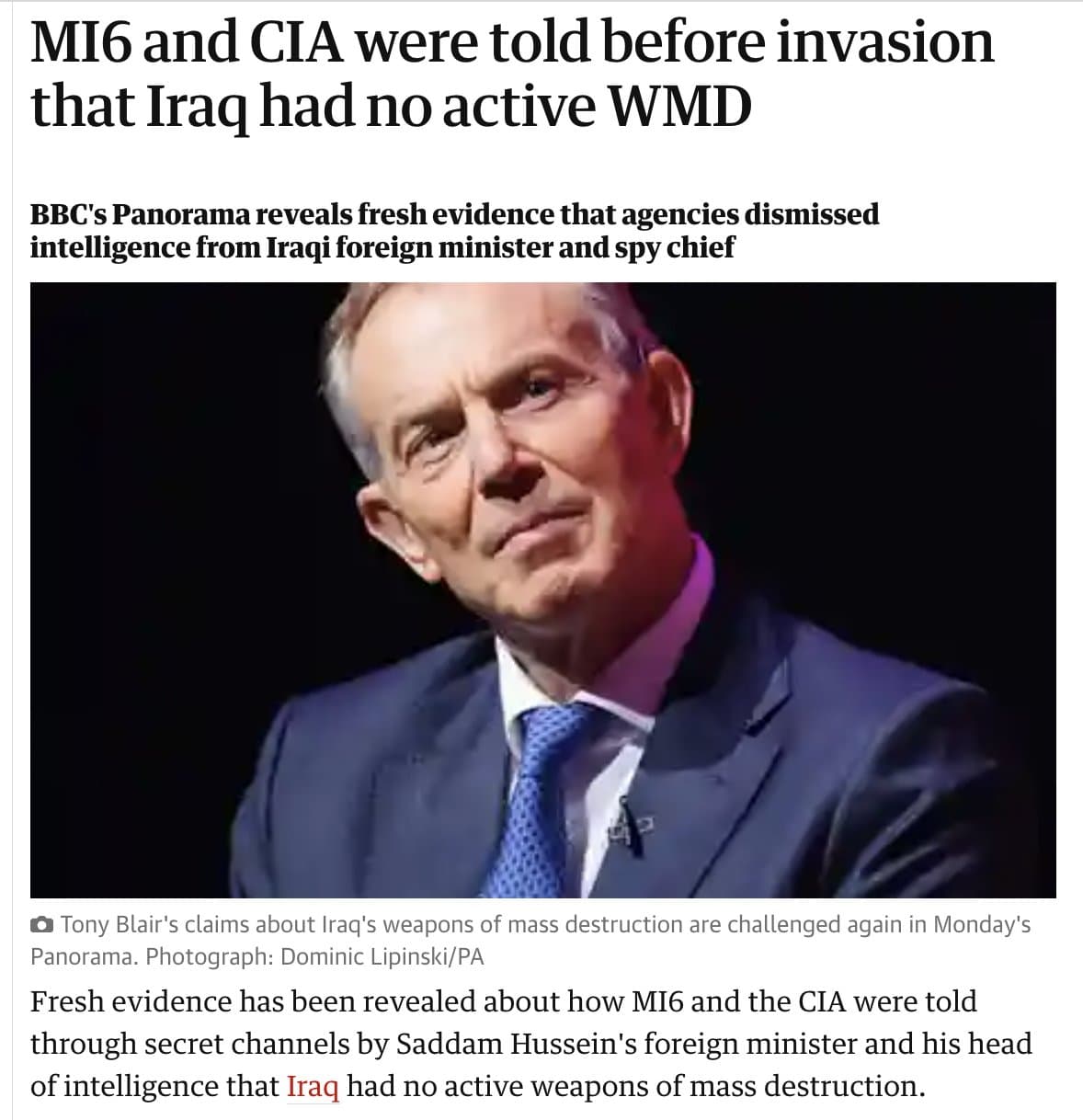
The Chilcot Inquiry revealed MI6 knew their Iraqi WMD sources were unreliable but presented intelligence as solid fact. The notorious '45-minute' claim was based on a single uncorroborated source deemed unreliable by analysts.
“British intelligence assessments of Iraqi WMD capabilities were based on solid, corroborated intelligence”
From “crazy” to confirmed
The Claim Is Made
This is the moment they called it crazy.
When Britain went to war in Iraq in 2003, the public was told the decision rested on solid intelligence about weapons of mass destruction. Prime Minister Tony Blair and his government presented a case that seemed irrefutable: Saddam Hussein possessed chemical and biological weapons, and the threat was imminent. The famous "45-minute claim"—that Iraqi forces could deploy WMDs in less an hour—appeared in the government's dossier and dominated headlines as a key justification for military action.
Years later, as no weapons were found and the war dragged on with devastating consequences, questions inevitably arose. How had British intelligence gotten it so wrong? The answer, when it finally emerged through official inquiry, was far more troubling than simple miscalculation.
The Chilcot Inquiry, formally known as The Report of the Iraq Inquiry, was commissioned to investigate Britain's role in the decision to go to war. Released in 2016—over a decade after the invasion—the inquiry's findings documented something that had been denied for years: British intelligence analysts knew their sources were unreliable but presented the information as fact anyway.
The notorious 45-minute claim serves as the starkest example. Investigators traced this assertion back to a single source described in internal documents as having "credibility problems." Yet this single, uncorroborated piece of information—provided by a source whose reliability MI6 had already questioned—became one of the most prominent claims in the public case for war. Intelligence officers knew better. Their own assessments documented the source's questionable track record.
The Chilcot Report revealed the mechanism by which this happened. Intelligence was filtered through a process where inconvenient caveats and warnings were stripped away as the information traveled upward to political decision-makers. Analysts' doubts about source reliability weren't communicated with the force they should have been. The human intelligence that formed the backbone of the WMD case was presented as more solid than it actually was.
British officials, when challenged at the time, defended their position with confidence. They insisted the intelligence community stood behind the assessments. Skeptics who questioned whether Iraq actually possessed WMDs were marginalized. The weight of government authority seemed overwhelming.
But the documentary record tells a different story. Internal memos, assessments, and communications revealed during the inquiry show that uncertainty existed at every level. What the public heard was a streamlined version of events—one that omitted the doubts, the disagreements, and the questionable sourcing that analysts knew characterized their case.
The Chilcot findings matter because they expose the mechanics of how intelligence can be shaped to support political decisions rather than inform them objectively. This wasn't necessarily a case of deliberate fabrication in the traditional sense, but rather of curated presentation—emphasizing what supported the case for war while downplaying or omitting what didn't.
The consequence was catastrophic. Hundreds of thousands died in Iraq. Trillions in resources were expended. And public trust in government institutions took a hit from which it has never fully recovered. When official inquiries finally confirmed what skeptics had long suspected—that intelligence was presented with more certainty than it deserved—many citizens drew an obvious conclusion: institutions had knowingly misled them about a matter of war and peace.
That realization didn't just affect views of this one conflict. It fundamentally altered how citizens approach claims made by their governments, especially regarding military action.
Get the 5 biggest receipts every week, straight to your inbox — plus an exclusive PDF: The Top 10 Conspiracy Theories Proven True in 2025-2026. No spam. No agenda. Just the papers they couldn't hide.
You just read "British Intelligence Created Fake WMD Intelligence to Suppor…". We send ones like this every week.
No one's said anything yet. Be the first to drop your take.