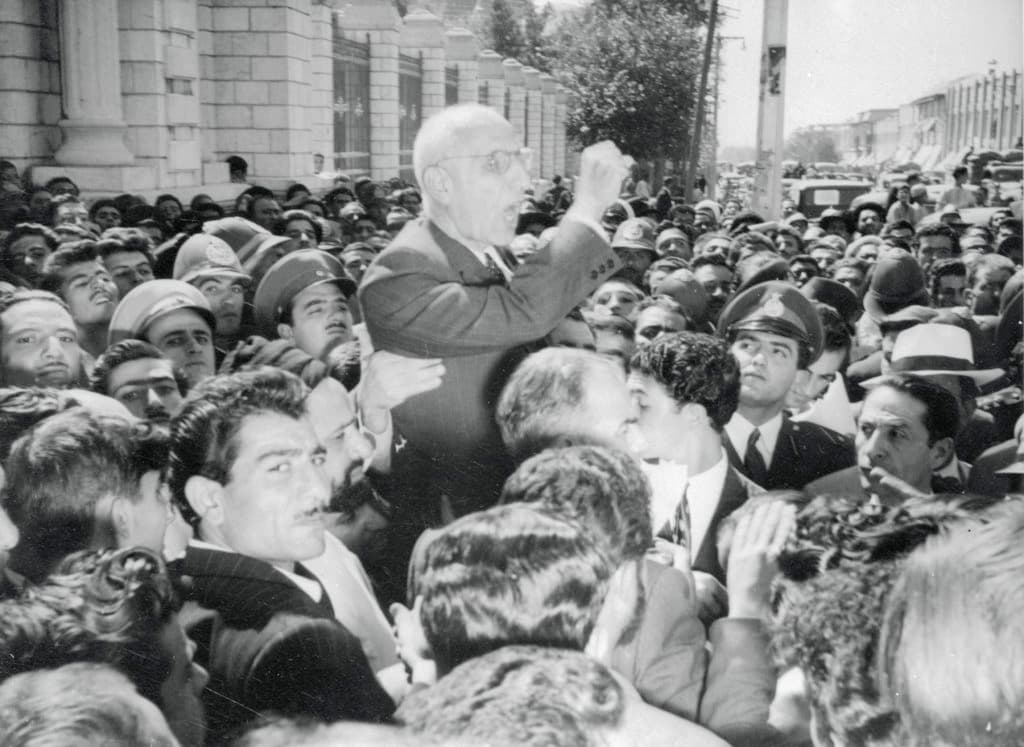
In 1953, the CIA (Operation Ajax) and MI6 (Operation Boot) overthrew Iran's democratically elected PM Mohammad Mosaddegh after he nationalized Iran's oil industry. The coup installed Shah Mohammad Reza Pahlavi as an authoritarian ruler. The US denied involvement for 60 years until the CIA officially acknowledged the coup in declassified documents released in 2013. This event is considered a root cause of the 1979 Iranian Revolution.
“The CIA overthrew the democratically elected government of Iran in 1953 to protect British and American oil interests.”
What they said vs. what the evidence shows
“The political changes in Iran in 1953 were the result of internal Iranian dynamics. The United States played no role in the change of government.”
— US State Department (for decades) · Jan 1954
SourceFrom “crazy” to confirmed
The Claim Is Made
This is the moment they called it crazy.
For six decades, the United States government maintained a consistent story about Iran: in 1953, Mohammad Mosaddegh's government fell due to internal instability and communist threats. The CIA had nothing to do with it. This version of events was repeated by presidents, repeated in textbooks, and repeated so often that it calcified into accepted history.
In 2013, that story fell apart.
The National Security Archive released declassified CIA documents confirming what Iran had always claimed and what historians had long suspected: American and British intelligence services had directly orchestrated the coup that removed Mosaddegh, Iran's democratically elected prime minister. The operation wasn't a defense against communism or internal chaos. It was about oil.
Mosaddegh's crime, in Western eyes, was straightforward. In 1951, he nationalized Iran's oil industry, threatening the British-controlled Anglo-Iranian Oil Company's monopoly on Iranian petroleum. Britain couldn't tolerate the loss of revenue. The United States, preoccupied with Cold War concerns and aligned with its British ally, agreed to help remove him. The CIA codenamed their operation "Ajax." The British called theirs "Boot."
The official dismissal of these claims was thorough and confident. For decades, U.S. officials denied involvement entirely. When pressed, they pointed to the supposed communist threat from the Tudeh Party and characterized Mosaddegh as an unstable leader whose government was teetering anyway. The narrative was tidy: if anything went wrong in Iran, it was Iran's own doing. American fingerprints were nowhere near the scene.
Get the 5 biggest receipts every week, straight to your inbox — plus an exclusive PDF: The Top 10 Conspiracy Theories Proven True in 2025-2026. No spam. No agenda. Just the papers they couldn't hide.
You just read "The CIA and MI6 orchestrated the 1953 coup that overthrew Ir…". We send ones like this every week.
No one's said anything yet. Be the first to drop your take.
Confirmed: They Were Right
The truth comes out. Officially documented.
Confirmed: They Were Right
The truth comes out. Officially documented.
But the fingerprints were there. The 2013 declassified documents contained operational details, communications between CIA and State Department officials, and explicit discussion of how to engineer Mosaddegh's removal. The documents showed American and British intelligence officers coordinating with Iranian military figures and royalist politicians to orchestrate street protests, manipulate media coverage, and ultimately force Mosaddegh from office. The coup succeeded in August 1953, and Mohammad Reza Shah Pahlavi, the young monarch who had initially fled the country, returned as an absolute ruler backed by American support.
The consequences rippled across decades. The Shah's authoritarian regime, propped up by U.S. military and financial aid, brutally suppressed dissent through his secret police. Iranians never forgot that their elected leader had been removed by foreign powers to serve foreign economic interests. When the Iranian Revolution erupted in 1979, anti-American sentiment wasn't abstract grievance—it was rooted in lived experience.
The 1953 coup matters now for a straightforward reason: it illustrates how official denials can persist for generations when backed by institutional power. The U.S. government didn't admit the truth because evidence emerged gradually or because journalists finally broke through. It admitted the truth because classified documents were declassified, making denial impossible.
This raises an uncomfortable question about what else governments might be denying today. Not every controversial claim turns out to be true, but this one did—after sixty years of being called a conspiracy theory. That gap between official denial and documented reality is worth remembering.
Beat the odds
This had a 4.7% chance of leaking — someone talked anyway.
Conspirators
~200Network
Secret kept
60 years
Time to 95% exposure
500+ years