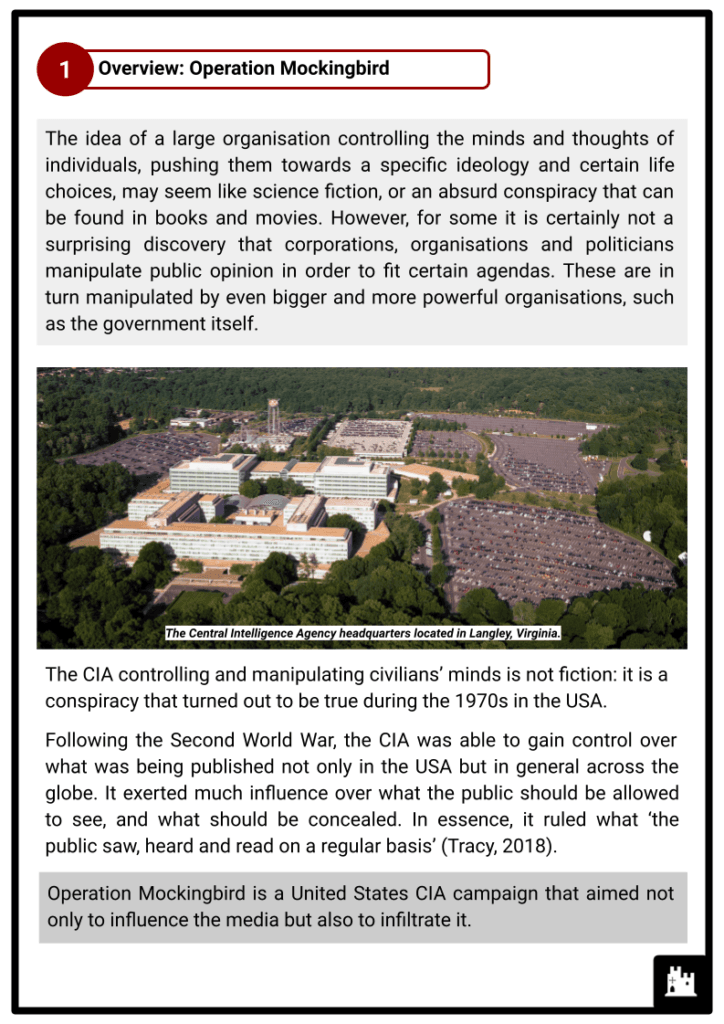
The CIA denied influencing American media, but congressional investigations revealed recruitment of journalists at major outlets to plant stories and shape coverage.
“The CIA does not have any relationship with American news organizations or journalists”
From “crazy” to confirmed
The Claim Is Made
This is the moment they called it crazy.
For decades, the notion that American intelligence agencies secretly influenced news coverage seemed like the stuff of paranoid speculation. Yet by the mid-1970s, declassified documents would confirm what seemed unthinkable: the CIA had systematically recruited journalists and planted stories in major American newspapers and magazines to shape public opinion and advance its agenda.
The program, known as Operation Mockingbird, began in the 1950s as an extension of broader CIA influence operations during the Cold War. The agency's reasoning was straightforward from their perspective: controlling media narratives was essential to national security. They didn't see it as propaganda so much as strategic communication in an ideological war against Soviet communism. What this meant in practice was far more troubling.
When journalists and researchers first raised questions about CIA involvement in the media during the early 1970s, official denials were swift and categorical. CIA leadership claimed the agency maintained strict boundaries between intelligence operations and American journalism. The suggestion that they would compromise the independence of the press was treated as unfounded conspiracy thinking, the kind of paranoia that reflected poorly on those making such accusations.
This changed abruptly in 1975. The Church Committee, officially the United States Senate Select Committee to Study Governmental Operations with Respect to Intelligence Activities, began investigating 's domestic operations. What they uncovered was damning. The committee's final report documented that the CIA had indeed recruited journalists at major American newspapers, including the New York Times, Washington Post, and other outlets. These journalists, some knowingly and some through intermediaries, had allowed their reporting to be shaped or influenced by intelligence handlers.
Get the 5 biggest receipts every week, straight to your inbox — plus an exclusive PDF: The Top 10 Conspiracy Theories Proven True in 2025-2026. No spam. No agenda. Just the papers they couldn't hide.
You just read "CIA's Operation Mockingbird secretly recruited journalists a…". We send ones like this every week.
No one's said anything yet. Be the first to drop your take.
The evidence was specific and extensive. Documents showed the CIA had relationships with over 400 journalists during the Cold War period. Some were paid assets. Others were cultivated relationships where CIA officials would provide information, context, and editorial guidance that journalists would incorporate into their reporting. Major stories about foreign policy, international events, and government operations were filtered through intelligence agency priorities before reaching the American public.
Perhaps most significantly, the Church Committee discovered that CIA officials had placed propaganda stories directly into American newspapers, which then republished them as legitimate reporting, amplifying their reach and credibility. This wasn't simply offering a perspective or providing background information. This was the systematic manufacturing of consent through the manipulation of news itself.
The revelations fundamentally challenged the mythology surrounding American press freedom. Journalists who believed they were investigating stories independently had instead been unwitting participants in intelligence operations. News organizations that prided themselves on accuracy and independence had become conduits for government propaganda. The public, believing they were receiving objective information, had instead been fed narratives carefully constructed by intelligence bureaucrats.
Decades later, Operation Mockingbird remains relevant precisely because public trust in media has continued its decline. The program demonstrated a hard truth: institutional safeguards against propaganda are fragile. When organizations prioritize access and official sources above independence, manipulation becomes possible. The question that lingers is whether the relationships between intelligence agencies and media outlets truly ended, or whether they simply became more sophisticated and harder to detect. What we learned from Mockingbird is that verifying what we're told requires constant vigilance.
Beat the odds
This had a 4% chance of leaking — someone talked anyway.
Conspirators
~200Network
Secret kept
50.4 years
Time to 95% exposure
500+ years