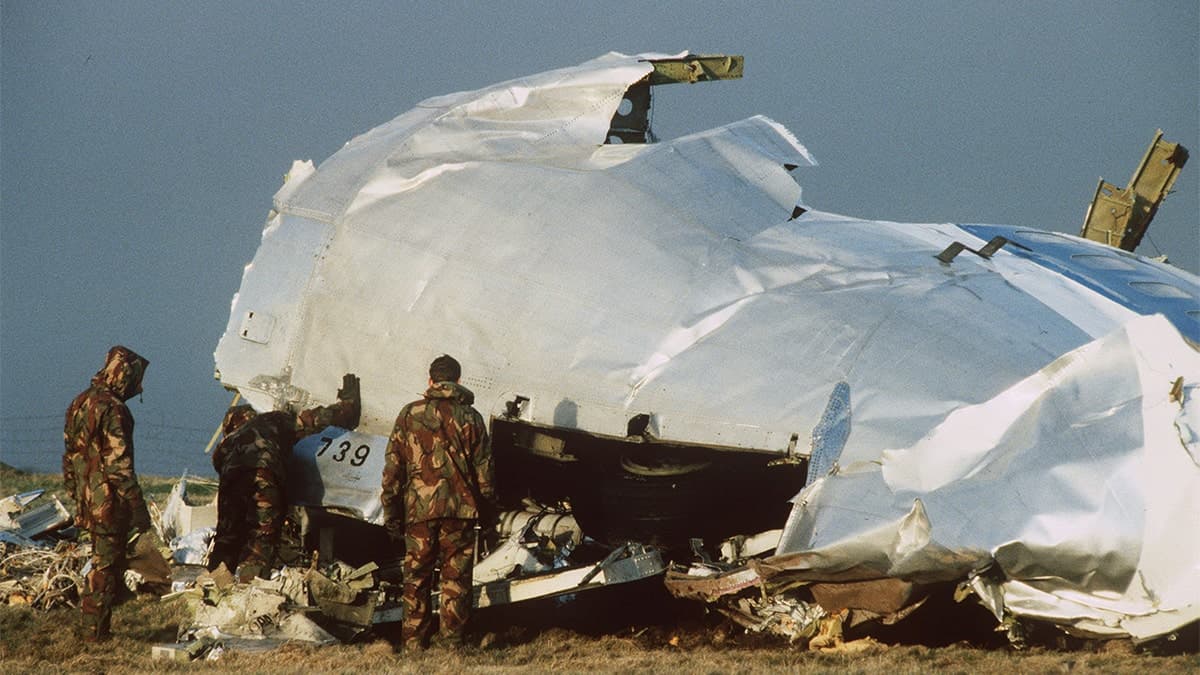
Early evidence in the 1988 Lockerbie bombing of Pan Am Flight 103 (270 dead) pointed to Iran and the PFLP-GC as retaliation for the US shooting down Iran Air Flight 655. Investigators allegedly pivoted to blame Libya after a Bush-Thatcher phone call, as the US needed Iran's cooperation for Gulf War coalition building. The sole convicted Libyan, Megrahi, had his conviction questioned by the Scottish Criminal Cases Review Commission.
“Investigation switched after Bush-Thatcher call.”
From “crazy” to confirmed
The Claim Is Made
This is the moment they called it crazy.
On December 21, 1988, Pan Am Flight 103 exploded over Lockerbie, Scotland, killing 270 people. Within days, investigators had collected evidence pointing in a specific direction. Within years, the official narrative had shifted dramatically—and the questions about why have never fully gone away.
The initial evidence was straightforward. Forensic investigators and intelligence agencies traced the bomb to the Popular Front for the Liberation of Palestine–General Command (PFLP-GC), a group known to be working closely with Iran. The timing appeared significant: the bombing occurred just months after the USS Vincennes shot down Iran Air Flight 655 in the Persian Gulf, killing 290 civilians. Iran had publicly vowed retaliation. Multiple intelligence reports suggested Iranian officials had commissioned the attack as payback for American military action.
This theory remained the working hypothesis through much of the late 1980s. German police raids uncovered PFLP-GC operatives in possession of similar bomb-making materials. Witnesses reported sightings consistent with known members of the group. The chain of evidence, while circumstantial, pointed consistently eastward toward Iran and its proxy networks.
Then, gradually and without clear public explanation, the focus shifted. By the early 1990s, the investigation had pivoted entirely toward Libya and its leader Muammar Gaddafi. In 1991, the United States and Britain jointly indicted two Libyan intelligence officers. One of them, Abdelbaset al-Megrahi, was eventually tried, convicted, and sentenced to life imprisonment in 2001. Libya eventually accepted responsibility and paid billions in compensation.
But the pivot itself raised questions that official channels have struggled to answer convincingly. Investigative journalists and some government sources have documented that the shift in focus coincided closely with geopolitical calculations. The first Gulf War was approaching, and the United States needed regional cooperation. Iran, despite tensions, had diplomatic channels worth preserving. Libya, already under international sanctions, was expendable in a way Iran was not.
Get the 5 biggest receipts every week, straight to your inbox — plus an exclusive PDF: The Top 10 Conspiracy Theories Proven True in 2025-2026. No spam. No agenda. Just the papers they couldn't hide.
You just read "Lockerbie Bombing Investigation Was Redirected from Iran to …". We send ones like this every week.
No one's said anything yet. Be the first to drop your take.
According to accounts reported by PBS Frontline and other outlets, high-level discussions between American and British officials preceded the changed direction of the investigation. The suggestion, never fully proven but extensively documented, is that political necessity trumped investigative evidence.
The conviction of Megrahi added another complication. In 2007, the Scottish Criminal Cases Review Commission concluded there may have been a miscarriage of justice and referred the case back for possible appeal. Questions emerged about witness reliability, evidence handling, and whether the case against Megrahi was as airtight as prosecutors had claimed. Megrahi was ultimately released on compassionate grounds in 2009, maintaining his innocence until his death in 2012.
The Lockerbie case matters because it sits at an intersection of legitimate national security concerns and legitimate public skepticism. Governments do sometimes redirect investigations for diplomatic reasons. They also sometimes face genuine dilemmas where justice and foreign policy collide. What's harder to accept is the absence of transparency about how those decisions were made.
Whether Iran was truly responsible, Libya partially responsible, or some combination of both, the public record remains incomplete. The families of those 270 victims deserved clarity about how the investigation unfolded and why. Instead, they got a conviction that was questioned and answers that never fully materialized. That gap between what officials knew and what they said has become the real story.
Beat the odds
This had a 2% chance of leaking — someone talked anyway.
Conspirators
~200Network
Secret kept
24.9 years
Time to 95% exposure
500+ years