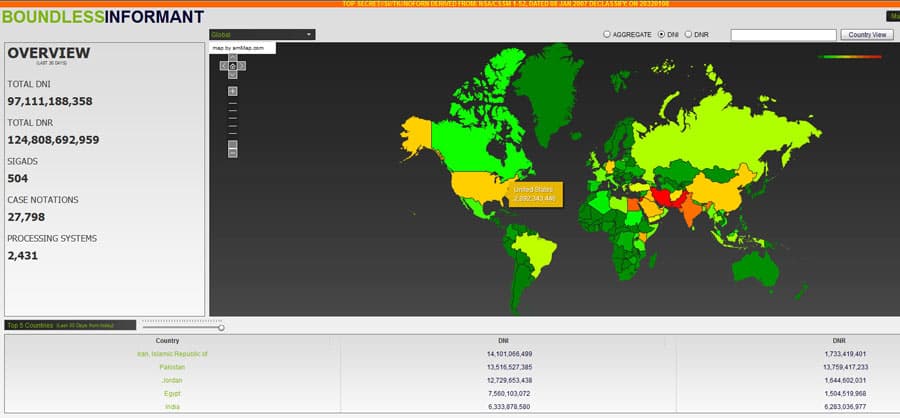
Snowden leaked details of Boundless Informant, an NSA data visualization tool that counted and categorized metadata collected globally. In March 2013 alone, the NSA collected 97 billion pieces of intelligence from computer networks worldwide, with Iran (14 billion), Pakistan (13.5 billion), and Jordan (12.7 billion) being top targets. The tool's existence directly contradicted NSA Director Keith Alexander's testimony to Congress that the NSA did not have the ability to determine how much data it collects on Americans.
“The NSA has a tool that tracks and counts everything they collect. They are cataloging billions of pieces of intelligence each month from around the world — and they lied to Congress about it.”
From “crazy” to confirmed
The Claim Is Made
This is the moment they called it crazy.
When Edward Snowden handed over classified NSA documents to journalists in 2013, one piece of software caught particular attention: a tool called Boundless Informant. This wasn't a dramatic backdoor into American phones or a secret wiretapping program. It was something arguably more significant—a simple data visualization tool that counted exactly how much intelligence the NSA was collecting.
The numbers it revealed were staggering. In March 2013 alone, the NSA's Boundless Informant system showed the agency had collected 97 billion pieces of intelligence from computer networks worldwide. These weren't isolated incidents or targeted operations. They were systematic, ongoing collections sorted by country, with Iran receiving 14 billion data points, Pakistan 13.5 billion, and Jordan 12.7 billion.
For years, the NSA had maintained a specific position on this exact question. Keith Alexander, who served as NSA Director at the time, had testified to Congress that the agency simply did not have the capability to determine how much data it was collecting on Americans or anyone else. This wasn't a minor technical detail. It was a foundational claim about the agency's own limitations—a claim that shaped Congressional oversight and public understanding of surveillance scope.
The Boundless Informant tool directly contradicted that testimony. Here was an NSA system, built by the NSA itself, designed specifically to do what the director had said was impossible: quantify and categorize the metadata being collected across the globe. The tool tracked collections in real time, breaking down intelligence by source, target, and geographic location. It was functioning, operational, and generating the exact metrics Alexander claimed didn't exist.
Get the 5 biggest receipts every week, straight to your inbox — plus an exclusive PDF: The Top 10 Conspiracy Theories Proven True in 2025-2026. No spam. No agenda. Just the papers they couldn't hide.
You just read "NSA's Boundless Informant tool revealed they collected 97 bi…". We send ones like this every week.
No one's said anything yet. Be the first to drop your take.
Confirmed: They Were Right
The truth comes out. Officially documented.
Confirmed: They Were Right
The truth comes out. Officially documented.
When The Guardian published the details in June 2013, the NSA's response was careful but revealing. The agency didn't deny the tool's existence or its capabilities. Instead, it clarified that Boundless Informant tracked only metadata—the records about communications rather than their content. This distinction mattered, but it didn't resolve the core problem: the NSA had the ability to measure what it was collecting, contradicting previous congressional testimony.
The implications extended beyond simple dishonesty. If the NSA couldn't account for its own data collection, how could Congress effectively oversee it? How could policymakers set meaningful limits? If the agency's leadership couldn't or wouldn't accurately describe the scope of operations, what other claims about surveillance programs deserved skepticism?
This case illustrates a particular kind of institutional problem. The NSA wasn't accused of technical incompetence or having lost control of its systems. If anything, Boundless Informant demonstrated impressive technical sophistication. The problem was that the agency's public statements diverged significantly from what its own tools revealed about its operations. Whether through misstatement, misunderstanding, or deliberate obfuscation, the gap between what officials said and what documents proved became the story.
For public trust in surveillance oversight, this matters substantially. Citizens can debate what level of data collection is acceptable. Congress can decide what warrants are necessary. But these decisions become meaningless if the institutions being overseen provide inaccurate information about what they're actually doing. Boundless Informant didn't prove the NSA was breaking the law—it proved the NSA's leaders weren't accurately describing their activities to those tasked with holding them accountable.
Beat the odds
This had a 0% chance of leaking — someone talked anyway.
Conspirators
~150Network
Secret kept
0.5 years
Time to 95% exposure
500+ years