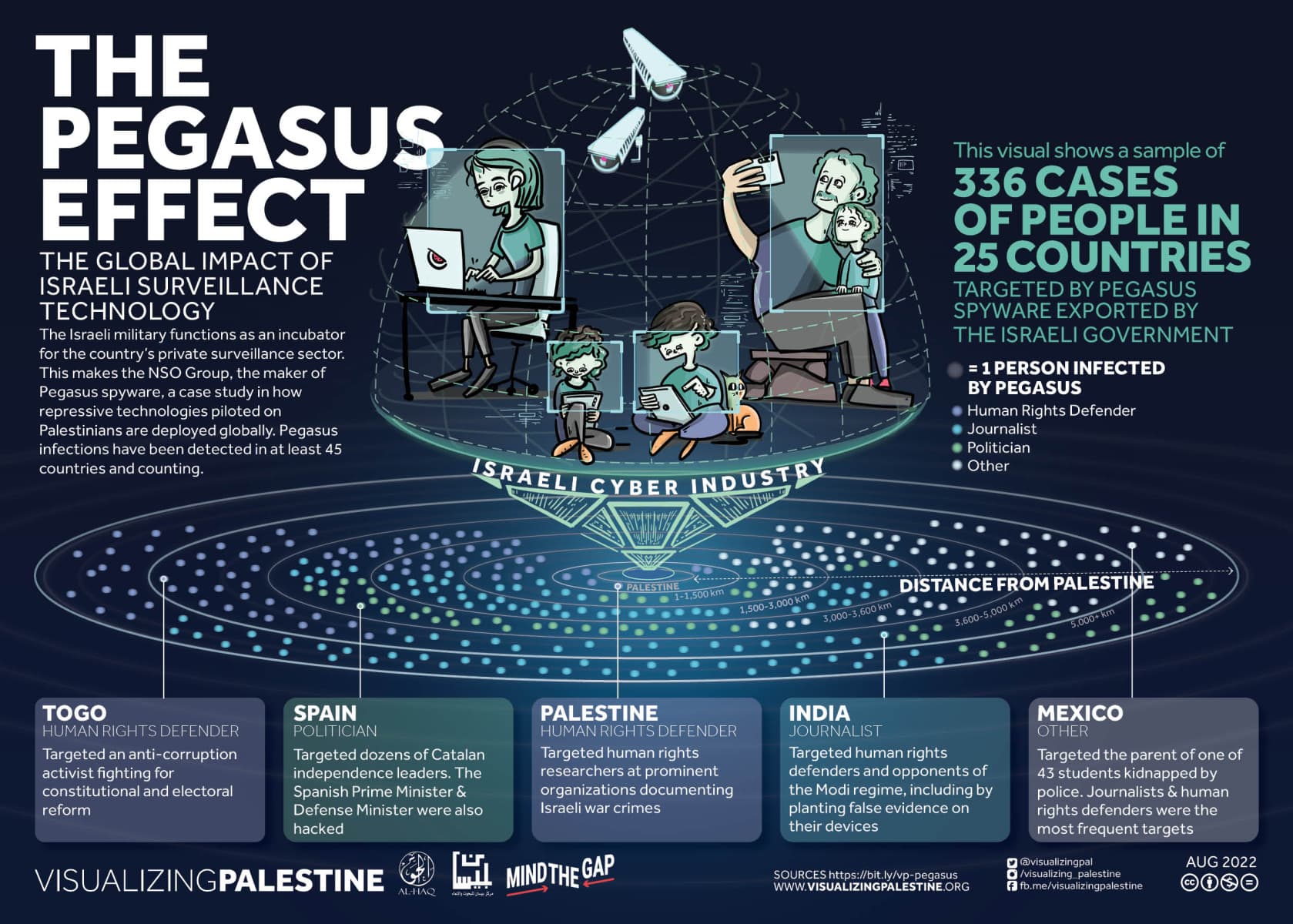
NSO Group's Pegasus spyware, developed by Israeli intelligence veterans, targeted 50,000+ phone numbers including 14 heads of state, 600 politicians, and 189 journalists. The spyware was found on the phone of Jamal Khashoggi's fiancee just four days after his murder by Saudi agents. NSO Group claimed it only sells to governments for law enforcement purposes.
“NSO spyware facilitates human rights violations on massive scale.”
From “crazy” to confirmed
The Claim Is Made
This is the moment they called it crazy.
For years, civil liberties organizations and cybersecurity researchers warned that a powerful piece of Israeli spyware was being used to monitor activists, journalists, and political opponents across the globe. The claims sounded alarming but remained largely abstract until 2021, when a coordinated investigation by Amnesty International and dozens of news organizations provided something concrete: proof that the spyware had infiltrated the phones of world leaders, politicians, and at least one woman with an intimate connection to a murdered journalist.
The spyware in question was Pegasus, developed by the Israeli firm NSO Group, which was founded by former Israeli intelligence officers. NSO Group maintained that its product was sold exclusively to governments for legitimate law enforcement and national security purposes. The company positioned itself as a necessary tool in the fight against terrorism and serious crime, arguing that only authorized government agencies could access its capabilities.
This narrative changed dramatically in July 2021 when The Pegasus Project, a collaborative investigation involving Amnesty International and major international news outlets, published its findings. Researchers had analyzed a leaked database containing 50,000 phone numbers that NSO Group targeted through Pegasus between 2016 and 2021. The numbers belonged to prominent activists, business executives, government officials, and journalists across multiple continents.
The investigation revealed disturbing specifics. At least 14 heads of state were targeted, along with approximately 600 politicians and 189 journalists. The list included leaders from countries with poor human rights records, raising questions about whether the tool was being used to suppress dissent rather than fight terrorism. Perhaps most striking was the discovery that Pegasus had been installed on the phone of Hatice Cengiz, the fiancee of Saudi Arabian journalist Jamal Khashoggi, just four days after his murder at the Saudi consulate in Istanbul in October 2018.
Get the 5 biggest receipts every week, straight to your inbox — plus an exclusive PDF: The Top 10 Conspiracy Theories Proven True in 2025-2026. No spam. No agenda. Just the papers they couldn't hide.
You just read "Israeli Spyware Pegasus Targeted World Leaders and Khashoggi…". We send ones like this every week.
No one's said anything yet. Be the first to drop your take.
Confirmed: They Were Right
The truth comes out. Officially documented.
Confirmed: They Were Right
The truth comes out. Officially documented.
The timing was difficult to dismiss as coincidence. Khashoggi had been a vocal critic of the Saudi government, and his fiancee's phone being infected with advanced spyware created a direct line between NSO Group's technology and one of the decade's most controversial political assassinations. Whether the surveillance was used to track Khashoggi himself before his death, or to monitor his fiancee afterward, remained an open question.
NSO Group pushed back against the report, arguing that their customer list did not include Saudi Arabia during the relevant timeframe. However, this raised its own complications: if Saudi Arabia couldn't directly purchase the spyware, how did it end up on Cengiz's phone? The investigation suggested that NSO's sales verification procedures may have been inadequate or that the company had limited control over how governments actually deployed the tool once purchased.
The Pegasus Project documented the specifics through forensic analysis conducted by Amnesty International's Security Lab, examining metadata and infection patterns on actual compromised devices. These weren't theoretical vulnerabilities or potential threats, but confirmed cases of successful penetration.
This case matters because it exposed a gap between what a technology company claims about its product and how that product actually gets used. NSO Group's assertion that Pegasus was a carefully controlled law enforcement tool proved insufficient against evidence showing it was deployed to monitor journalists, activists, and the families of murdered dissidents. The verification of these claims fundamentally altered how governments, civil society, and the public understood the risks posed by commercially available surveillance technology in the hands of authoritarian regimes.
Beat the odds
This had a 0% chance of leaking — someone talked anyway.
Conspirators
~200Network
Secret kept
0.5 years
Time to 95% exposure
500+ years