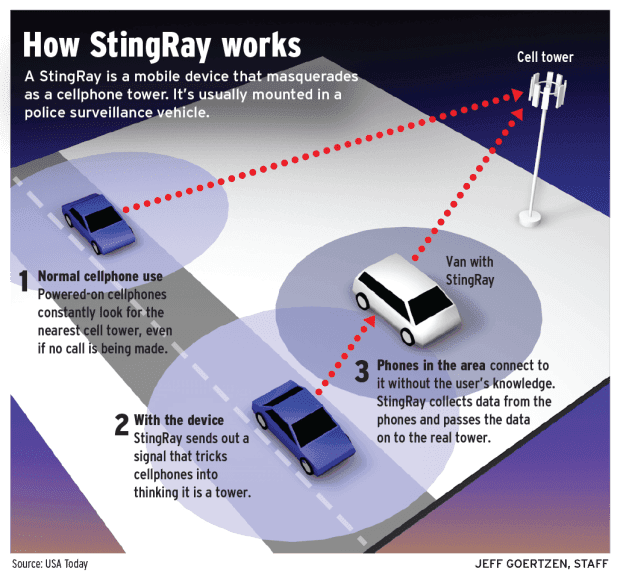
Law enforcement agencies across the US secretly deployed Stingray (IMSI catcher) devices that mimic cell towers to intercept phone communications and track locations — often without warrants. The FBI required police departments to sign NDAs and even drop cases rather than reveal the technology's use. An ACLU investigation found at least 75 agencies in 27 states using the devices. Courts have since ruled warrants are required.
“Police have secret devices that can track your phone and intercept your calls by pretending to be cell towers. They're using them without warrants.”
What they said vs. what the evidence shows
“Our products are lawfully used by authorized law enforcement and government agencies to protect public safety and national security.”
— Harris Corporation (Stingray manufacturer) · Jan 2014
SourceFrom “crazy” to confirmed
The Claim Is Made
This is the moment they called it crazy.
For years, civil liberties advocates claimed that American police departments were using sophisticated surveillance technology called Stingray devices to track people's locations and intercept their communications—often without obtaining warrants first. Law enforcement agencies denied these allegations or refused to comment. Today, this claim stands as one of the most consequential verified instances of secret government surveillance that reached far beyond its intended targets.
Stingray devices, officially known as IMSI catchers, are sophisticated pieces of equipment that mimic cell phone towers. When activated, they force nearby mobile phones to connect to them instead of legitimate towers, allowing operators to intercept calls, text messages, and location data. The technology was originally developed for military and intelligence purposes, but beginning in the early 2000s, it migrated into the hands of domestic law enforcement agencies who saw its potential as an investigative tool.
The problem was profound: police departments deployed these devices with virtually no public knowledge, no clear legal framework, and no meaningful oversight. When suspects' attorneys asked how their clients had been located or surveilled, law enforcement agencies refused to answer. Some cases were mysteriously dropped rather than proceed to trial, a pattern that raised serious questions about what evidence law enforcement was unwilling to disclose.
The Federal Bureau of Investigation actively enforced this secrecy. The FBI required police departments that acquired Stingray technology to sign non-disclosure agreements that prohibited them from revealing the devices' existence—even in court proceedings. This meant that defense attorneys couldn't challenge the legality of the surveillance, judges couldn't evaluate whether warrants should have been obtained, and the public remained entirely in the dark.
Get the 5 biggest receipts every week, straight to your inbox — plus an exclusive PDF: The Top 10 Conspiracy Theories Proven True in 2025-2026. No spam. No agenda. Just the papers they couldn't hide.
You just read "Police secretly used Stingray cell-site simulators to track …". We send ones like this every week.
No one's said anything yet. Be the first to drop your take.
Confirmed: They Were Right
The truth comes out. Officially documented.
Confirmed: They Were Right
The truth comes out. Officially documented.
The American Civil Liberties Union launched a comprehensive investigation into these practices. Their findings were startling: at least 75 law enforcement agencies across 27 states possessed Stingray devices. The ACLU documented cases where the technology had been used hundreds of times, often without warrants and with the knowledge that innocent people's data would be swept up in the process. USA Today's reporting corroborated these findings, detailing specific instances where police had deployed the technology in ways that clearly violated Fourth Amendment protections against unreasonable searches.
What made this claim even more difficult to dismiss was the paper trail. Internal communications, equipment purchase records, and court documents all pointed to the same conclusion: law enforcement agencies had deliberately hidden their surveillance capabilities from judges, juries, and defense attorneys. The secrecy wasn't incidental—it was structural and intentional.
Federal courts eventually forced the issue. Judges began ruling that Stingray surveillance without a warrant violated constitutional protections. Several states passed legislation requiring police to obtain warrants before deploying the technology. The FBI's gag orders, once absolute, began to crack under legal pressure.
This case matters because it represents a fundamental breach of the social contract between government and citizens. Surveillance that was kept secret couldn't be debated, regulated, or limited through normal democratic processes. Innocent people had their communications intercepted and locations tracked without their knowledge or legal justification. The fact that authorities went to such lengths to hide this capability suggests they knew exactly how troubling the public would find it.
The Stingray story demonstrates why transparency in law enforcement technology isn't merely a nice ideal—it's essential to maintaining any meaningful distinction between a free society and a surveillance state.
Beat the odds
This had a 0.2% chance of leaking — someone talked anyway.
Conspirators
~150Network
Secret kept
4 years
Time to 95% exposure
500+ years