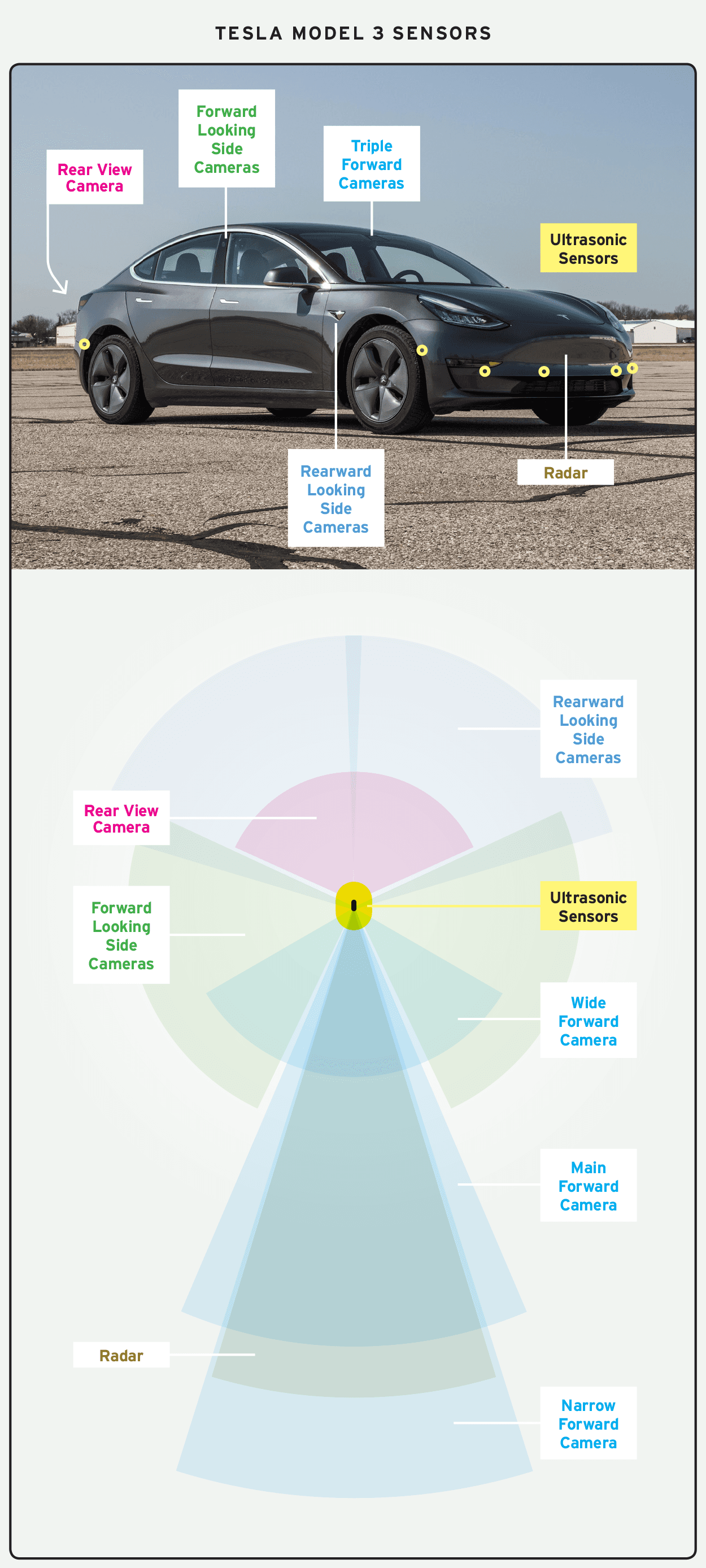
Tesla quietly removed radar sensors from Model 3 and Y vehicles while maintaining Autopilot pricing. Safety ratings were downgraded and some features eliminated without informing customers of changes.
“Vision-only Autopilot is safer and more capable than our previous sensor-fusion approach”
From “crazy” to confirmed
The Claim Is Made
This is the moment they called it crazy.
When Tesla began shipping vehicles without radar sensors, the company didn't issue a press release or notify existing customers. Instead, the change appeared quietly in technical specifications, buried in the kind of place most people never look. For a company that had spent years marketing Autopilot as an advanced safety feature worth thousands of dollars, the move raised an obvious question: if the sensors were essential, why remove them?
The original claim emerged from independent researchers and automotive safety organizations who noticed Tesla had stripped radar from its Model 3 and Model Y production lines. This wasn't speculation—it was happening in real time, visible to anyone comparing new vehicle specifications against previous versions. Critics argued that removing sensors while maintaining Autopilot pricing and marketing claims represented either a cynical cost-cutting measure or an admission that Autopilot's performance claims were overstated.
Tesla's response was characteristically dismissive. The company contended that its camera-based vision system was superior to multi-sensor approaches and that radar had become redundant. Elon Musk and company representatives suggested that removing the hardware actually represented an advancement in technology. The implication was clear: this was progress, not a downgrade. Anyone who disagreed simply didn't understand the sophistication of Tesla's engineering.
The evidence that vindicated critics came from the Insurance Institute for Highway Safety. When IIHS conducted its evaluations, it downgraded Tesla's safety ratings for vehicles equipped without radar sensors. The organization found that the removal of this sensor degraded performance in specific safety scenarios. More significantly, Tesla lost awards it had previously earned—a concrete, measurable change that couldn't be explained away as a matter of perspective.
What made this particularly striking was the asymmetry in information. Existing Tesla owners weren't notified that their vehicles' safety systems had been fundamentally altered through over-the-air updates. Potential buyers looking at Autopilot features couldn't easily discover that new models had fewer sensors than older ones. Tesla continued pricing Autopilot identically across its lineup, even as the underlying hardware that powered some features was being removed.
Get the 5 biggest receipts every week, straight to your inbox — plus an exclusive PDF: The Top 10 Conspiracy Theories Proven True in 2025-2026. No spam. No agenda. Just the papers they couldn't hide.
You just read "Tesla Autopilot Sensors Were Secretly Downgraded Without Dis…". We send ones like this every week.
No one's said anything yet. Be the first to drop your take.
This situation illustrates a broader problem in how consumers interact with technology companies. When a traditional automaker removes safety equipment, it's typically announced, tested, and submitted for regulatory approval. When Tesla does it, the change manifests as a technical specification update in a database most people never consult. The company moved fast and broke things—in this case, the transparency that's supposed to protect consumer trust.
The lesson here isn't that Tesla's camera-based system is inherently inferior or that Autopilot doesn't work. Rather, it's that a company can substantially alter a product's core components while maintaining the same price point and marketing claims, with the most reliable feedback coming not from the manufacturer but from independent safety evaluators. When IIHS had to tell the public what Tesla wouldn't, it revealed something important: they knew what they were doing, and they chose not to say.
Beat the odds
This had a 0.3% chance of leaking — someone talked anyway.
Conspirators
~150Network
Secret kept
5 years
Time to 95% exposure
500+ years