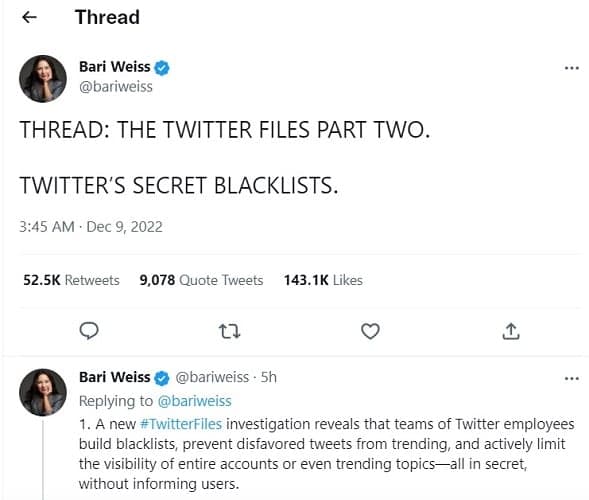
The Twitter Files, released in December 2022 by journalists Matt Taibbi, Bari Weiss, and Michael Shellenberger, revealed that Twitter maintained secret blacklists, suppressed trending topics, and limited account visibility — all while publicly denying the practice of shadow banning. Internal tools like 'Visibility Filtering' allowed staff to make accounts effectively invisible without notification. The files also showed the FBI regularly flagged accounts and content for suppression, blurring the line between government censorship and private platform moderation.
“Twitter is secretly shadow banning accounts and suppressing certain viewpoints while publicly denying it. They have blacklists and tools to make you invisible without telling you.”
From “crazy” to confirmed
The Claim Is Made
This is the moment they called it crazy.
For years, social media researchers, conservative commentators, and ordinary users reported a consistent experience: their tweets disappeared from searches, their engagement plummeted overnight, and their accounts seemed to vanish from public view—despite not being suspended. Twitter repeatedly insisted this wasn't happening. The company's official position was clear: shadow banning wasn't real, and claims to the contrary were conspiracy theories.
In December 2022, that position became difficult to maintain.
A collection of internal Twitter documents, released to journalists Matt Taibbi, Bari Weiss, and Michael Shellenberger, revealed that Twitter had operated a sophisticated system of visibility suppression that contradicted nearly everything the company had said publicly. The Twitter Files showed that Twitter maintained blacklists of accounts, used automated systems to suppress trending topics, and employed a tool called "Visibility Filtering" that could render an account nearly invisible to other users without any notification to the account holder.
This wasn't speculation or inference. These were actual internal documents showing how the moderation worked in practice.
What made the revelations more significant was the scope beyond partisan concerns. The files documented regular requests from federal agencies—including the FBI and the Department of Homeland Security—flagging accounts and content for removal or suppression. Twitter employees appeared to treat these government requests as urgent priorities, sometimes acting within hours. This revealed something the original complaints about shadow banning had only hinted at: the blurring of lines between what Twitter chose to do as a private platform and what it felt pressured or compelled to do at government request.
Get the 5 biggest receipts every week, straight to your inbox — plus an exclusive PDF: The Top 10 Conspiracy Theories Proven True in 2025-2026. No spam. No agenda. Just the papers they couldn't hide.
You just read "Twitter Files confirmed secret blacklists, visibility filter…". We send ones like this every week.
No one's said anything yet. Be the first to drop your take.
Confirmed: They Were Right
The truth comes out. Officially documented.
Confirmed: They Were Right
The truth comes out. Officially documented.
Twitter's previous denials had been specific and confident. Company executives, when questioned by journalists or researchers about shadow banning, stated flatly that it didn't exist. They suggested that users experiencing visibility problems were misunderstanding how algorithms worked or simply seeing the natural results of engagement metrics. When the company did acknowledge content moderation, it framed actions as responses to rule violations—transparent, consistent, and applied equally.
The internal documents told a different story. They showed deliberate suppression campaigns, sometimes for accounts that hadn't violated any stated policy. They revealed that the company's public statements about how its systems worked didn't match its actual practices. More troublingly, they showed that decisions to suppress content sometimes came from government pressure rather than the company's independent judgment.
The verification of these claims matters beyond Twitter's reputation. For years, people who raised concerns about shadow banning and visibility filtering faced dismissal from mainstream media outlets and technology analysts. Researchers studying content moderation found it difficult to document practices that the platforms denied existed. The Twitter Files provided tangible evidence that some of what had been dismissed as paranoia or misunderstanding was actually happening.
This case illustrates a broader problem in the technology industry: the gap between what platforms claim they do and what they actually do. When companies control the tools for communication, and when government agencies work through them to shape information flow, the public loses the ability to verify claims about how those systems work. Trust becomes nearly impossible.
The Twitter Files didn't just confirm one controversial claim. They demonstrated that institutional skepticism about tech company transparency was justified—and that the people raising concerns had been right to push back against official denials.
Beat the odds
This had a 0.3% chance of leaking — someone talked anyway.
Conspirators
~150Network
Secret kept
4.9 years
Time to 95% exposure
500+ years