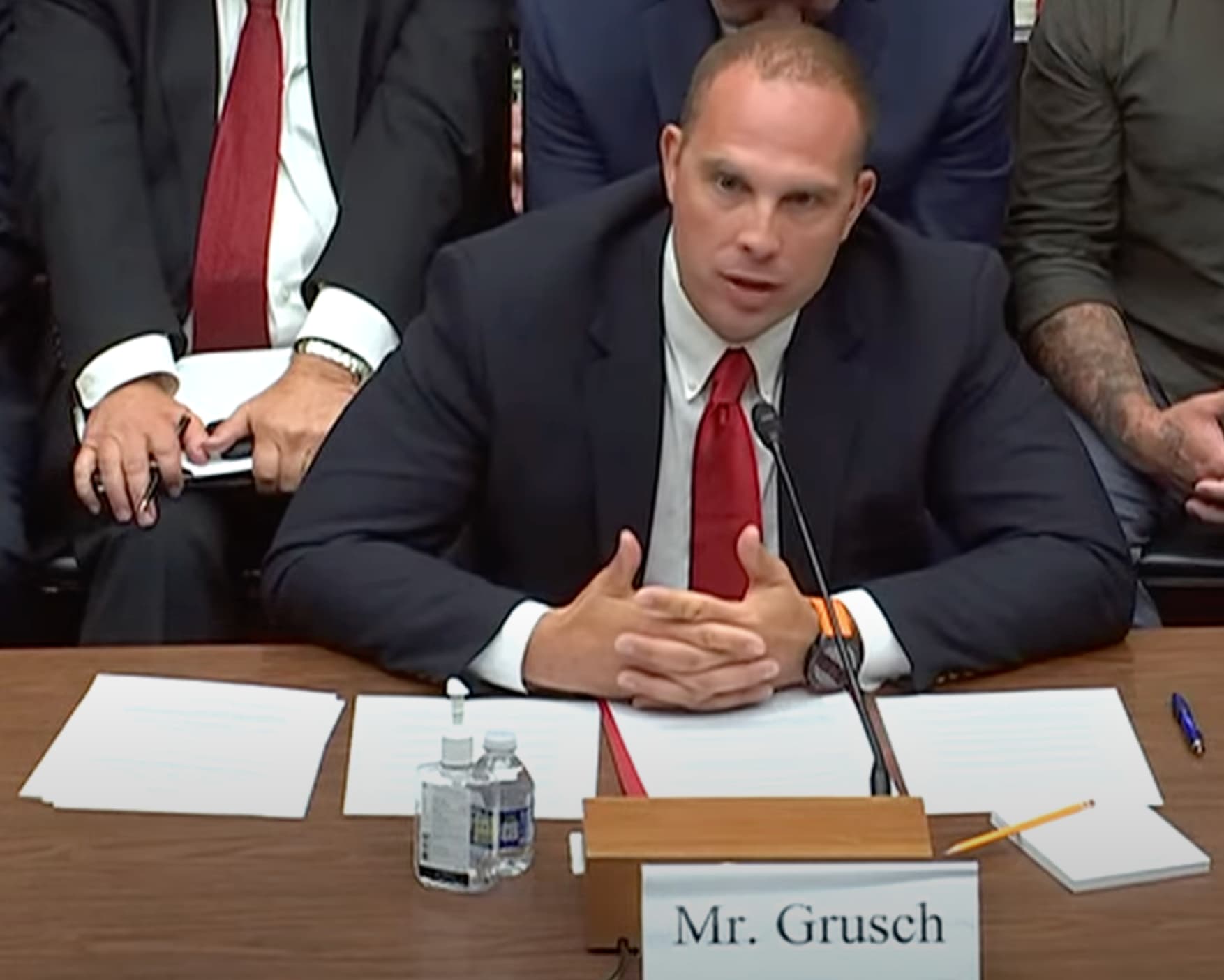
In July 2023, David Grusch — a former intelligence official and UAP Task Force member — testified before Congress under oath that the US government possesses recovered vehicles of non-human origin and has been running secret retrieval programs. The Pentagon's AARO office investigated but found no evidence of extraterrestrial technology. However, Congress passed legislation requiring disclosure of UAP-related programs, suggesting they took the claims seriously.
“The US government has recovered craft of non-human origin and is running secret programs to reverse-engineer this technology.”
What they said vs. what the evidence shows
“To date, AARO has not discovered any verifiable information to substantiate claims that any programs regarding the possession or reverse-engineering of extraterrestrial materials have existed.”
— Pentagon Press Secretary · Jul 2023
From “crazy” to confirmed
The Claim Is Made
This is the moment they called it crazy.
When David Grusch walked into a congressional hearing room on July 26, 2023, he brought with him a claim that challenged decades of official denials: the United States government possesses recovered vehicles of non-human origin. Grusch, a former intelligence officer who had worked with the Pentagon's UAP (Unidentified Anomalous Phenomena) Task Force, testified under oath that classified programs exist to retrieve and reverse-engineer these craft.
The specificity of Grusch's testimony gave it unusual weight. He wasn't speculating or relying on secondhand accounts. He detailed his role within official government structures, his access to classified information, and his direct knowledge of what he described as a "multi-decade" retrieval program. This wasn't a fringe believer making vague accusations—it was someone with verifiable credentials speaking in a formal congressional setting.
The government's response was swift and, predictably, dismissive. The Pentagon's All-domain Anomaly Resolution Office (AARO) launched an investigation into Grusch's claims. Their conclusion, delivered with bureaucratic certainty, was that they found "no credible evidence" that the US possesses extraterrestrial technology or vehicles. Case closed, the official position suggested.
But the actual response from Congress told a different story. Rather than dismissing Grusch as a conspiracy theorist, lawmakers took his testimony seriously enough to pass legislation requiring the disclosure of UAP-related programs and materials. This legislative action indicates that members of Congress—who presumably have access to classified briefings that the public does not—viewed his claims as credible enough to warrant formal action.
Get the 5 biggest receipts every week, straight to your inbox — plus an exclusive PDF: The Top 10 Conspiracy Theories Proven True in 2025-2026. No spam. No agenda. Just the papers they couldn't hide.
You just read "Former intelligence officer David Grusch testified under oat…". We send ones like this every week.
No one's said anything yet. Be the first to drop your take.
Intelligence Officer Says U.S. Has Retrieved Craft of Non-Human Origin (The Debrief)
What adds texture to this situation is the emerging pattern of acknowledgment. Representatives like Luna have referenced receiving congressional briefings on UAP phenomena that members "are not able to explain." These aren't conspiracy theories anymore—they're classified discussions happening in secure briefing rooms. Meanwhile, figures like Bill Maher have publicly stated their conviction that non-human intelligence is already present on Earth, framing it not as fringe speculation but as reasonable conclusion.
The verification status of Grusch's claim remains partial because the core assertion—that the government possesses recovered non-human craft—remains officially unproven to the public. AARO found no evidence, but that investigation had access only to what it was allowed to investigate. Congressional legislation doesn't constitute proof; it constitutes a demand for proof.
This case illustrates a crucial gap in how we evaluate truth claims. Official denial doesn't equal disproof. An absence of publicly available evidence doesn't mean the absence of evidence. When a credentialed insider with nothing obvious to gain testifies under oath, and Congress responds by legislating transparency requirements rather than dismissing him outright, the narrative becomes more complicated than a simple true-or-false answer.
What matters here is institutional behavior. Grusch's testimony has forced a reckoning with government secrecy around UAP phenomena that transcends whether his specific claims about recovered craft ultimately prove true. Whether or not he's right about the vehicles, he appears to have been right about one thing: there are classified programs related to UAP that the government has been unwilling to discuss transparently. That acknowledgment, hard-won through congressional pressure, may matter more than any single claim.
Beat the odds
This had a 0.2% chance of leaking — someone talked anyway.
Conspirators
~200Network
Secret kept
2.9 years
Time to 95% exposure
500+ years