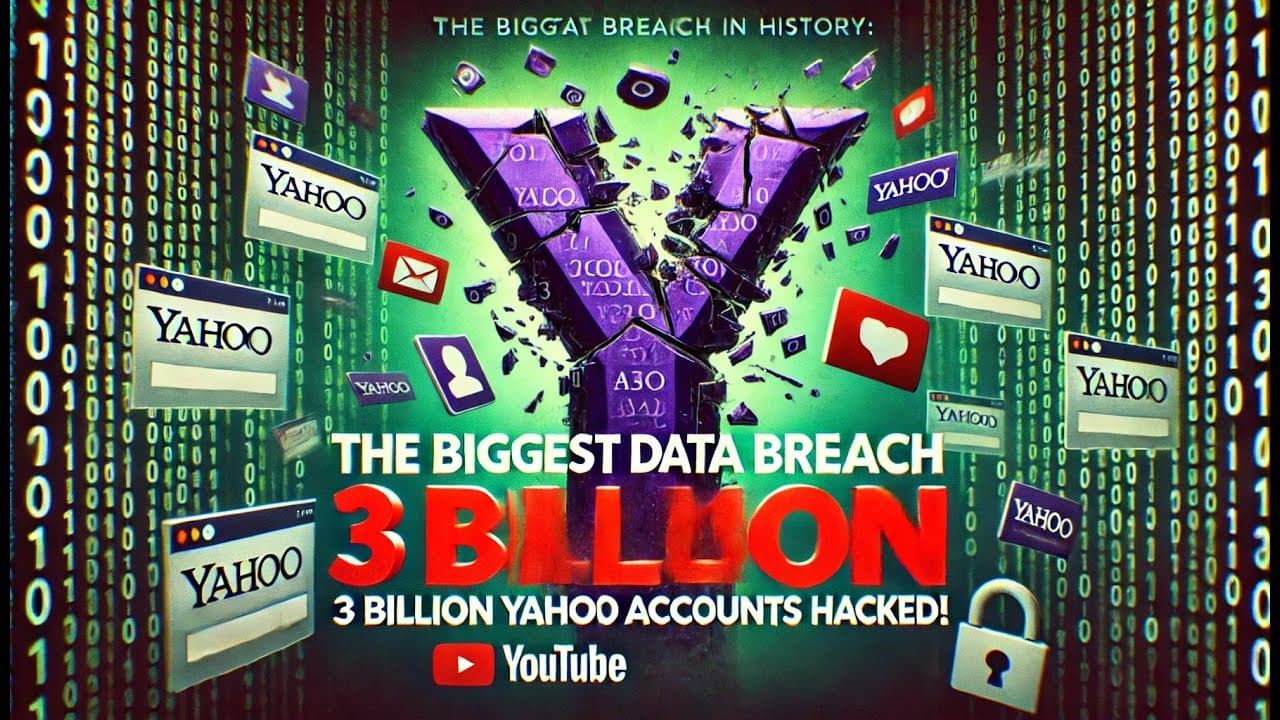
Yahoo hid massive data breach affecting all three billion accounts from 2013-2016. Company only disclosed hack during Verizon acquisition negotiations.
“Yahoo takes the security of our users' information very seriously and investigates all credible reports of security issues.”
From “crazy” to confirmed
The Claim Is Made
This is the moment they called it crazy.
In 2016, as Verizon prepared to acquire Yahoo for $4.8 billion, the search giant revealed something that should have surfaced years earlier: hackers had stolen data from essentially every Yahoo account in existence. The breach, which affected approximately three billion user accounts, hadn't just happened recently. It occurred in 2013. Yahoo had known about it for three years and said nothing.
This wasn't a case of a company discovering an intrusion and immediately going public. Yahoo's timeline of concealment reveals a deliberate gap between what the company knew and what it told the world. In August 2013, attackers gained access to the massive user database containing names, email addresses, telephone numbers, dates of birth, and encrypted passwords. Yahoo's security teams identified the breach. The company did not disclose it.
For thirty-six months, Yahoo continued operating as if nothing had happened. New users signed up. Existing users logged in daily. None of them knew their personal information had been compromised. Yahoo issued no warnings, sent no notifications, and made no public statements. The company kept the breach confined to internal discussions and, apparently, nowhere else.
The disclosure came only when Verizon's acquisition team began its due diligence process. As part of evaluating the company's actual condition, Yahoo finally admitted the breach to potential buyers in September 2016. The announcement shocked both security researchers and the public. A breach of this magnitude should have triggered immediate notification under basic principles of data security and corporate responsibility. Instead, it had been buried for years.
Yahoo's official response when forced to acknowledge the breach was characteristically defensive. The company claimed it was still investigating the incident and had no evidence that the stolen data had been misused at scale. This explanation rang hollow to security experts. The fact of the breach itself—affecting every single user—was the problem. Whether attackers had "used" the data yet seemed beside the point.
The evidence proved the concealment undeniable. Wikipedia's documentation of Yahoo data breaches, compiled from public reporting and security research, established the timeline with precision. The 2013 breach date was confirmed through forensic analysis and historical records. Yahoo's own statements, once the company was forced to come clean, corroborated the three-year gap between breach and disclosure.
The revelation had immediate consequences. Verizon reduced its acquisition offer by $350 million, citing the security breach as a major liability. Yahoo eventually agreed to the lower price. Regulators began examining whether the company had violated disclosure requirements. Security researchers questioned how a breach of such scale could remain hidden for so long.
What makes this case significant isn't just that a major company failed to protect user data—that happens. What matters is that Yahoo actively concealed the failure. For three years, the company chose not to inform users that their personal information was compromised. It only disclosed the breach when forced to do so during a financial transaction.
This episode demonstrates why public trust in technology companies remains fragile. When corporations can bury major security incidents for years without consequence until a business deal forces their hand, it reveals a fundamental misalignment between corporate interests and user safety. The Yahoo breach showed that sometimes the most dangerous conspiracy isn't what companies do in the dark—it's what they know and deliberately keep quiet.
Get the 5 biggest receipts every week, straight to your inbox — plus an exclusive PDF: The Top 10 Conspiracy Theories Proven True in 2025-2026. No spam. No agenda. Just the papers they couldn't hide.
You just read "Yahoo Concealed Three Billion Account Breach for Three Years". We send ones like this every week.
No one's said anything yet. Be the first to drop your take.