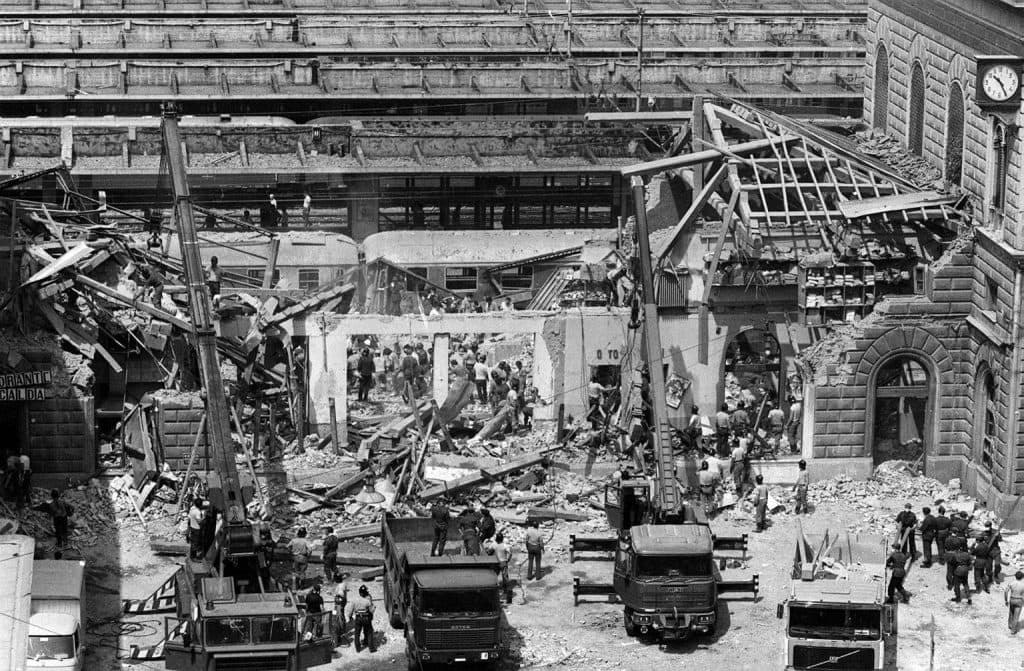
On August 2, 1980, a bomb exploded in Bologna's central railway station, killing 85 people and wounding over 200 — Italy's deadliest post-war terrorist attack. Initially blamed on leftists, investigations revealed the perpetrators were neo-fascist NAR members acting on instructions from Propaganda Due (P2), a secret Masonic lodge led by Licio Gelli. The explosives were identified as 'retrieved military explosives' of the same type used in previous Gladio-linked attacks. Italian courts eventually convicted the bombers and linked the massacre to the broader 'strategy of tension' campaign.
“The Bologna massacre was carried out by neo-fascist operatives connected to Gladio stay-behind networks and the P2 Masonic Lodge.”
What they said vs. what the evidence shows
“The bombing was carried out by far-left extremists. There is no connection to state security apparatus.”
— Italian Intelligence Services (SISMI) · Aug 1980
SourceFrom “crazy” to confirmed
The Claim Is Made
This is the moment they called it crazy.
Confirmed: They Were Right
The truth comes out. Officially documented.
Confirmed: They Were Right
The truth comes out. Officially documented.
On August 2, 1980, a suitcase bomb detonated in Bologna's central railway station during the summer holiday rush. The blast killed 85 people and wounded over 200 in what remains Italy's deadliest post-war terrorist attack. For years, the official story blamed left-wing extremists—a convenient narrative that fit the geopolitical tensions of Cold War Italy.
The initial investigation steered public attention toward communist and anarchist groups. Italian authorities and media outlets repeated this line consistently, and it gained international credibility. The public accepted that this was yet another attack in the long string of leftist violence plaguing Italy during the "Years of Lead." The narrative was tidy and politically useful for those in power.
What emerged over the following years told a drastically different story. Investigation revealed that the perpetrators were members of NAR, the Armed Revolutionary Nuclei—a neo-fascist organization, not a leftist one. More significantly, they were acting under instructions from Propaganda Due, or P2, a shadowy Masonic lodge operating in the shadows of Italian politics and intelligence services. P2 was led by Licio Gelli, a financier and political operator with deep connections throughout Italy's establishment.
The evidence extended further. Forensic analysis identified the explosives used in the Bologna bombing as military-grade material—specifically, the same type used in previous attacks linked to Operation Gladio, NATO's secret stay-behind network established after World War II. Gladio was designed as insurance against Soviet invasion, but evidence suggested it had evolved into something more sinister: a tool for destabilizing left-wing movements through false-flag operations and coordinated violence.
Italian courts eventually convicted the NAR bombers responsible for planting the device. The judicial findings explicitly connected the massacre to what Italian investigators termed the "strategy of tension"—a coordinated campaign of bombings and attacks designed to frighten the Italian public and discredit leftist political movements. The strategy worked, at least temporarily, by shifting public fear and political momentum rightward.
The Bologna case illustrates a pattern that intelligence agencies and government officials later acknowledged existed. Documents and testimonies confirmed that Gladio networks across Europe had engaged in unauthorized operations, often targeting civilian populations. The P2 connection revealed how deeply fascist networks had penetrated Italian institutions decades after Mussolini's fall.
What makes this verification matter extends beyond historical interest. This wasn't a marginal theory confined to fringe publications. Italian judges, prosecutors, and eventually mainstream media outlets acknowledged the basic facts. Yet the initial false narrative—that leftists were responsible—shaped public opinion and policy for years. The delay in uncovering the truth cost society clarity about how its own institutions were functioning.
The Bologna bombing demonstrates why institutional skepticism remains warranted. When official narratives immediately blame convenient scapegoats, and when those narratives conveniently serve the interests of powerful groups, history suggests caution is appropriate. The attack killed real people, traumatized real families, and influenced real policy decisions—all based on a story that was fundamentally wrong. The documented truth eventually emerged, but only after years of investigation and resistance from those who benefited from the initial lies.
Get the 5 biggest receipts every week, straight to your inbox — plus an exclusive PDF: The Top 10 Conspiracy Theories Proven True in 2025-2026. No spam. No agenda. Just the papers they couldn't hide.
You just read "The 1980 Bologna railway station bombing that killed 85 peop…". We send ones like this every week.
No one's said anything yet. Be the first to drop your take.