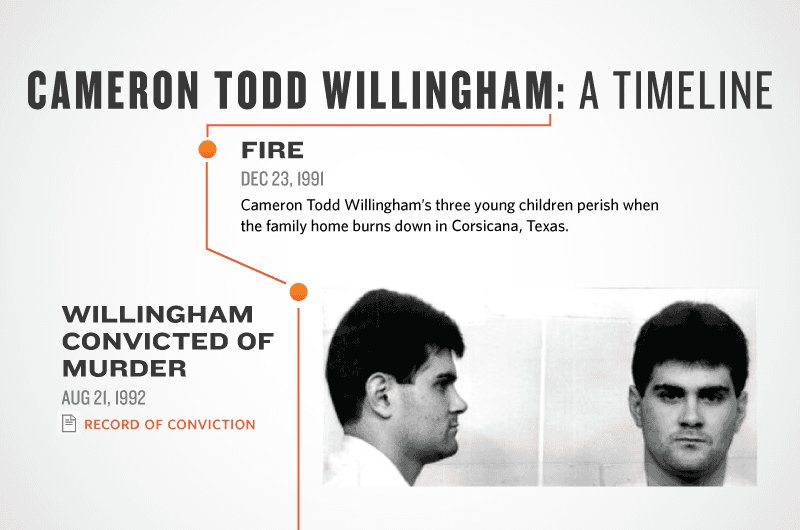
Texas executed Willingham in 2004 based on discredited fire science. Later investigations revealed the arson evidence was scientifically invalid and he was likely innocent.
“The evidence clearly shows Willingham deliberately set the fire that killed his children”
From “crazy” to confirmed
The Claim Is Made
This is the moment they called it crazy.
On February 17, 2004, the state of Texas executed a man based on fire science that didn't exist.
Cameron Todd Willingham died by lethal injection for the 1991 arson deaths of his three daughters in Corsicana, Texas. The prosecution's case rested almost entirely on testimony from fire investigators who claimed the burn patterns in the home proved arson. These patterns—the investigators said—indicated a deliberately set fire rather than an accidental one. At trial, no credible evidence of motive existed. Willingham had no criminal history of violence. But the flames, according to expert testimony, told the story. Or so everyone believed.
The official position was simple: the evidence was sound, the verdict was just, and Willingham's appeals failed. Texas courts reviewed his case multiple times. The governor's office, asked to examine evidence of innocence before execution, declined to halt the proceedings. No mainstream voice in law enforcement or the judiciary suggested the science itself might be fatally flawed.
Then the science changed.
In the years following Willingham's execution, the field of arson investigation underwent a fundamental reassessment. The National Academy of Sciences, fire safety organizations, and independent researchers began documenting that many of the indicators fire investigators had relied upon for decades were pseudoscience. Burn patterns once considered definitive proof of arson could occur naturally. Crazing in glass, inverted V-patterns on walls, spalling concrete—these phenomena didn't reliably distinguish intentional fires from accidental ones.
A report commissioned after Willingham's death found that the fire investigator in his case used investigative methods that would later be rejected by the scientific community. The arson evidence was not merely weak—it was scientifically invalid. The investigator had reached conclusions without proper testing and based his testimony on assumptions that contradict modern fire science.
What made this discovery particularly damning was the timing. Willingham was not executed before the science improved. The flaws in arson investigation methodology were becoming apparent even before 2004, though not universally accepted. The scientific consensus shifted more decisively in the years after his death, making clear what should have been questioned before the execution took place.
The state of Texas has not officially acknowledged executing an innocent man, though no credible fire scientist now believes the arson evidence was valid. No exoneration has been issued posthumously. The case exists in a gray zone of institutional silence—a space between what we can prove and what officials are willing to admit.
Cameron Todd Willingham's case matters because it reveals how the death penalty can intersect with scientific authority in ways that are nearly impossible to challenge at trial. Experts testified. Courts accepted their testimony. The system functioned as designed. Yet the foundation was sand. He cannot be retried. He cannot be pardoned. The only recourse is acknowledgment, and that has been slow in coming.
When flawed science leads to irreversible punishment, and that science is later proven wrong, it raises a question that should haunt every jurisdiction with capital punishment: how many other executions rest on similar foundations? Willingham's case is verified not just as a tragedy, but as evidence of a system's potential for fundamental failure.
Get the 5 biggest receipts every week, straight to your inbox — plus an exclusive PDF: The Top 10 Conspiracy Theories Proven True in 2025-2026. No spam. No agenda. Just the papers they couldn't hide.
You just read "Cameron Todd Willingham Executed Despite Flawed Arson Eviden…". We send ones like this every week.
No one's said anything yet. Be the first to drop your take.