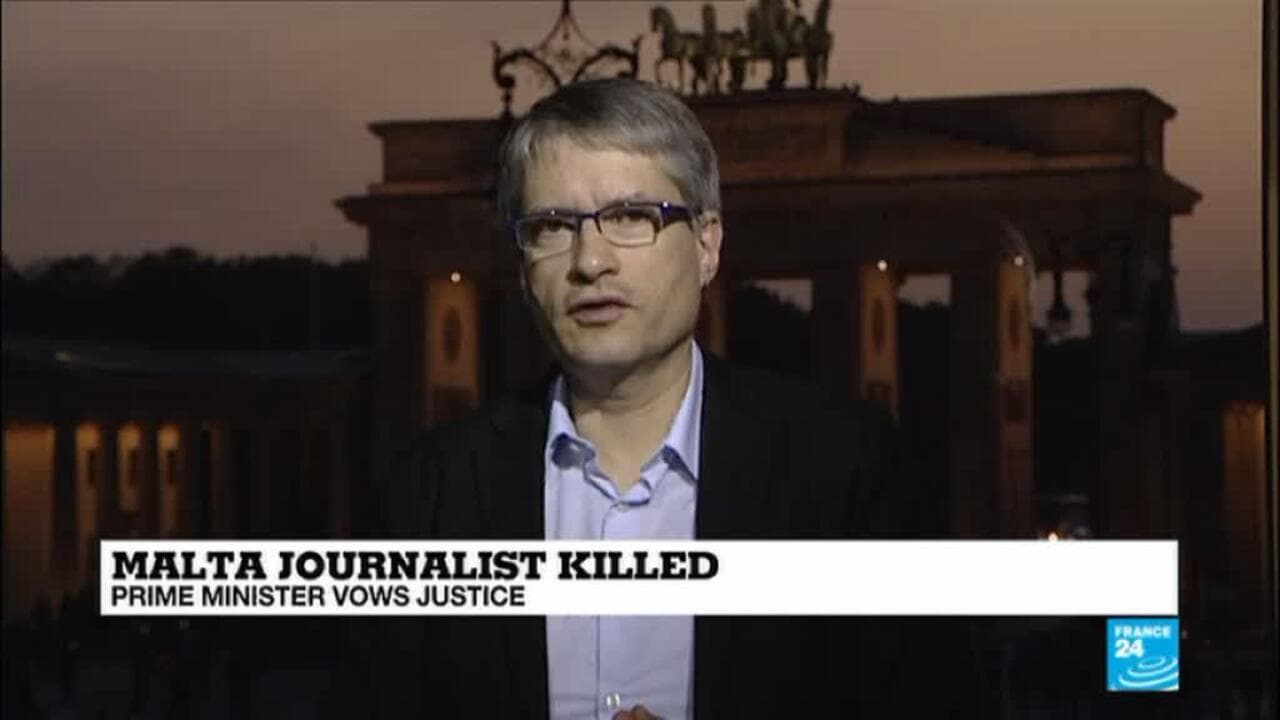
Oct 16, 2017: killed by remote bomb. Exposed PM's wife's offshore accounts. Hitmen: 40 years each. Inquiry: state responsible.
“She exposed the PM. They blew up her car. Government found responsible.”
What they said vs. what the evidence shows
From “crazy” to confirmed
The Claim Is Made
This is the moment they called it crazy.
Confirmed: They Were Right
The truth comes out. Officially documented.
Confirmed: They Were Right
The truth comes out. Officially documented.
On October 16, 2017, Daphne Caruana Galizia died when her car exploded on a rural road in Malta. She was a 53-year-old investigative journalist who had become one of her country's most dogged watchdogs, publishing the Malta angle of the Panama Papers leak just months before her death. Her murder wasn't a random act of violence—it was a calculated elimination of a threat.
At the time, Malta's government and parts of the international community treated her death as a tragedy but an isolated incident. Some suggested organized crime connections. Others hinted at unrelated feuds. The narrative pushed by officials was that while her reporting was admittedly aggressive, there was no evidence of state involvement. The implication was clear: don't draw conclusions, don't assume the worst about the government, wait for facts.
But the facts, when they finally emerged, told a different story entirely.
Caruana Galizia had reported that the wife of Malta's Prime Minister Joseph Muscat held shell companies in Panama that received suspicious payments. This was exactly the kind of corruption story that governments would prefer to remain buried. After her death, investigations by Maltese police and international bodies slowly pieced together what happened. Hitmen were identified and eventually convicted, receiving 40-year sentences. But the real revelation came when a public inquiry determined that the state itself bore responsibility for her death.
The inquiry found that state institutions had failed to protect her despite clear threats against her life. More troublingly, it suggested that the political environment created by government officials had enabled the violence. When you have a prime minister's office at odds with a journalist exposing your family's financial secrets, and that journalist ends up dead, the chain of causation becomes difficult to ignore.
This wasn't about proving the government literally ordered the hit—though some observers believed the evidence suggested complicity at higher levels. Rather, it was about establishing that the state's negligence, its creation of a hostile environment toward press freedom, and its failure to take threats seriously all contributed to her death. A public inquiry concluded that the state bore responsibility. That's not speculation or conspiracy theorizing. That's institutional accountability.
What makes this case significant isn't just that a journalist was killed for doing her job. Journalists have been murdered in many countries without their governments being held accountable at all. What matters here is that Malta's system, flawed as it was, eventually produced an official finding that acknowledged state responsibility. An inquiry—a formal mechanism of government—concluded that institutions failed catastrophically.
The case illustrates why claims about government corruption or danger to journalists matter. At the moment Caruana Galizia published her Panama Papers reporting, calling out a prime minister's family was risky. When she died, dismissing connections between her work and her death felt reasonable to many. But when evidence accumulated and institutions eventually moved, the picture became impossible to deny.
Today, her case stands as a stark reminder that journalists who expose financial crimes and political corruption face real danger. It also demonstrates that official denials and dismissals don't settle truth—evidence and time do. The state didn't order her death, but the state failed her. Malta had to reckon with that failure. Few governments ever do.
Get the 5 biggest receipts every week, straight to your inbox — plus an exclusive PDF: The Top 10 Conspiracy Theories Proven True in 2025-2026. No spam. No agenda. Just the papers they couldn't hide.
You just read "Panama Papers journalist car-bombed - Malta state found resp…". We send ones like this every week.
No one's said anything yet. Be the first to drop your take.