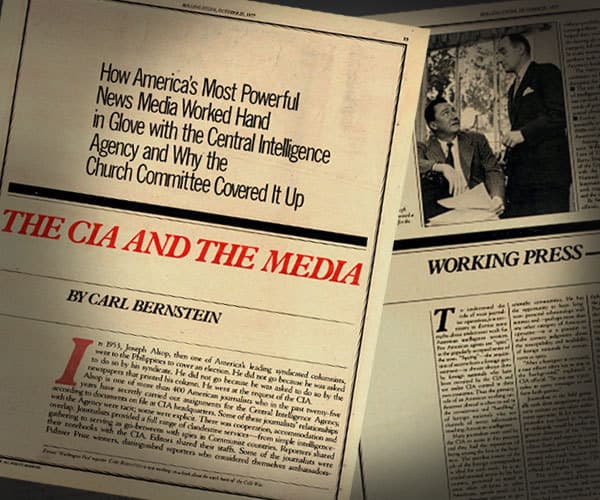
In his landmark 1977 Rolling Stone investigation 'The CIA and the Media,' Carl Bernstein revealed that more than 400 US journalists had secretly carried out CIA assignments. The Church Committee had found 50 with official secret relationships. Media organizations involved included CBS, Time, the New York Times, and the Associated Press. The CIA had journalists plant stories, gather intelligence, and serve as conduits for disinformation.
“The agency's relationship with the press became one of the institution's most productive means of intelligence gathering.”
From “crazy” to confirmed
The Claim Is Made
This is the moment they called it crazy.
When Carl Bernstein, the Watergate reporter who helped bring down a president, turned his investigative lens toward the American press itself in 1977, he uncovered something that challenged the fundamental role journalists claimed to play in democracy. What he found was that the Fourth Estate had been compromised from within—not by government pressure, but through secret collaboration.
Bernstein's investigation, published in Rolling Stone under the title "The CIA and the Media," revealed that more than 400 American journalists had secretly carried out assignments for the CIA. These weren't casual informants or passive sources. These were working reporters at major news organizations—CBS, Time, the New York Times, the Associated Press—who had agreed to gather intelligence, plant stories, and serve as conduits for government disinformation while maintaining their positions in newsrooms across the country.
At the time, the official response was one of measured denial mixed with bureaucratic parsing. The CIA acknowledged some relationships existed, but the numbers seemed impossibly small. The Church Committee, which was simultaneously investigating CIA abuses in the mid-1970s, had documented 50 journalists with official secret relationships to the agency. Fifty seemed like an outlier, a historical footnote about a few bad actors. Four hundred suggested something far more systemic.
But Bernstein's sources were solid. He had interviewed former CIA officials willing to talk about the program's scope. He had examined agency documents. What emerged was a picture of an intelligence apparatus that didn't just occasionally recruit a journalist for a favor—it had built an infrastructure of media relationships across the country's most trusted news organizations. wasn't just spying on Americans; it was using the press itself as an operational tool.
Get the 5 biggest receipts every week, straight to your inbox — plus an exclusive PDF: The Top 10 Conspiracy Theories Proven True in 2025-2026. No spam. No agenda. Just the papers they couldn't hide.
You just read "Carl Bernstein revealed over 400 American journalists secret…". We send ones like this every week.
No one's said anything yet. Be the first to drop your take.
Confirmed: They Were Right
The truth comes out. Officially documented.
Confirmed: They Were Right
The truth comes out. Officially documented.
The evidence proved devastating. Internal CIA documents confirmed the numbers were real. Journalists had been trained to spot potential intelligence sources in their reporting. They had relayed information gathered in interviews back to their handlers. They had allowed their bylines and editorial platforms to be used to advance intelligence objectives, often without public knowledge of their dual roles. Some had been doing this for decades, moving between newsrooms while maintaining their security clearances and their operational status.
What made this revelation particularly significant was the timing. It came just as the Church Committee was concluding its investigation into intelligence agency abuses. The discovery of press infiltration added another dimension to the question of whether American institutions could police themselves when national security was invoked.
Today, this claim remains verified not because it's been definitively proven in every detail—some CIA files remain classified—but because it was confirmed by multiple independent sources, including government investigations and the agency's own admissions. The specific numbers Bernstein cited have held up under scrutiny.
The reason this matters extends beyond historical interest. It reveals that the watchdog institutions we rely on to hold power accountable can themselves be compromised. When journalists work for intelligence agencies, their reporting becomes suspect. Their independence becomes theoretical rather than real. The public's ability to trust what they read is undermined at its foundation. More than four decades later, this remains one of the most consequential threats to press freedom ever documented—one that came not from outside suppression, but from within.
Beat the odds
This had a 0% chance of leaking — someone talked anyway.
Conspirators
~200Network
Secret kept
0.5 years
Time to 95% exposure
500+ years