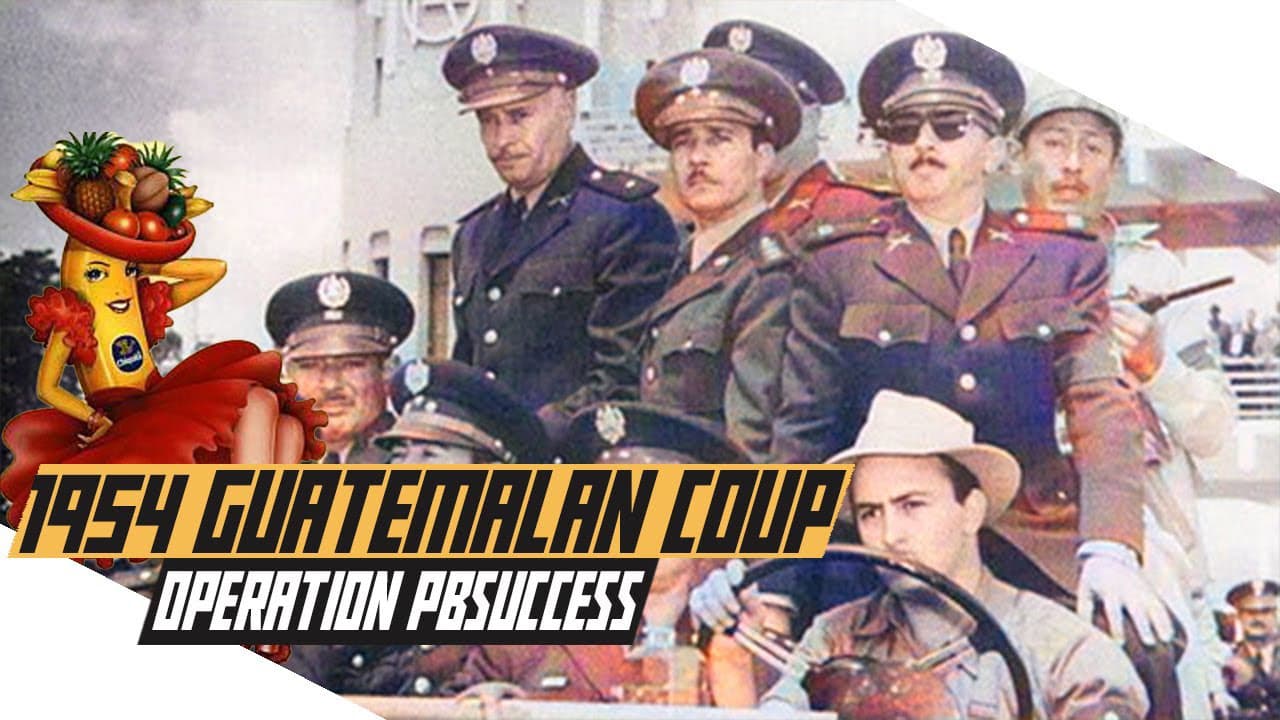
In 1954, the CIA overthrew the democratically elected government of Jacobo Arbenz in Guatemala, primarily to protect the United Fruit Company's land holdings threatened by agrarian reform. CIA Director Allen Dulles and Secretary of State John Foster Dulles both had financial ties to United Fruit. The resulting 36-year civil war killed over 200,000 people, with a UN truth commission finding the state responsible for 93% of atrocities.
“CIA deposed democratically elected leader.”
From “crazy” to confirmed
The Claim Is Made
This is the moment they called it crazy.
For decades, the United States government categorically denied orchestrating the 1954 coup that toppled Guatemala's democratically elected President Jacobo Arbenz. The official story was straightforward: Guatemala was falling into Soviet hands during the Cold War, and American intervention was a defensive necessity. Classified documents now tell a different story entirely.
What critics alleged at the time seemed almost too crude to believe. They claimed the CIA removed Arbenz not because he was a communist threat, but because his land reform program threatened the vast holdings of the United Fruit Company—a powerful American corporation. More damning still, they pointed out that CIA Director Allen Dulles and Secretary of State John Foster Dulles both had direct financial interests in United Fruit. The accusation looked like conspiracy thinking born from Cold War paranoia.
Government officials dismissed these claims outright. The State Department maintained that the operation, code-named PBSUCCESS, targeted a genuine communist infiltration of the Guatemalan government. American policymakers argued that Arbenz's modest agrarian reforms were cover for a Soviet takeover of Central America. The narrative held firm through the 1960s, 1970s, and 1980s.
Then came declassification. Released documents from the National Security Archive revealed something the public had suspected but couldn't prove: the Dulles brothers' financial ties to United Fruit were not coincidental details. Allen Dulles had worked as a lawyer for the company before joining the CIA. John Foster Dulles had similar connections through his law firm. More significantly, the documents showed that American decision-makers were far more concerned about Arbenz's land redistribution than about communist ideology. United Fruit's plantations covered nearly 550,000 acres of Guatemalan territory, and the company fiercely opposed any reduction in its holdings.
Get the 5 biggest receipts every week, straight to your inbox — plus an exclusive PDF: The Top 10 Conspiracy Theories Proven True in 2025-2026. No spam. No agenda. Just the papers they couldn't hide.
You just read "CIA Overthrew Guatemala's Democracy for a Banana Company". We send ones like this every week.
No one's said anything yet. Be the first to drop your take.
Confirmed: They Were Right
The truth comes out. Officially documented.
Confirmed: They Were Right
The truth comes out. Officially documented.
The declassified cables and operational memos demonstrated that PBSUCCESS was less about Cold War strategy and more about protecting American corporate interests. The CIA manufactured propaganda about communist threats and executed a textbook regime change operation. The operation succeeded in removing Arbenz, but the consequences extended far beyond 1954.
The coup triggered a civil war that would consume Guatemala for 36 years. Over 200,000 people died in the conflict. A United Nations truth commission, created years later to investigate the violence, concluded that the Guatemalan state was responsible for 93 percent of the documented atrocities. The military regimes that ruled after Arbenz—many with continued American support—conducted what the UN classified as genocide against indigenous populations.
This case matters because it reveals how institutional secrecy can sustain falsehoods at scale. For three decades, the American government maintained an official narrative that contradicted documented reality. Citizens and journalists who questioned the official story were dismissed as conspiracy theorists. Only when documents became impossible to suppress did the truth emerge.
Today, the Guatemala case stands as a reminder that skepticism toward official accounts isn't inherently paranoid—sometimes it's warranted. The question is how many other operations, justified through classified reasoning and selective disclosure, remain hidden behind the same walls of secrecy that once protected this particular truth.
Beat the odds
This had a 0% chance of leaking — someone talked anyway.
Conspirators
~200Network
Secret kept
0.5 years
Time to 95% exposure
500+ years