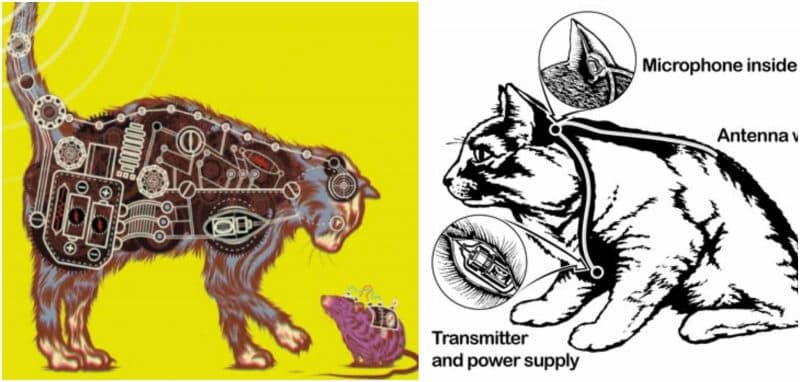
Declassified documents revealed CIA spent $20 million in 1960s surgically implanting listening devices and antennas in cats for espionage. The program was abandoned after operational failures.
“The CIA does not comment on alleged intelligence activities or operations”
From “crazy” to confirmed
The Claim Is Made
This is the moment they called it crazy.
During the Cold War, when paranoia ran deep and innovation ran deeper, the CIA spent millions of taxpayer dollars on an idea that sounds pulled straight from a spy movie: implanting microphones and transmitters inside cats. What once seemed like urban legend or the fevered imagination of conspiracy theorists turned out to be exactly what happened.
The concept was deceptively straightforward. Cats could move freely through neighborhoods and into secure locations where human spies couldn't penetrate. They didn't need cover stories, didn't arouse suspicion, and could theoretically position themselves near targets. In the 1960s, the CIA's Technical Services Division began Project Acoustic Kitty with genuine hopes of turning ordinary house cats into sophisticated listening devices.
The agency surgically implanted sophisticated microphones, radio transmitters, and antennas into living cats. The surgical procedure alone was invasive and experimental. Researchers had to place the equipment inside the animals' bodies while keeping them alive and mobile. The project cost approximately $20 million in 1960s dollars—a staggering sum for an operation of dubious feasibility.
For years, anyone who mentioned this program was dismissed as a conspiracy theorist spinning ridiculous tales. Mainstream media outlets rejected the story as too absurd to be credible. Government officials denied such a program ever existed. The official line was simple: the CIA would never conduct such an implausible operation. Critics argued that the very concept violated common sense—how would a cat reliably deliver intelligence? How would handlers control the animal? How would they retrieve the data?
Get the 5 biggest receipts every week, straight to your inbox — plus an exclusive PDF: The Top 10 Conspiracy Theories Proven True in 2025-2026. No spam. No agenda. Just the papers they couldn't hide.
You just read "CIA's Project ACOUSTIC KITTY Implanted Surveillance Devices …". We send ones like this every week.
No one's said anything yet. Be the first to drop your take.
The dismissals continued until the CIA released declassified documents through its FOIA Reading Room. The official government records confirmed that Project Acoustic Kitty was real and extensively funded. The documents detailed the surgical procedures, the technical specifications of the implanted devices, and the operational challenges the program faced. There was no ambiguity in the paperwork—the CIA had genuinely attempted to weaponize house cats.
Operational reality, however, proved to be the program's undoing. The cats didn't perform as intended. Animal behavior couldn't be reliably controlled or predicted. The first cat was released near the Soviet compound in Manhattan, but it was struck by a taxi before it could transmit any intelligence. Subsequent operations encountered similar failures. Cats wandered off, ignored handlers' expectations, and proved unmanageable as intelligence assets.
The program was quietly shelved after realizing that feline espionage wasn't a viable intelligence-gathering method. But the existence of Acoustic Kitty raises uncomfortable questions about government oversight and accountability. If the CIA could spend millions on an implausible surveillance program with minimal public knowledge or scrutiny, what other projects existed in the shadows?
The declassified documents matter because they remind us that institutions can pursue genuinely dubious ideas with enormous resources. They demonstrate why public skepticism toward official denials isn't paranoia—it's practical wisdom. The CIA said Acoustic Kitty didn't exist until evidence proved otherwise.
That's the real lesson here. Not that the government once implanted microphones in cats, but that dismissing claims as "conspiracy theories" sometimes means ignoring what officials have actually done. We were right to be skeptical of the dismissals, even if the underlying concept still sounds absurd.
Beat the odds
This had a 1.5% chance of leaking — someone talked anyway.
Conspirators
~150Network
Secret kept
24.5 years
Time to 95% exposure
500+ years