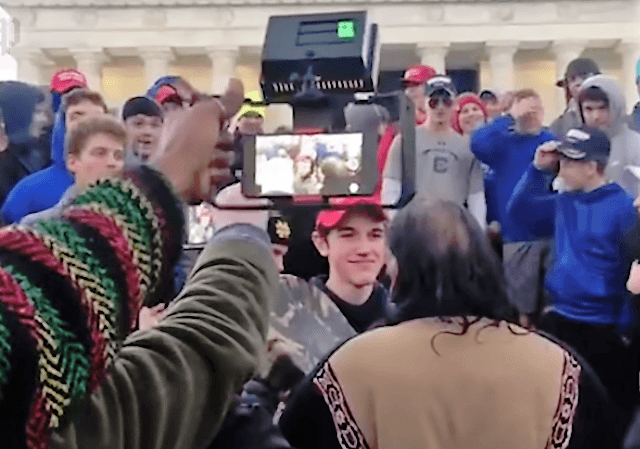
In January 2019, a short video clip of Nick Sandmann appearing to 'smirk' at Native American elder Nathan Phillips at the Lincoln Memorial went viral. Major media instantly branded the teen a racist. Extended footage revealed the Black Hebrew Israelites had been hurling insults at the students, and Phillips had approached them. The initial narrative was almost entirely fabricated from a deceptive clip. Sandmann, then 16, sued multiple outlets for defamation. CNN and the Washington Post settled for undisclosed amounts. NBC Universal also settled.
“The media jumped to conclusions and smeared a teenager based on a short, deceptively edited video clip. The full video shows the complete opposite of what was reported.”
What they said vs. what the evidence shows
“This video shows a group of MAGA hat-wearing teens mocking and surrounding a Native American elder. It speaks for itself.”
— Initial media coverage / Twitter mob · Jan 2019
SourceFrom “crazy” to confirmed
The Claim Is Made
This is the moment they called it crazy.
A 16-year-old boy became the face of racial intolerance across America's major news networks in a matter of hours. The culprit wasn't his actions—it was 16 seconds of video.
In January 2019, Nick Sandmann, a student at Covington Catholic High School in Kentucky, stood at the Lincoln Memorial during the March for Life rally. A brief clip showed him appearing to smirk while facing Nathan Phillips, an elderly Native American elder and drummer. The image spread instantly across social media. Within hours, CNN, the Washington Post, NBC, and numerous other outlets had constructed a narrative: the white Catholic teenager had surrounded and mocked an indigenous man, an act many described as racist intimidation.
The story fit neatly into existing cultural anxieties. It reinforced concerns about young white males, Catholic schools, and the persistence of racism. News organizations covered it as confirmation of a troubling social reality. Some outlets dug into Sandmann's social media history. The teenager became recognizable to millions—but only as a villain.
Then the full video emerged. The extended footage told a completely different story. The Black Hebrew Israelites, a religious group present at the memorial, had been directing slurs and insults at the Covington students for several minutes. It was Phillips who had approached the students, walking into their group while playing his drum. Sandmann had stood relatively still, his expression one of bewilderment rather than contempt. The initial narrative, constructed from deceptive editing and selective framing, collapsed under scrutiny.
The damage, however, had already been done. Sandmann faced harassment. His school received threats. His family feared for his safety.
Get the 5 biggest receipts every week, straight to your inbox — plus an exclusive PDF: The Top 10 Conspiracy Theories Proven True in 2025-2026. No spam. No agenda. Just the papers they couldn't hide.
You just read "The media smeared a 16-year-old Covington Catholic student b…". We send ones like this every week.
No one's said anything yet. Be the first to drop your take.
Confirmed: They Were Right
The truth comes out. Officially documented.
Confirmed: They Were Right
The truth comes out. Officially documented.
In 2020, Sandmann sued major news organizations for defamation. CNN settled for an undisclosed amount. The Washington Post did the same. NBC Universal also reached a settlement. These weren't victories earned through trial verdicts—they were admissions made quietly through financial settlements, the kind of resolution that avoids further examination.
What makes this case instructive isn't that media outlets made an error. Journalism is inherently imperfect. What matters is the speed of the conviction and the severity of the condemnation before basic facts were established. Major news organizations with resources to verify claims instead competed to be first with the outrage. They constructed a narrative that served their audiences' expectations rather than investigating what actually occurred.
The Sandmann case reveals something deeper about institutional trust. When people claim the media operates with bias or carelessness, they're often dismissed as conspiracy theorists. Yet here was a documented instance where major news organizations smeared a minor based on incomplete information, required financial settlement to acknowledge the harm, and faced minimal professional consequences.
The settlements were quiet. The apologies were quieter still. Most Americans never learned the outcome. The initial story—the smirk, the racism, the threat—remained the dominant image in millions of minds.
This is why the distinction between "verified claims" and "conspiracy theories" matters less than the distinction between institutional accountability and institutional indifference.
Beat the odds
This had a 0% chance of leaking — someone talked anyway.
Conspirators
~100Network
Secret kept
1 years
Time to 95% exposure
500+ years