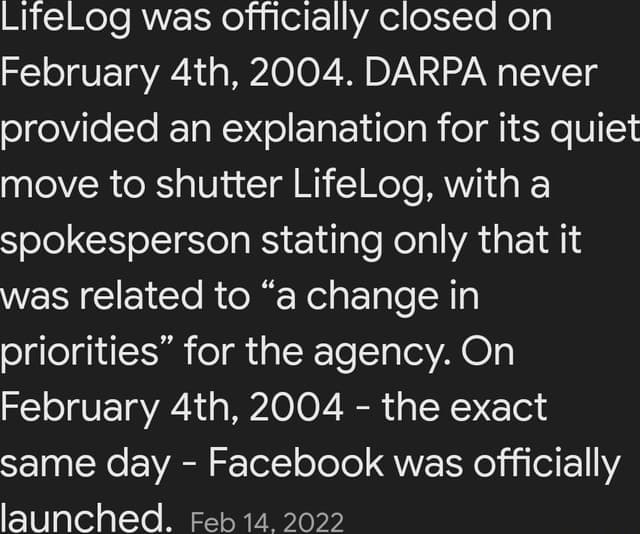
LifeLog: trace every activity/relationship. Cancelled Feb 4, 2004. Same day: Facebook launched. Facebook became the world's largest voluntary personal database.
“Pentagon life-recording project cancelled the EXACT SAME DAY Facebook launched.”
What they said vs. what the evidence shows
“Change in priorities.”
— DARPA · Feb 2004
SourceFrom “crazy” to confirmed
The Claim Is Made
This is the moment they called it crazy.
On February 4, 2004, two significant events occurred in the digital world. Facebook launched publicly from a Harvard dorm room. The same day, DARPA officially cancelled its LifeLog program. The timing has raised questions that deserve serious examination, regardless of where they lead.
DARPA's LifeLog was conceived as an ambitious research project designed to create a comprehensive digital archive of a person's entire existence. The program aimed to record and index every photograph, document, phone call, and interaction—essentially creating a searchable database of a human life. It wasn't science fiction; it was a real Pentagon initiative with real funding and real technical specifications. The project had been in development for years and represented genuine technological ambition.
The official explanation for LifeLog's cancellation was straightforward: privacy advocates and Congress grew uncomfortable with the implications. The Electronic Privacy Information Center (EPIC) had raised alarms about the surveillance potential. By early 2004, the political environment made continuation untenable. DARPA quietly shut it down. This narrative has been repeated in most mainstream accounts and remains the standard explanation offered by government sources.
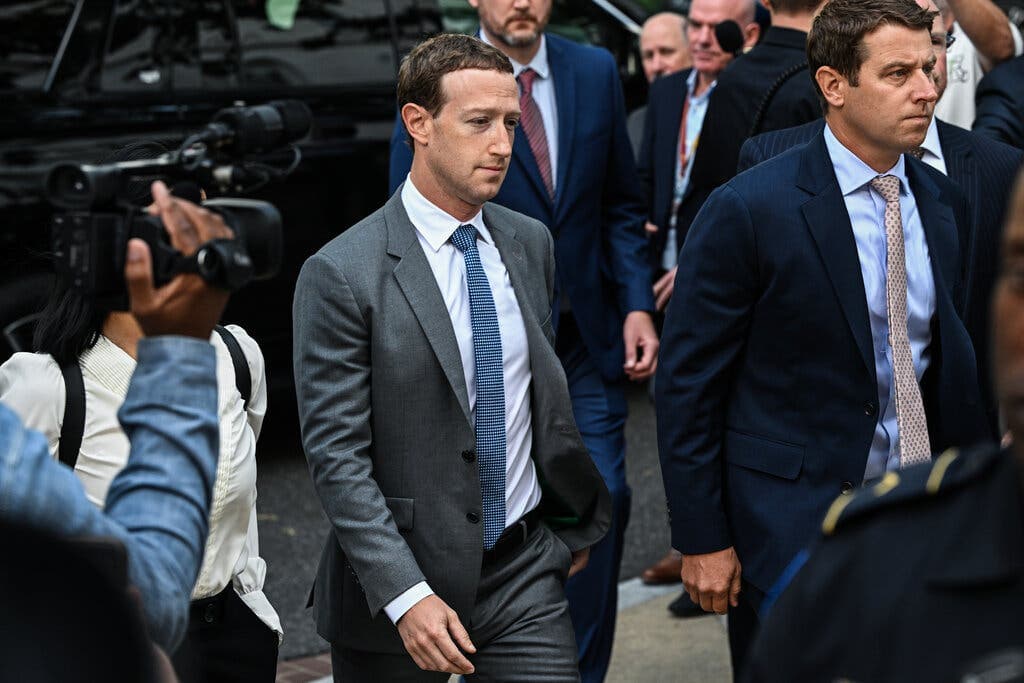
What makes the timing worth examining is the parallel emergence of Facebook. Mark Zuckerberg launched TheFacebook.com from his Harvard dorm on the same date DARPA cancelled LifeLog. Within months, the platform began collecting precisely what LifeLog had proposed to collect—a comprehensive digital record of human activity, relationships, locations, and preferences. Facebook would eventually accomplish at massive scale what the government program could not do directly: create a voluntary, comprehensive personal database of billions of people.
Get the 5 biggest receipts every week, straight to your inbox — plus an exclusive PDF: The Top 10 Conspiracy Theories Proven True in 2025-2026. No spam. No agenda. Just the papers they couldn't hide.
You just read "DARPA LifeLog cancelled EXACT day Facebook launched: Feb 4, …". We send ones like this every week.
No one's said anything yet. Be the first to drop your take.
To be clear, there is no documented evidence of direct institutional coordination or a deliberate handoff between DARPA and Facebook. No whistleblower has emerged with internal communications proving such a connection. This is crucial to state plainly. What exists instead is a remarkable temporal coincidence and a structural parallel—the exact same day the government formally abandoned its surveillance archive project, a private company launched a platform that would become history's most efficient personal data collection system.
The absence of evidence of coordination, however, doesn't fully resolve the question. The timing itself invites scrutiny. Why cancel on that exact day? Was it truly a response to Congressional pressure, or was the pressure itself part of a coordinated transition strategy from public to private data collection? Did DARPA researchers migrate to Facebook or similar projects? These questions remain unanswered.
What matters here is transparency and public understanding. Whether the timing was coincidental or coordinated, the outcome is the same: a comprehensive personal database was built anyway, just not by the government directly. Citizens who rejected DARPA's LifeLog unknowingly embraced its functional equivalent through a social media platform.
This case illuminates a broader pattern in technology policy—when the public rejects one surveillance approach, similar capabilities emerge through alternative channels. The mechanism changes; the capacity doesn't disappear. Understanding this pattern requires asking difficult questions about timing, connections, and whose interests are served. The DARPA-Facebook timeline deserves continued scrutiny, not because proof exists of wrongdoing, but precisely because the public interest demands clarity when significant institutional transitions occur.
Beat the odds
This had a 0.5% chance of leaking — someone talked anyway.
Conspirators
~150Network
Secret kept
8.1 years
Time to 95% exposure
500+ years