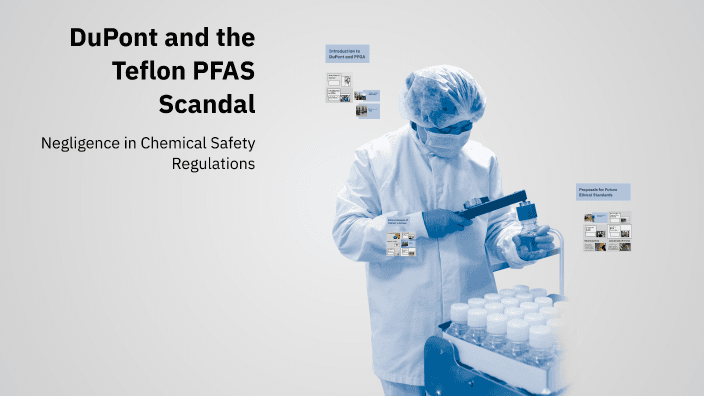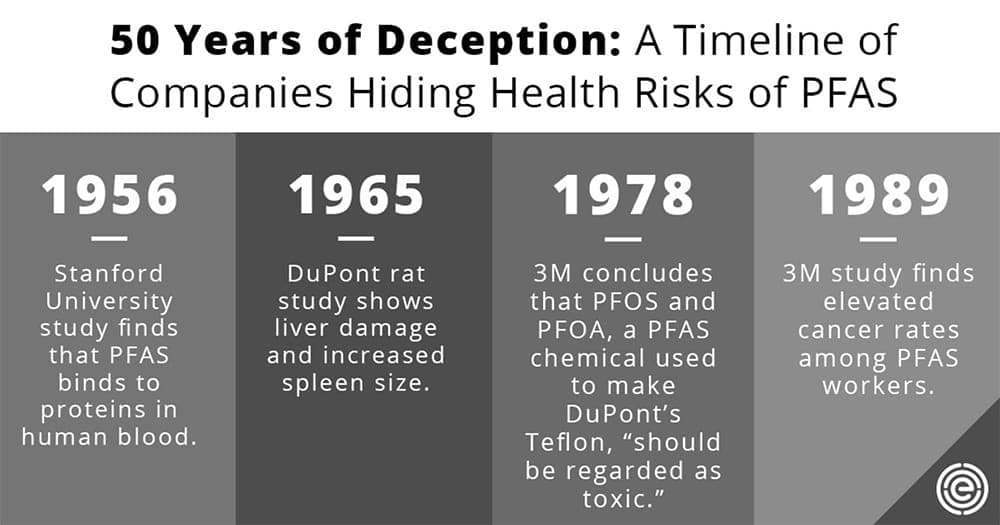
Internal DuPont documents revealed the company knew since the 1980s that PFOA caused cancer and birth defects in workers and nearby communities. They concealed health studies and continued production while publicly denying health risks.
“DuPont's chemicals are safe for workers and communities when used as directed”
From “crazy” to confirmed
The Claim Is Made
This is the moment they called it crazy.
When workers at DuPont's Washington Works facility in Parkersburg, West Virginia began falling ill in the 1980s, the company's internal scientists already knew why. Documents would later reveal that DuPont had identified PFOA—a chemical used to manufacture Teflon—as a potent toxin linked to cancer and birth defects. Instead of warning employees or regulators, the company systematically concealed the evidence.
For over 20 years, DuPont maintained a public position that PFOA posed no significant health risk. The company published reassuring statements, cooperated selectively with regulators, and controlled what information reached workers and nearby residents whose water supplies had been contaminated. All the while, their own researchers documented serious health effects in laboratory animals and, most troublingly, in their workforce.
The specific claim that emerged was straightforward: DuPont knew PFOA caused cancer and birth defects but hid this knowledge. Initially, this sounded like the kind of corporate malfeasance that gets dismissed as paranoid speculation. Companies don't openly confess to poisoning people. Regulators are supposed to catch these things. The official response from DuPont was predictable—assertions that their safety protocols were sound, that PFOA exposure was minimal, and that any health concerns were unsubstantiated.
What changed was discovery. In litigation brought by Parkersburg residents, lawyers obtained internal DuPont documents that had been kept from public view. These papers told a different story entirely. Company scientists had conducted studies throughout the 1980s and 1990s showing PFOA caused liver cancer, pancreatic cancer, and testicular cancer in rats exposed to the chemical. More damning were findings of birth defects in offspring of exposed animals.
Get the 5 biggest receipts every week, straight to your inbox — plus an exclusive PDF: The Top 10 Conspiracy Theories Proven True in 2025-2026. No spam. No agenda. Just the papers they couldn't hide.
You just read "DuPont knew PFOA chemicals caused cancer and birth defects b…". We send ones like this every week.
No one's said anything yet. Be the first to drop your take.
The documents showed that DuPont management was aware of these findings and made deliberate decisions about what to disclose. When the company finally acknowledged problems, decades had passed. Thousands of people in the Parkersburg area had been exposed to PFOA through contaminated drinking water. Some had already developed cancer. Others gave birth to children with developmental problems.
The 2001 epidemiological study commissioned by DuPont itself, conducted by researchers at Johns Hopkins, found a statistically significant association between PFOA exposure and testicular cancer and kidney cancer in workers. The company initially tried to suppress the study's release. When it became public, it provided concrete evidence linking the chemical to human disease—exactly what internal research had suggested years earlier.
This case matters for reasons that extend far beyond DuPont or PFOA specifically. It demonstrates how institutional power can shield harmful practices from public knowledge for decades. It shows that the regulatory system designed to protect health can be navigated, delayed, and influenced by the very companies being regulated. And it reveals that corporate knowledge of risk is not the same as corporate admission of risk.
Today, PFOA contamination affects water supplies across the United States, and the chemical persists in the human bloodstream with an estimated half-life of several years. The scientific consensus now aligns with what DuPont's scientists understood in the 1980s: PFOA is a serious health hazard. The question that lingers is how many preventable illnesses occurred because a company chose silence over transparency. That gap between what was known and what was revealed remains the core of why this claim matters.
See also: [DuPont's Teflon Cover-Up: How Internal Memos Exposed a Decades-Long Chemical Conspiracy](/blog/teflon-dupont-pfoa-coverup-documents) — our deeper breakdown of this topic.
Beat the odds
This had a 1% chance of leaking — someone talked anyway.
Conspirators
~100Network
Secret kept
25.2 years
Time to 95% exposure
500+ years