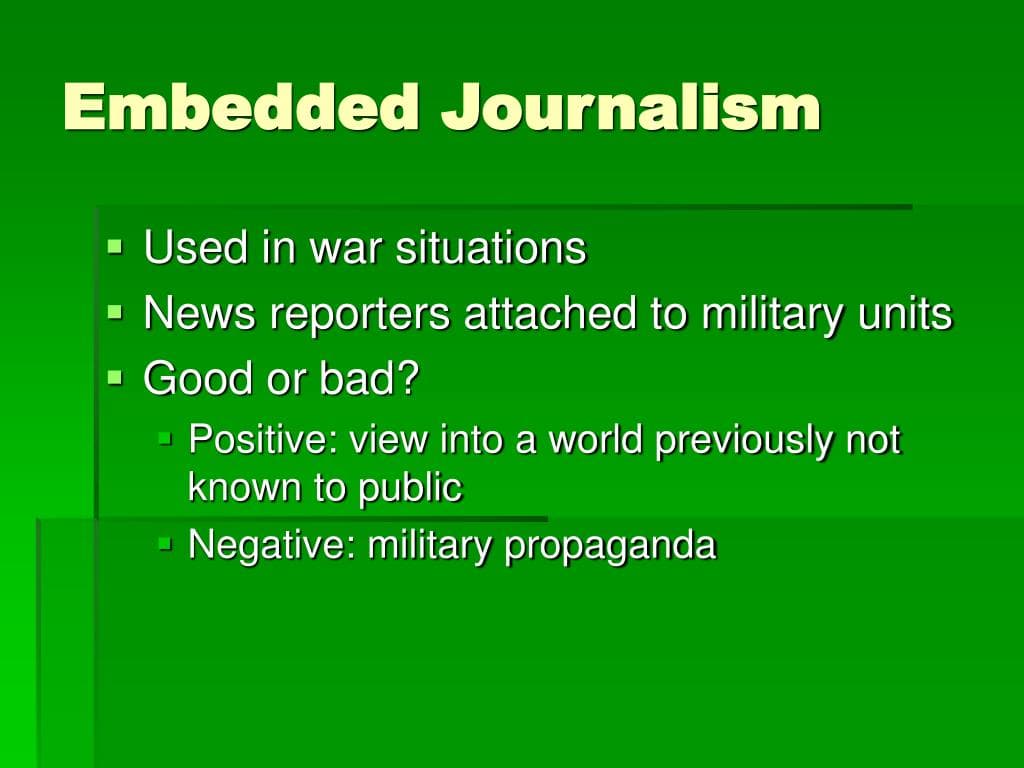
When the US invaded Iraq in 2003, 570-750 journalists were 'embedded' with military units. When asked why, Lt. Col. Rick Long of the US Marine Corps stated: 'Frankly, our job is to win the war. Part of that is information warfare. So we are going to attempt to dominate the information environment.' Reporters signed contracts promising not to report compromising information. 90% of embedded articles used soldiers as sources. The program emphasized military successes while blocking coverage of Iraqi civilian casualties. Additionally, the Pentagon secretly paid Iraqi media to publish pro-US articles, and paid Bell Pottinger for fake news content.
“Frankly, our job is to win the war. Part of that is information warfare. So we are going to attempt to dominate the information environment.”
What they said vs. what the evidence shows
“The embedding program provides unprecedented access to the conflict. Reporters are free to report what they see and hear.”
— Pentagon Press Secretary · Apr 2003
SourceFrom “crazy” to confirmed
The Claim Is Made
This is the moment they called it crazy.
When the United States launched its invasion of Iraq in March 2003, a carefully orchestrated access program was rolled out alongside the military campaign itself. Over 570 journalists—some sources cite up to 750—were embedded with American military units, given unprecedented frontline access in exchange for operating under strict guidelines. What these reporters were told and what was actually happening turned out to be two different things entirely.
The embedding program was presented to the media and public as a straightforward solution to a practical problem: how to cover a complex military operation fairly while maintaining operational security. The military would get better coverage; journalists would get better access. It seemed like a reasonable trade-off in theory. But when questioned about the program's real objectives, military officials were remarkably candid about intentions that went far beyond mere logistics.
Lieutenant Colonel Rick Long of the US Marine Corps provided a window into the program's actual design when he explained the strategic thinking behind it. "Frankly, our job is to win the war," Long stated. "Part of that is information warfare. So we are going to attempt to dominate the information environment." Those words, documented in multiple sources examining the Iraq conflict, revealed what the embedding program actually was: not a journalistic arrangement, but a component of military strategy specifically designed to shape the information environment during wartime.
The mechanics of this "information warfare" became clearer as the program unfolded. Embedded journalists signed contracts that required them to avoid reporting information deemed compromising to military operations. The results were predictable and measurable. Research examining the embedded reporting showed that approximately 90 percent of articles filed by embedded journalists relied on soldiers as their primary sources—hardly an independent perspective on military operations. The program succeeded brilliantly at what it was designed to do: emphasize military successes while systematically limiting coverage of Iraqi civilian casualties and other aspects of the conflict that might complicate the narrative.
Get the 5 biggest receipts every week, straight to your inbox — plus an exclusive PDF: The Top 10 Conspiracy Theories Proven True in 2025-2026. No spam. No agenda. Just the papers they couldn't hide.
You just read "Embedded journalism was explicitly designed as 'information …". We send ones like this every week.
No one's said anything yet. Be the first to drop your take.
Confirmed: They Were Right
The truth comes out. Officially documented.
Confirmed: They Were Right
The truth comes out. Officially documented.
The embedding program was only part of the larger information operation. Simultaneously, the Pentagon was running a parallel program paying Iraqi media outlets to publish pro-American articles. The military also contracted with Bell Pottinger, a British public relations firm, to create and distribute fake news content designed to shape perceptions of the conflict. These weren't isolated incidents or individual overreach—they were coordinated components of an acknowledged strategy to control the information environment.
Skeptics at the time argued that embedding was simply how modern warfare worked, that security concerns justified the arrangements, and that journalists could still operate independently within those constraints. Critics countered that the very structure of the program—the dependence on military logistics, the contractual restrictions, the reliance on military sources—made genuine independence impossible by design.
What's significant about this claim is not that governments shape information during conflicts. What matters is the explicit acknowledgment that this was the intention, the systematic implementation of that strategy, and the consequence for public understanding of a major military operation. When Lt. Colonel Long described the program as information warfare, he wasn't exaggerating or misspeaking. He was describing the program accurately.
For public trust in media institutions, the lesson is sobering. Access is a powerful form of control. When journalists depend on military logistics and cooperation to cover military operations, true independence becomes theoretical rather than practical.
Beat the odds
This had a 0.1% chance of leaking — someone talked anyway.
Conspirators
~100Network
Secret kept
3.7 years
Time to 95% exposure
500+ years