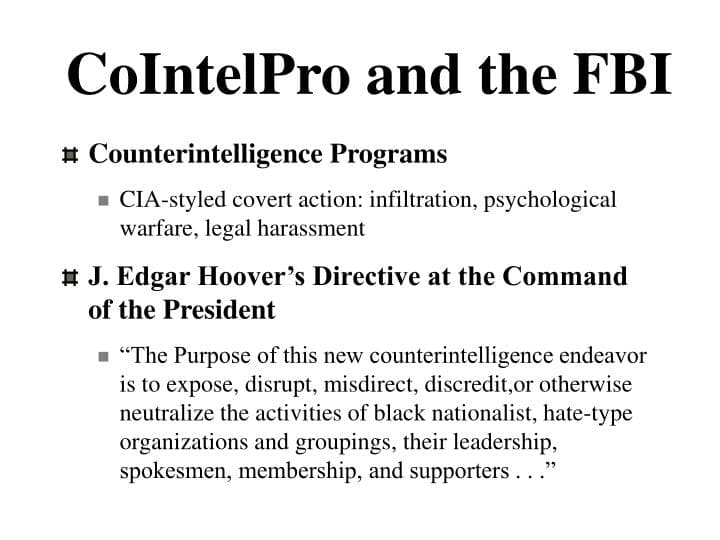
From 1956-1971, the FBI conducted covert operations to infiltrate, discredit and disrupt domestic political organizations including civil rights groups.
“The FBI does not engage in harassment or disruption of lawful political activities”
From “crazy” to confirmed
The Claim Is Made
This is the moment they called it crazy.
On the night of March 8, 1971, burglars broke into an FBI field office in Media, Pennsylvania. What they found inside would eventually unravel one of the most significant abuses of power by a federal agency in American history. Among the stolen documents were references to a program the FBI had kept secret for over a decade: COINTELPRO.
For years, civil rights activists, particularly those involved in the Black Power movement, had complained that federal agents were following them, infiltrating their organizations, and spreading disinformation to sow discord within their ranks. The FBI denied these allegations. Bureau leadership, including Director J. Edgar Hoover, insisted that such operations were either fabrications or necessary counterintelligence work to prevent violence and protect national security. The mainstream media largely accepted these denials.
The stolen documents told a different story. Once the media began publishing them, Congress launched investigations that would confirm the activists' worst suspicions. Between 1956 and 1971, the FBI had operated a systematic campaign called COINTELPRO to infiltrate, discredit, and disrupt domestic political organizations. The targets went far beyond what the government claimed was necessary—civil rights groups, anti-war activists, environmentalists, and countless others fell under surveillance and active disruption.
The methods were chilling in their sophistication. FBI agents posed as members to encourage illegal activities, then arrested the activists they had radicalized. They created fake letters to turn allies against each other. They sent threatening correspondence to leaders like Martin Luther King Jr., even threatening him with public exposure of alleged affairs in an attempt to destroy his credibility. The program was authorized at the highest levels of hierarchy, with evidence showing Hoover personally approved operations against civil rights leaders.
Get the 5 biggest receipts every week, straight to your inbox — plus an exclusive PDF: The Top 10 Conspiracy Theories Proven True in 2025-2026. No spam. No agenda. Just the papers they couldn't hide.
You just read "FBI COINTELPRO program systematically targeted and disrupted…". We send ones like this every week.
No one's said anything yet. Be the first to drop your take.
What made this revelation particularly damaging to public trust was the scale of the deception. The FBI had not simply made a few mistakes or overstepped boundaries in isolated cases. COINTELPRO was an organized, funded, approved program that had treated American citizens exercising their constitutional rights as enemies of the state. Thousands of documents existed. Hundreds of operations had been conducted.
Congress responded to the revelations with investigations that led to reforms. The Church Committee hearings of 1975-1976 provided the most comprehensive public examination of the program and recommended stricter oversight of intelligence agencies. These investigations formally established that the FBI's denials had been false and that the activists' claims had been justified all along.
The significance of COINTELPRO extends beyond its historical importance. It demonstrated that even the nation's highest law enforcement authority could lie systematically to the public and Congress. It showed that constitutional protections could be meaningless when agencies operated in secrecy. And it revealed that those who warned the public about government overreach were often dismissed as paranoid conspiracy theorists—until the proof became undeniable.
Today, COINTELPRO serves as a crucial reminder. When activists claim they are being targeted, when whistleblowers emerge from intelligence agencies, when the public questions official explanations, these concerns deserve serious scrutiny rather than automatic dismissal. The burden should rest on those wielding power to prove their transparency, not on citizens to prove their accusations.
Beat the odds
This had a 4.3% chance of leaking — someone talked anyway.
Conspirators
~200Network
Secret kept
55.2 years
Time to 95% exposure
500+ years