A bipartisan House inquiry found Beijing encourages fentanyl precursor manufacture and export with generous financial incentives. A ProPublica investigation revealed a state-run prison in Shijiazhuang owned Yafeng Chemical, which sold fentanyl products to Americans for eight years. A former federal prosecutor stated: 'The Chinese government pays you to send drugs to America but executes you for selling them in China.' Over 100,000 Americans now die annually from overdoses, primarily fentanyl. Families call it 'chemical warfare.'
“The Chinese government pays you to send drugs to America but executes you for selling them in China.”
From “crazy” to confirmed
The Claim Is Made
This is the moment they called it crazy.
For years, the narrative around the fentanyl crisis split neatly into two camps: either it was a failure of American doctors and pharmaceutical companies, or it was a problem of street-level drug traffickers. Few wanted to consider a third possibility: that a foreign government was actively profiting from America's addiction epidemic while executing its own citizens for the same crime.
A former federal prosecutor summarized the absurdity bluntly: "The Chinese government pays you to send drugs to America but executes you for selling them in China." This wasn't opinion. It was an observation grounded in documented government policy and corporate ownership records that had been hiding in plain sight.
The claim that China's state apparatus was complicit in the fentanyl crisis wasn't new. Families of overdose victims, desperate for someone to blame, had pointed fingers eastward for years. Law enforcement agencies documented the pipeline. But the mainstream response was dismissive. Critics called it scapegoating. Others argued it was oversimplified—surely the real problem was supply and demand, American addiction, the medical establishment's role in creating dependency. China's involvement was real but peripheral, the reasoning went.
Then ProPublica did the reporting no one else had done systematically.
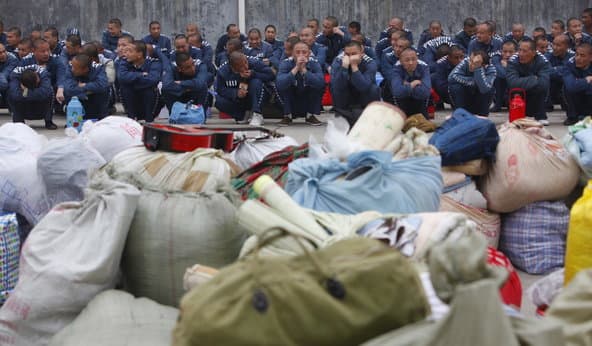
Investigators discovered that a chemical company called Yafeng Chemical, located in Shijiazhuang, had been supplying fentanyl precursors to American buyers for eight years. The company wasn't some anonymous private enterprise. It was owned and operated by a state-run prison. For nearly a decade, a government facility held prisoners—likely as forced labor—while the facility itself manufactured and exported the raw materials that would eventually kill over 100,000 Americans annually.
Get the 5 biggest receipts every week, straight to your inbox — plus an exclusive PDF: The Top 10 Conspiracy Theories Proven True in 2025-2026. No spam. No agenda. Just the papers they couldn't hide.
You just read "A Chinese state-run prison owned a chemical company that exp…". We send ones like this every week.
No one's said anything yet. Be the first to drop your take.
The evidence wasn't circumstantial. The company's records existed. Customer emails existed. Port manifests existed. A bipartisan House inquiry conducted parallel research and reached the same conclusion: Beijing didn't merely tolerate fentanyl precursor manufacturing. The Chinese government actively encouraged it through "generous financial incentives."
The parallel policy was equally damning. While the state profited from exporting these chemicals, China executed its own citizens convicted of drug trafficking. The contrast wasn't accidental. It was policy. Sell abroad, execute at home. Profit from American deaths, maintain zero-tolerance domestically.
What makes this case significant isn't just that the claim proved true. It's the lag between evidence and acknowledgment. Families had been calling it "chemical warfare" for years. Law enforcement knew. Congressional committees knew. The press had pieces of the story. Yet the full picture—a state actor running a prison that manufactured drugs exported to America—required new investigation to crystallize.
This matters for public trust in two ways. First, it vindicated those who had been called conspiracy theorists for pointing at government complicity. But second, and more troubling, it revealed how institutional friction keeps inconvenient truths compartmentalized. No single journalist knew everything. No single agency pursued it fully. The ecosystem that should have connected these dots didn't.
Over 100,000 Americans died while the narrative remained incomplete. When evidence of state-level involvement finally surfaced, it had to come from outside traditional power structures. That's not how oversight is supposed to work.
Beat the odds
This had a 0.9% chance of leaking — someone talked anyway.
Conspirators
~300Network
Secret kept
7.3 years
Time to 95% exposure
500+ years