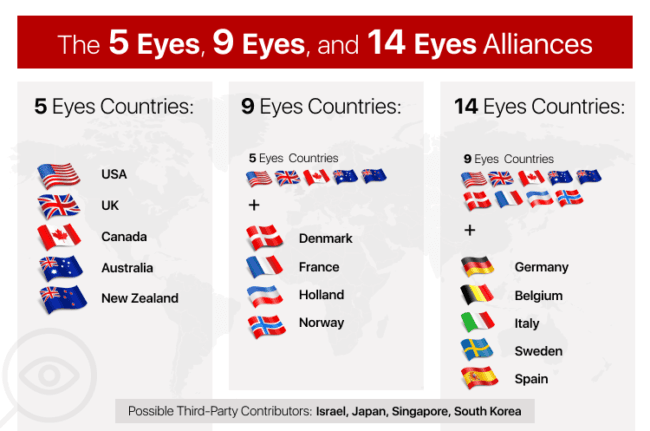
Snowden documents confirmed the long-suspected arrangement where Five Eyes alliance members (US, UK, Canada, Australia, New Zealand) share intelligence to bypass their own domestic surveillance restrictions. GCHQ collects data on Americans and shares it with the NSA, while the NSA does the same for British citizens — allowing each to claim they are not spying on their own people. The UKUSA Agreement formalized this arrangement, and the Tempora and MUSCULAR programs demonstrated the data-sharing pipeline in practice.
“The intelligence agencies of the US, UK, Canada, Australia, and New Zealand spy on each other's citizens and share the data — so each can claim they're not violating their own laws.”
From “crazy” to confirmed
The Claim Is Made
This is the moment they called it crazy.
For decades, privacy advocates whispered about an arrangement that seemed too brazen to be true. The world's most powerful intelligence agencies—those of the United States, United Kingdom, Canada, Australia, and New Zealand—were supposedly circumventing their own domestic surveillance laws by spying on each other's citizens and then trading the data like currency. If true, it would mean that citizens living under strict privacy protections were actually being watched by foreign governments operating under no such restrictions.
The claim wasn't new. Researchers and journalists had been connecting dots since the Cold War era. But governments denied it systematically. When questioned, officials insisted they operated under strict legal frameworks that prevented mass surveillance of their own populations. Each nation maintained that its intelligence agencies were bound by domestic law—the Foreign Intelligence Surveillance Act in America, the Regulation of Investigatory Powers Act in Britain. These safeguards, they assured the public, prevented the kind of dragnet surveillance that authoritarian regimes might employ.
Then Edward Snowden changed everything.
In 2013, the former NSA contractor released classified documents that confirmed what skeptics had long suspected. The UKUSA Agreement, formalized after World War II, had evolved into an elaborate mechanism for mass surveillance. The arrangement was elegant in its circumvention: GCHQ, Britain's signals , would collect vast amounts of data on Americans and share it with . The NSA would reciprocate by collecting data on British citizens and sharing it with GCHQ. Each agency could technically claim it wasn't spying on its own citizens—someone else was doing it for them.
Get the 5 biggest receipts every week, straight to your inbox — plus an exclusive PDF: The Top 10 Conspiracy Theories Proven True in 2025-2026. No spam. No agenda. Just the papers they couldn't hide.
You just read "Five Eyes nations share surveillance data to spy on each oth…". We send ones like this every week.
No one's said anything yet. Be the first to drop your take.
Confirmed: They Were Right
The truth comes out. Officially documented.
Confirmed: They Were Right
The truth comes out. Officially documented.
The documents revealed specific programs that made this arrangement operational. Tempora, a British operation, vacuumed up internet communications on a massive scale. MUSCULAR, a joint NSA-GCHQ effort, targeted the undersea cables that carry global internet traffic. These weren't narrow, targeted operations focused on specific threats. They were industrial-scale surveillance infrastructure designed to capture and analyze communications on a population-wide level.
The revelations forced governments to acknowledge what they had previously denied. Investigations in multiple countries confirmed the basic facts of the arrangement. Privacy commissioners and congressional committees issued reports documenting the scope of the programs. Some reforms followed—though many critics argue they were cosmetic, designed more to manage public relations than to meaningfully constrain surveillance.
What makes this matter isn't just the historical record. It establishes a crucial pattern: when governments promise to protect privacy through law, those promises can be outsourced away. The Five Eyes arrangement revealed that domestic legal protections only work as well as other nations' cooperation in subverting them. A citizen in London lived under strict privacy protections that were rendered meaningless by an American agency operating under different rules. The inverse was equally true.
The Five Eyes story also matters because it normalized a conversation that should never have been routine: the idea that mass surveillance of entire populations might be acceptable if it's dressed up in bureaucratic language and hidden behind classification stamps. The documents proved the claim was true. But they also proved something darker—that suspicion itself had been inadequate. The reality was larger than anyone had publicly suggested.
Beat the odds
This had a 0% chance of leaking — someone talked anyway.
Conspirators
~150Network
Secret kept
0.5 years
Time to 95% exposure
500+ years