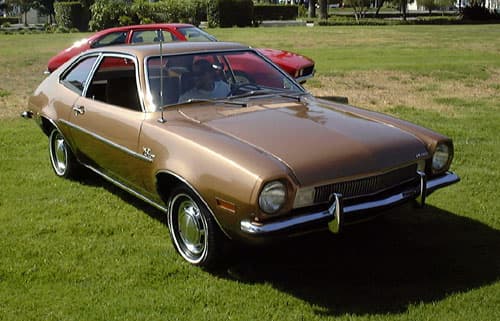
Internal Ford documents revealed the company calculated it was cheaper to pay wrongful death settlements than fix a $11 fuel tank defect. Ford executives knew the Pinto's rear-mounted fuel tank would rupture in rear-end collisions.
“The Pinto meets all applicable federal safety standards”
From “crazy” to confirmed
The Claim Is Made
This is the moment they called it crazy.
A manufacturing decision made in the early 1970s would haunt Ford Motor Company for decades. The Pinto, designed to compete with cheap imports, had a critical flaw: its fuel tank sat inches behind the rear bumper, vulnerable to rupture in even moderate rear-end collisions. Between 1971 and 1980, at least 180 people died in fires that resulted from these crashes.
When crash investigators and consumer advocates first raised concerns about the Pinto's design, Ford didn't acknowledge a systemic problem. Company officials maintained that the vehicle met all federal safety standards in place at the time and that rear-impact fires were rare. They suggested that driver error or unusual circumstances caused the accidents. It was the standard corporate response—deny, deflect, and defend.
But in the late 1970s, a legal discovery process revealed something that changed the narrative entirely. Internal Ford documents, including a now-infamous cost-benefit analysis, showed that engineers had identified the fuel tank vulnerability years before the car reached dealerships. More damning, the documents revealed that Ford had calculated the financial impact of both fixing the defect and paying settlements for deaths and injuries.
The math was brutal and coldly precise. Ford estimated that fixing the fuel tank problem would cost approximately $11 per vehicle across the entire Pinto line. Multiplying that across millions of cars meant a total expenditure in the hundreds of millions of dollars. By contrast, the company's projections suggested that paying wrongful death settlements, medical expenses, and legal fees for anticipated accident victims would cost less. From a purely financial standpoint, Ford had decided that deaths were acceptable losses.
This wasn't speculation or interpretation. The documents were contemporaneous evidence of how the decision was made. Engineers had presented the problem. Finance teams had run the numbers. And executives had chosen the cheaper option.
The revelation became public knowledge gradually through litigation, particularly through the work of safety advocates and journalists who obtained and published these internal memos. When the full scope of Ford's knowledge became clear, public outrage was swift. The company faced multiple lawsuits, criminal prosecution, and a permanent stain on its reputation. Ford eventually recalled the Pinto and implemented fixes, but only after far more lives had been lost than might have been saved by acting on the original engineering concerns.
What makes this case significant today isn't simply that a corporation prioritized profit over safety—a story as old as industrialization. Rather, it's the documented evidence that Ford knew precisely what it was doing. There were no ambiguities, no gray areas of scientific uncertainty. The company had the information, understood the risks, and made a deliberate choice.
The Pinto case fundamentally altered how Americans viewed corporate accountability and product safety. It led to regulatory changes, stricter standards for vehicle design, and heightened skepticism toward manufacturer claims. It proved that "we didn't know" was sometimes a convenient fiction when uncomfortable truths could be buried in internal memos.
Decades later, the Pinto remains a textbook example of how corporate denial eventually crumbles when documents surface. It's a reminder that claims dismissed as conspiracy theories or exaggeration can sometimes be backed by paper trails that nobody expected would see daylight.
Get the 5 biggest receipts every week, straight to your inbox — plus an exclusive PDF: The Top 10 Conspiracy Theories Proven True in 2025-2026. No spam. No agenda. Just the papers they couldn't hide.
You just read "Ford Motor Company knew about Pinto fuel tank defect that ki…". We send ones like this every week.
No one's said anything yet. Be the first to drop your take.