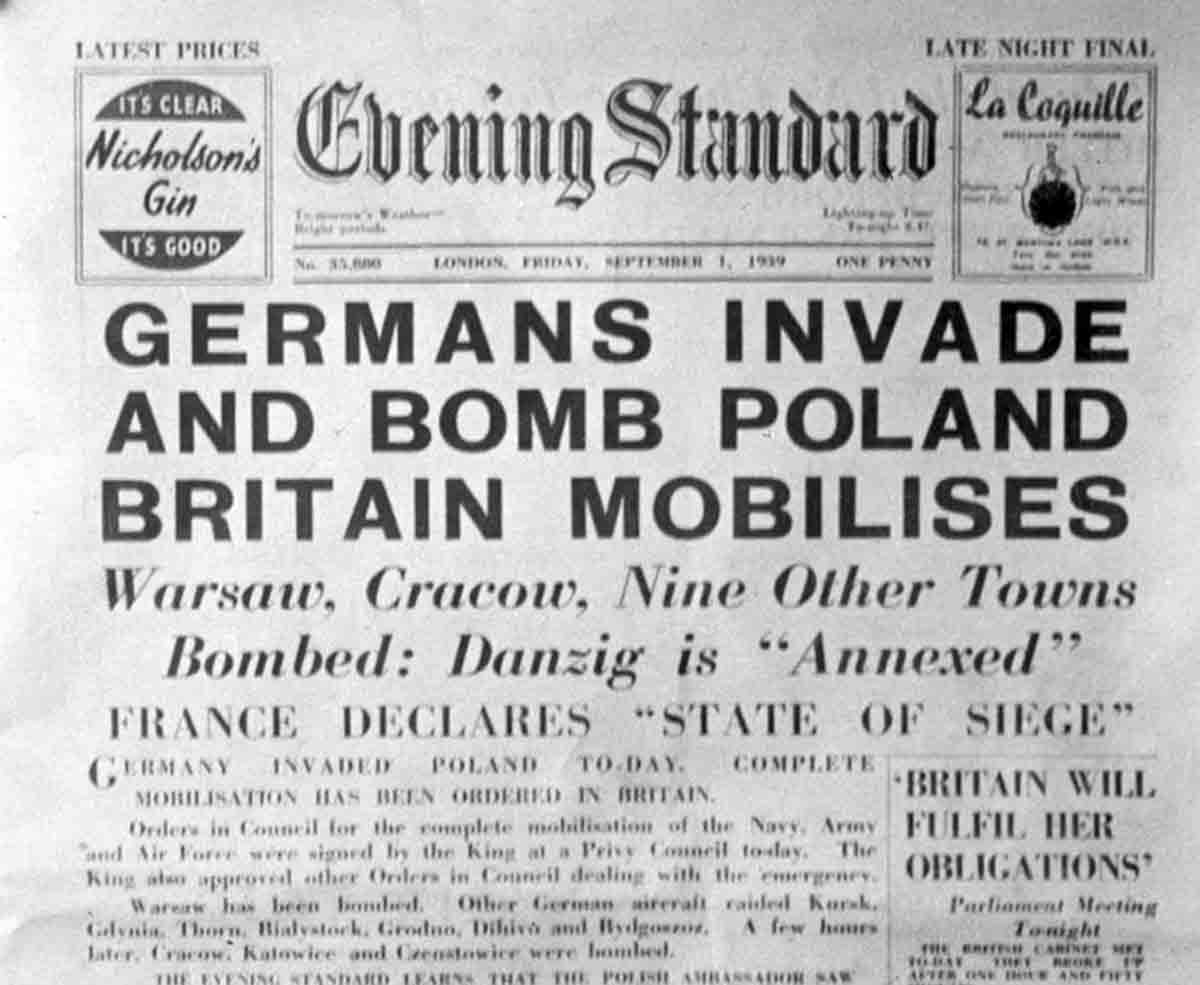
On August 31, 1939, SS officer Alfred Naujocks led Operation Himmler — a series of false flag attacks designed to look like Polish aggression against Germany. At the Gleiwitz radio station, SS operatives dressed in Polish uniforms broadcast a short anti-German message, then left a murdered concentration camp prisoner (Franciszek Honiok) in a Polish uniform at the scene. The next day, Hitler invaded Poland, citing 'Polish aggression.' Naujocks confessed at Nuremberg, providing the definitive account of the deception.
“On orders from Heydrich, I organized the simulated attack on the radio station near Gleiwitz... We seized the radio station and broadcast a message in Polish.”
What they said vs. what the evidence shows
From “crazy” to confirmed
The Claim Is Made
This is the moment they called it crazy.
Confirmed: They Were Right
The truth comes out. Officially documented.
Confirmed: They Were Right
The truth comes out. Officially documented.
On the night of August 31, 1939, German radio stations broadcast urgent reports of a military emergency. Polish forces, they claimed, had attacked the Gleiwitz radio station in German territory. By dawn, Adolf Hitler had his justification. Within hours, German troops crossed into Poland, and World War II began.
The story told to the German people was straightforward: Poland had committed an act of aggression that left Hitler no choice but to respond militarily. This narrative was repeated in official statements, newspapers, and radio broadcasts across Nazi-controlled territory. It provided the legal and moral pretext that Hitler needed, both for his own people and for international observers.
But within weeks of Germany's invasion, skeptics emerged. Journalists and observers noted inconsistencies in the official account. How exactly did Polish soldiers manage to attack a radio station inside German territory? Why were there no credible witnesses to this "Polish aggression"? The narrative began to crack under scrutiny, though Hitler's military momentum made further investigation difficult during wartime.
The truth emerged only after the war ended. At the Nuremberg Trials, SS officer Alfred Naujocks provided a detailed confession about what actually happened that night. Operation Himmler, as it was code-named, was not a response to Polish aggression—it was the orchestration of false aggression. Naujocks himself led SS operatives dressed in Polish uniforms to the Gleiwitz radio station. They broadcast a brief anti-German message in Polish, creating the appearance of an attack.
To make the scene convincing, the SS needed physical evidence. They obtained a murdered concentration camp prisoner named Franciszek Honiok, dressed his corpse in a Polish military uniform, and left it at the station as a supposed casualty of the "firefight." The body would later be photographed and displayed as proof of Polish aggression.
Naujocks's testimony was corroborated by other Nazi officials and documented in trial records. The historical record became clear: the Nazis had manufactured the entire incident from scratch. There had been no Polish attack. The invasion of Poland was not a defensive action but the calculated opening move of an aggressive war, preceded by deliberate deception.
What makes this case significant is not merely that a government lied—that is common enough. What matters is the scale of the deception and its consequences. A false flag operation, executed on a single August night, provided the pretext for an invasion that would kill millions and reshape the global order. A manufactured attack, complete with a staged corpse, served as the official justification for beginning World War II.
This case illustrates why verification matters. For years, the Nazi account was accepted as fact by people who had no way to investigate it. Only after military defeat and international prosecution could the truth be documented and verified. It demonstrates that even large-scale historical events, accepted as established fact by entire populations, can rest on fabricated foundations.
The Gleiwitz incident reminds us why independent investigation, documentary evidence, and accountability mechanisms exist. Without them, those in power can simply declare their wars justified, their aggression defensive, their fabrications factual. History depends on people willing to question official narratives and demand proof.
Get the 5 biggest receipts every week, straight to your inbox — plus an exclusive PDF: The Top 10 Conspiracy Theories Proven True in 2025-2026. No spam. No agenda. Just the papers they couldn't hide.
You just read "The Nazis staged a fake Polish attack on a German radio stat…". We send ones like this every week.
No one's said anything yet. Be the first to drop your take.