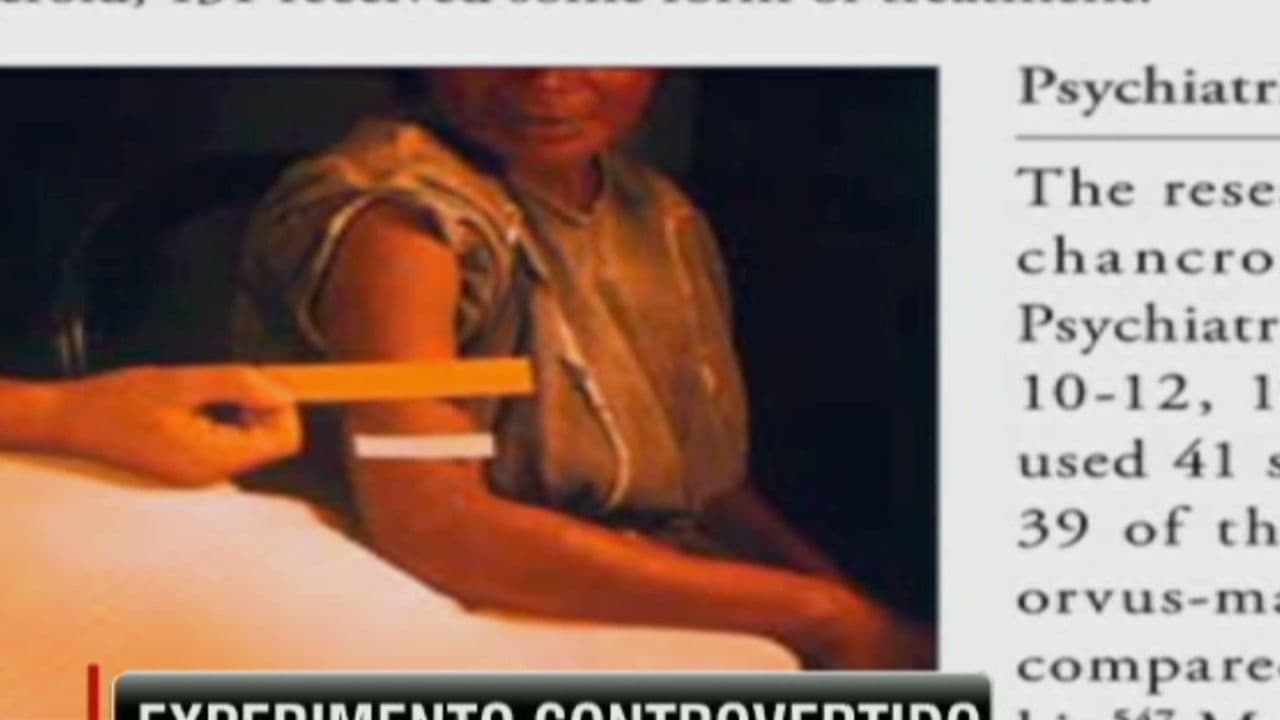
From 1946-1948, the US Public Health Service deliberately infected over 5,500 Guatemalan prisoners, sex workers, soldiers, children, and psychiatric patients with syphilis, gonorrhea, or chancroid. Subjects were infected through sex workers, open wounds, or direct urethral insertion of bacteria — all without consent. The same principal investigator (Dr. John Charles Cutler) also ran the Tuskegee experiment. The experiments were hidden until historian Susan Reverby discovered them in 2010. Obama apologized to Guatemala.
“The US government conducted nonconsensual human medical experiments, deliberately infecting vulnerable populations with sexually transmitted diseases.”
From “crazy” to confirmed
The Claim Is Made
This is the moment they called it crazy.
For decades, a dark chapter of American medical history remained hidden in plain sight—filed away in archives and institutional records that few would ever examine. Between 1946 and 1948, the US Public Health Service conducted a series of experiments in Guatemala that deliberately infected over 5,500 people with sexually transmitted diseases. The victims were prisoners, psychiatric patients, soldiers, sex workers, and children. None of them consented.
The experiments were designed to study how STDs spread and whether penicillin could prevent infection. Researchers infected subjects through sex workers, open wounds, and in some cases, direct bacterial insertion into the urethra. The stated purpose was scientific advancement. The actual result was mass violation of basic human dignity and medical ethics.
For six decades, the US government said nothing. There were no public statements, no acknowledgments, no apologies. The experiments were simply not part of the official narrative of American science. When questions arose, officials deflected or claimed ignorance. The assumption was that what happened in Guatemala would stay in Guatemala.
That changed in 2010 when historian Susan Reverby, conducting research at Wellesley College, discovered declassified documents detailing the entire program. She found detailed records of inoculations, follow-up observations, and communications between researchers. The evidence wasn't hidden or ambiguous—it was documented in meticulous detail. Reverby published her findings, and within days the story became international news.
The revelation was particularly damning because one of the principal investigators was Dr. John Charles Cutler, the same man who had overseen the experiment—one of the most notorious violations of research ethics in American history. Cutler hadn't learned from Tuskegee. He'd simply moved to Guatemala to continue the work.
Get the 5 biggest receipts every week, straight to your inbox — plus an exclusive PDF: The Top 10 Conspiracy Theories Proven True in 2025-2026. No spam. No agenda. Just the papers they couldn't hide.
You just read "The US government deliberately infected 5,500+ Guatemalans w…". We send ones like this every week.
No one's said anything yet. Be the first to drop your take.
Confirmed: They Were Right
The truth comes out. Officially documented.
Confirmed: They Were Right
The truth comes out. Officially documented.
The US government's response was swift but came nearly 65 years too late. President Obama issued a formal apology to Guatemala in 2010, acknowledging that the experiments were "clearly unethical." The State Department called the conduct "reprehensible." There were promises of compensation and institutional reforms.
But the real significance of this case isn't the apology—it's what it reveals about institutional memory and the durability of official narratives. The American medical establishment had essentially agreed to forget these experiments ever happened. They weren't secret in the sense of being hidden from the government; they were secret in the sense of being collectively ignored by institutions that benefited from that ignorance.
What makes this case belong on a list of verified claims is precisely that: it was a documented, systematic program with extensive records. It wasn't a whispered allegation or circumstantial evidence. Declassified documents proved every major element. Yet it took a historian's curiosity and six decades of institutional silence for the truth to emerge.
The Guatemala experiments matter because they expose the gap between official history and documented reality. When people distrust medical institutions or government health programs, this is part of why. The breach of trust wasn't just from the original experiments—it was from the systematic erasure that followed. This is why transparency and accountability in research aren't bureaucratic luxuries. They're the foundation of public health itself.
Unlikely leak
Only 7.5% chance this would come out. It did.
Conspirators
~300Network
Secret kept
64.7 years
Time to 95% exposure
500+ years