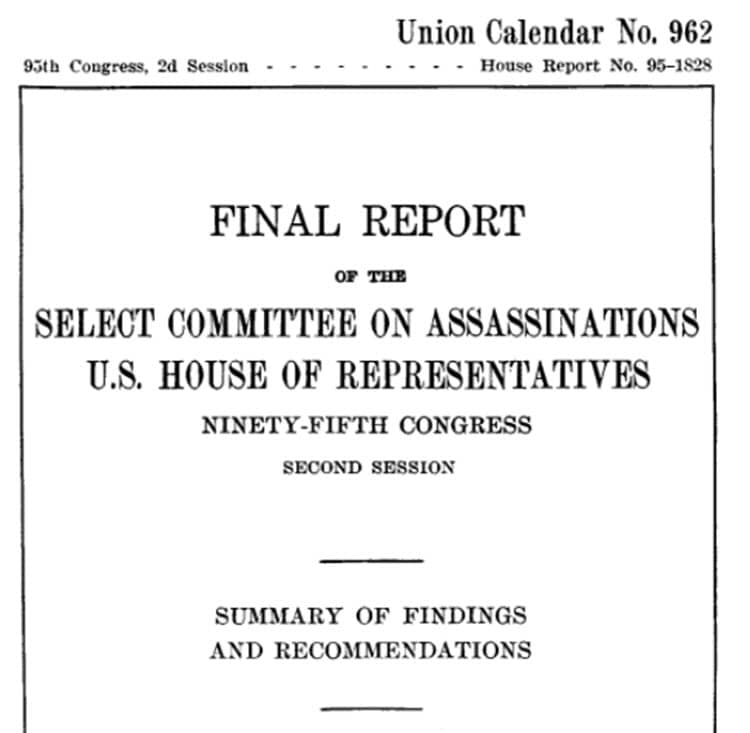
In 1979, the House Select Committee on Assassinations concluded that President Kennedy was 'probably assassinated as a result of a conspiracy' based on acoustic evidence suggesting a second shooter from the grassy knoll. The committee found that the CIA, FBI, and Secret Service all had deficiencies in sharing information. Despite this official government finding of probable conspiracy, the case was never reopened and documents remain classified.
“President John F. Kennedy was probably assassinated as a result of a conspiracy. The committee is unable to identify the other gunman or the extent of the conspiracy.”
From “crazy” to confirmed
The Claim Is Made
This is the moment they called it crazy.
In 1979, a government body tasked with investigating one of America's most significant moments concluded something the Warren Commission had rejected sixteen years earlier: President Kennedy was probably killed as part of a conspiracy. Yet this official finding by the House Select Committee on Assassinations has largely faded from public memory, overshadowed by decades of dismissal from establishment institutions.
The Warren Commission's 1964 conclusion—that Lee Harvey Oswald acted alone—had dominated the official narrative for nearly two decades. It was presented as settled history, the definitive answer to a question that had haunted millions of Americans. But by the mid-1970s, new evidence and public skepticism prompted Congress to authorize a fresh investigation. The House Select Committee on Assassinations was born from that pressure.
What the committee found was striking. Based on acoustic evidence suggesting a second shooter, specifically from the grassy knoll, the committee determined that Kennedy was "probably assassinated as a result of a conspiracy." This wasn't fringe speculation or wild theorizing. This was the official conclusion of a congressional committee with subpoena power and access to classified materials. The committee also identified significant failures: the CIA, FBI, and Secret Service had all failed to adequately share information about potential threats to the president before November 22, 1963.
The acoustic evidence centered on recordings from a Dallas police motorcycle. Acoustic experts detected what appeared to be four shots fired, not three. The timing and spacing of those shots suggested they came from two different locations. While subsequent analysis would debate the validity of this evidence, the committee at the time found it compelling enough to overturn the Warren Commission's lone-assassin conclusion.
Get the 5 biggest receipts every week, straight to your inbox — plus an exclusive PDF: The Top 10 Conspiracy Theories Proven True in 2025-2026. No spam. No agenda. Just the papers they couldn't hide.
You just read "The House Select Committee on Assassinations concluded JFK w…". We send ones like this every week.
No one's said anything yet. Be the first to drop your take.
Yet nothing changed. No reopened investigation followed. No senior officials at the intelligence agencies faced accountability for the information failures identified by the committee. The documents remained classified, their contents hidden from the public. The committee's finding was acknowledged, briefly noted in some media accounts, then allowed to fade into obscurity while the lone-gunman narrative persisted in popular consciousness.
This creates a peculiar situation: the official position of the U.S. Congress is that Kennedy was probably killed in a conspiracy, yet the case remains officially unsolved and investigatively dormant. For citizens trying to understand what actually happened in Dealey Plaza, this contradiction is bewildering. Were the committee members mistaken? If so, why hasn't their conclusion been formally disputed by another official body? If they were right, why was nothing done?
The significance transcends Kennedy himself. It reveals something about institutional credibility and historical truth. When a government committee reaches one conclusion, but the broader system fails to act on it or acknowledge it meaningfully, public trust erodes. Citizens are left wondering whether official findings matter, or whether they're simply filed away when inconvenient.
The HSCA's probable conspiracy finding remains documented, available, and official. Yet it exists in a strange limbo—too legitimate to ignore, too challenging to mainstream narratives to fully embrace. It's a reminder that truth and official acknowledgment are not always the same thing, and that some answers, once discovered, prove easier to suppress than to confront.
Unlikely leak
Only 9% chance this would come out. It did.
Conspirators
~500Large op
Secret kept
47.1 years
Time to 95% exposure
500+ years