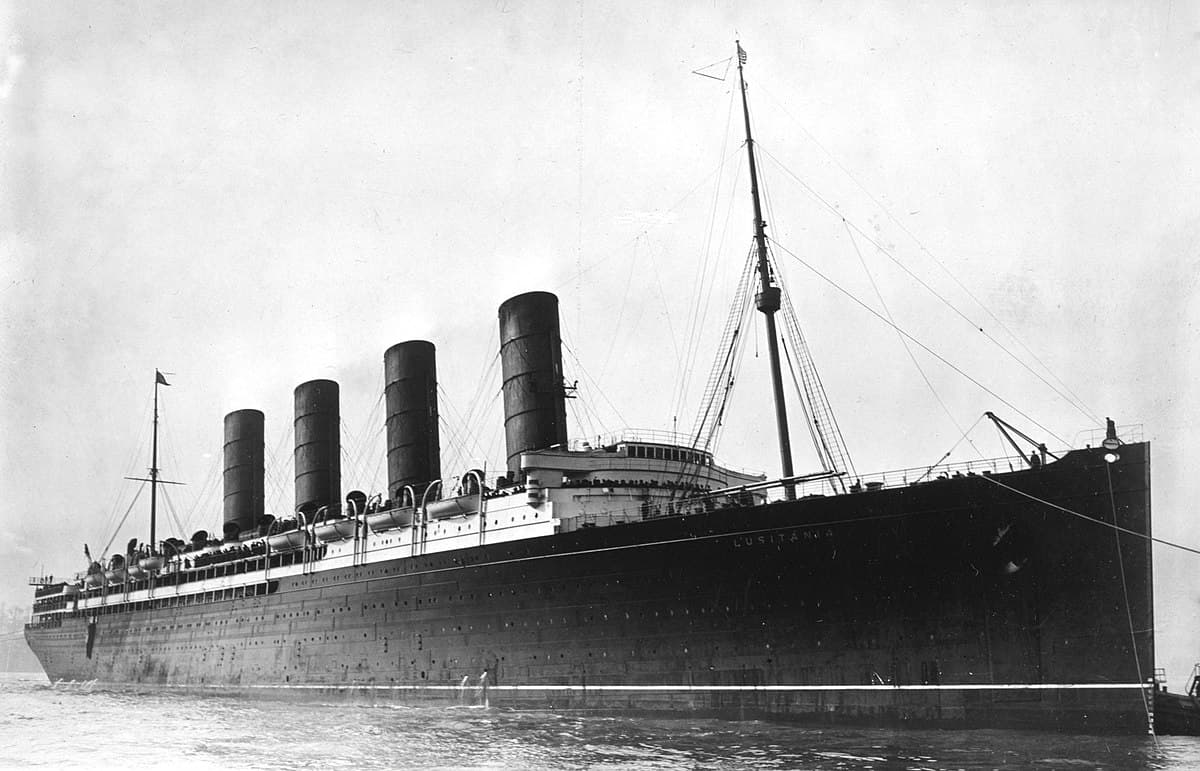
When Germany torpedoed the Lusitania on May 7, 1915, killing 1,198 (including 128 Americans), the US and UK publicly denied the ship carried military cargo, calling it an unprovoked attack on civilians. In reality, the Lusitania's hold contained 4.2 million rifle rounds, 5,000 shrapnel shell casings, and 3,240 percussion fuses — all listed on a cargo manifest that was hidden from the public. Divers later recovered live ammunition from the wreck. The sinking was instrumentalized to shift American public opinion toward entering WWI.
“The Lusitania was carrying significant quantities of war munitions. Both the British and American governments covered up the military cargo to maximize outrage over the sinking.”
What they said vs. what the evidence shows
“The Lusitania was an unarmed passenger vessel carrying no military cargo. Germany's attack was an act of piracy against innocent civilians.”
— British Admiralty / Cunard Line · May 1915
SourceFrom “crazy” to confirmed
The Claim Is Made
This is the moment they called it crazy.
When the RMS Lusitania slipped beneath the Atlantic on May 7, 1915, it took more than 1,198 lives with it. It also took a secret that governments on both sides of the Atlantic would guard jealously for decades.
The official story was straightforward and designed to inflame American sentiment. A German U-boat had deliberately targeted an unarmed British passenger liner, murdering 128 American civilians in an unprovoked act of aggression. President Woodrow Wilson's administration and the British government presented this narrative consistently and publicly. The Lusitania was a civilian vessel, they insisted. Any suggestion otherwise was dismissed as German propaganda.
But the ship's manifest told a different story—one that remained hidden from public view for over a century.
When researchers and divers finally examined the evidence closely, they found that the Lusitania's hold had been packed with 173 tons of military ordnance destined for British forces. The cargo included 4.2 million rifle rounds, 5,000 shrapnel shell casings, and 3,240 percussion fuses. This wasn't speculation or circumstantial evidence. The cargo manifest existed in official records. Divers who explored the wreck recovered live ammunition from the debris. The facts were there; they had simply been suppressed.
What makes this particularly significant is how the sinking was weaponized. The deaths of those American passengers became a rallying cry against Germany. American newspapers carried emotional accounts. Families of the victims called for vengeance. The incident shifted American public opinion measurably toward intervention in the war. Within two years, the United States entered World War I—partly on the moral outrage generated by the Lusitania's fate.
The question isn't whether Germany had legitimate military justifications for targeting a ship carrying munitions. International law and ethics can reasonably debate that question. The question is whether the American and British publics were deliberately deceived about what the Lusitania actually was.
Get the 5 biggest receipts every week, straight to your inbox — plus an exclusive PDF: The Top 10 Conspiracy Theories Proven True in 2025-2026. No spam. No agenda. Just the papers they couldn't hide.
You just read "The RMS Lusitania was secretly carrying 173 tons of war muni…". We send ones like this every week.
No one's said anything yet. Be the first to drop your take.
Confirmed: They Were Right
The truth comes out. Officially documented.
Confirmed: They Were Right
The truth comes out. Officially documented.
From a strategic perspective, the deception makes sense. Governments have always shaped narratives during wartime. Presenting the sinking as the murder of innocents was more persuasive than admitting the ship was a legitimate military target carrying weapons. But this explanation doesn't excuse the withholding of information from citizens who would die in the war that followed.
The Lusitania case reveals something uncomfortable about how democratic nations operate during crises. Officials didn't debate whether military cargo was present. They simply denied it, consistently, while possessing evidence they kept classified. Citizens who might have formed different opinions about the war were never given the chance.
What matters now is recognizing the pattern. When governments insist something is false, when they control access to documents, when the official narrative serves military interests perfectly—these are conditions worth scrutinizing. The truth about the Lusitania took over a hundred years to surface, long after it mattered for the decisions of 1915.
Public trust in institutions rests partly on the assumption that leaders tell the truth when stakes are highest. The Lusitania suggests that assumption deserves skepticism.
Expected to surface
31% probability of exposure — too many people knew.
Conspirators
~1,000Large op
Secret kept
92.7 years
Time to 95% exposure
500+ years