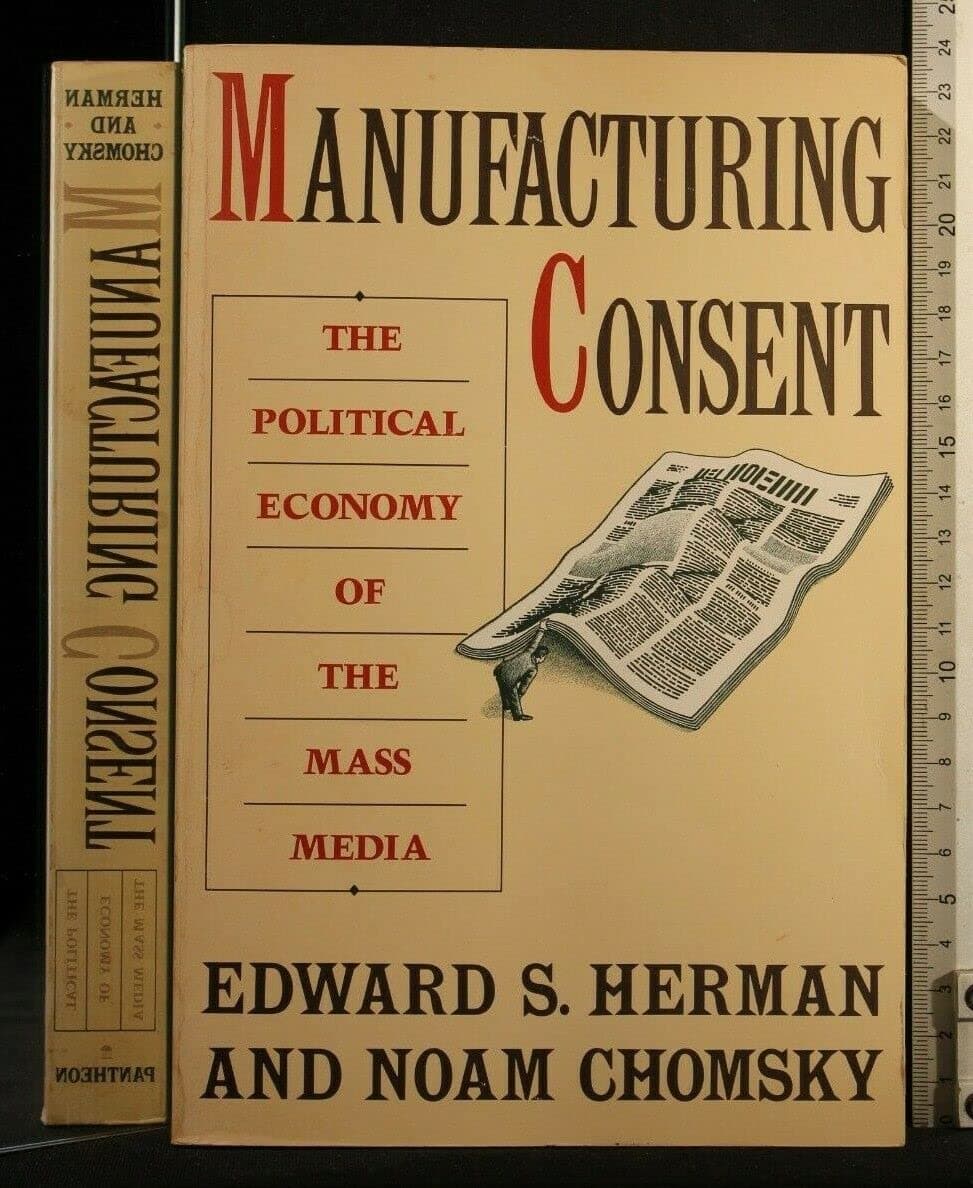
In 1988, Noam Chomsky and Edward Herman published 'Manufacturing Consent,' arguing that mass media serves as a propaganda system through five filters: ownership concentration, advertising dependency, reliance on official sources, 'flak' mechanisms, and ideological framing. A 2010 Harvard study confirmed their prediction: the NYT and LA Times stopped calling waterboarding 'torture' when the US government did it, but continued using the term for other countries. The model predicted Iraq War coverage failures, advertiser-driven content moderation, and tech platform censorship decades before they occurred.
“The mass media serve as a system for communicating messages and symbols to the general populace. It is their function to amuse, entertain, and inform, and to inculcate individuals with the values, beliefs, and codes of behavior that will integrate them into the institutional structures of the larger society. In a world of concentrated wealth, the performance of this function requires systematic propaganda.”
What they said vs. what the evidence shows
“Herman and Chomsky overstate their case, particularly with regards to reporting on Nicaragua. The propaganda model cannot explain the existence of critical journalism within mainstream media.”
— Walter LaFeber (Historian) · Mar 1989
SourceFrom “crazy” to confirmed
The Claim Is Made
This is the moment they called it crazy.
Confirmed: They Were Right
The truth comes out. Officially documented.
Confirmed: They Were Right
The truth comes out. Officially documented.
In 1988, two scholars published a book that mainstream media critics dismissed as fringe theory. Noam Chomsky and Edward Herman's "Manufacturing Consent" proposed something unsettling: that American newspapers and television networks weren't neutral observers of world events, but active participants in a system designed to shape public opinion in favor of powerful interests.
The book introduced what became known as the "propaganda model"—a framework with five filters through which news passes before reaching the public. These filters included media ownership concentration, dependence on advertising revenue, reliance on government officials as primary sources, organized campaigns ("flak") against dissenting views, and the shared ideological assumptions of journalists and editors. The authors weren't claiming some shadowy conspiracy. Rather, they argued these filters emerged naturally from how the industry was structured.
The response from the media establishment was predictable. Major outlets largely ignored the book or, when they engaged with it, characterized it as an exercise in unfounded skepticism. Academia treated it as polemical rather than empirical. The general message: Chomsky was too ideological to be trusted, and his model was too simplistic to capture the complexity of American journalism.
But then reality began matching their predictions with unusual precision.
In 2010, a Harvard study examined how major American newspapers covered waterboarding. The researchers found something striking: when the United States government used waterboarding on detainees, the New York Times and Los Angeles Times gradually stopped calling it "torture"—the term they had consistently applied to the same practice when other countries employed it. Once the terminology shifted in official statements, press coverage followed. This wasn't a conspiracy requiring secret meetings. It was the propaganda model operating exactly as Chomsky and Herman predicted: journalists unconsciously adopting the framing provided by official sources.
The Iraq War coverage that followed the 2003 invasion provided additional validation. Major newspapers, reliant on government sources and operating within shared ideological assumptions about American military interventions, initially failed to adequately question claims about weapons of mass destruction. The critical reporting came later, after the official narrative had already been established and public support already mobilized.
More recent examples have accumulated. Content moderation decisions at tech platforms often align suspiciously with government pressure and advertiser preferences. Stories that challenge pharmaceutical companies receive different treatment depending on whether major advertisers are affected. Foreign policy coverage shifts when business interests change. The mechanisms Chomsky identified—operating through incentive structures rather than explicit orders—continue producing remarkably consistent results.
What makes this verification significant isn't that it proves some vast conspiracy. Rather, it demonstrates that Chomsky and Herman identified real structural problems with how information flows through commercial media systems. Their model predicted outcomes that have repeatedly materialized, suggesting the framework captures something genuine about how institutional pressures shape news.
This matters because public trust in institutions depends on understanding how those institutions actually function. If major news organizations unconsciously filter information through predictable mechanisms—mechanisms that serve ownership interests and official sources—then citizens need to account for that when consuming news. Chomsky's model wasn't vindicated because it's complete or because nothing good comes from mainstream media. It was vindicated because it accurately described patterns that continue unfolding today, patterns that media institutions themselves still rarely acknowledge.
Get the 5 biggest receipts every week, straight to your inbox — plus an exclusive PDF: The Top 10 Conspiracy Theories Proven True in 2025-2026. No spam. No agenda. Just the papers they couldn't hide.
You just read "Chomsky's 'Manufacturing Consent' propaganda model has been …". We send ones like this every week.
No one's said anything yet. Be the first to drop your take.