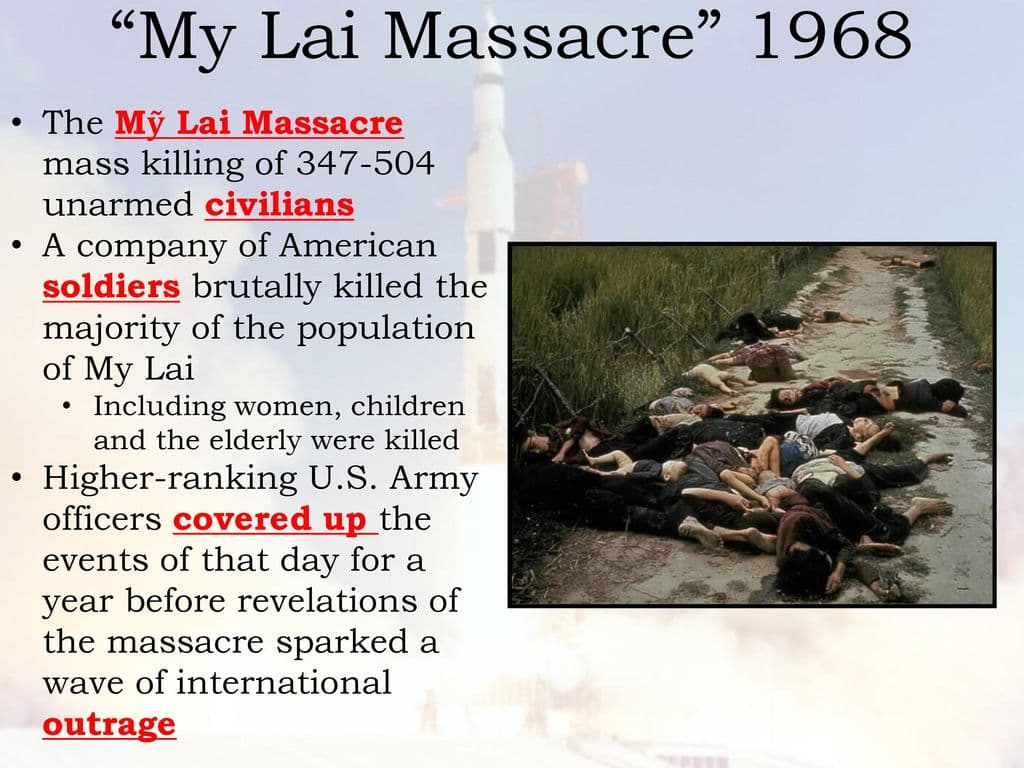
On March 16, 1968, soldiers of Charlie Company massacred between 347 and 504 unarmed Vietnamese civilians — almost all women, children, and elderly — in the village of My Lai. The Army's after-action report called it a success, claiming 128 'enemy' killed. The coverup lasted 20 months until soldier Ron Ridenhour wrote letters to Congress and Seymour Hersh's Pulitzer-winning investigation exposed the truth. The Peers Commission recommended charges against 28 officers for the coverup, but only Lt. William Calley was convicted — serving just 3.5 years of house arrest.
“Something rather dark and bloody did indeed occur sometime in March 1968 in a village called Pinkville in the Republic of Viet Nam.”
What they said vs. what the evidence shows
“128 Viet Cong killed in action. Light engagement with enemy forces in Son My village.”
— US Army Task Force Barker · Mar 1968
SourceFrom “crazy” to confirmed
The Claim Is Made
This is the moment they called it crazy.
Confirmed: They Were Right
The truth comes out. Officially documented.
Confirmed: They Were Right
The truth comes out. Officially documented.
On March 16, 1968, a United States Army company entered a small Vietnamese village and systematically killed between 347 and 504 unarmed civilians. Most were women, children, and elderly people who posed no military threat. By the time the truth emerged, the Army had already rewritten history—and nearly gotten away with it.
Charlie Company's commanders initially reported the operation as a battlefield success. The official after-action report listed 128 "enemy" killed in action at My Lai, a figure that would be entered into military records as routine. No one questioned the numbers because no one outside the chain of command knew what had actually happened inside that village.
For twenty months, the massacre remained hidden. Soldiers who witnessed it were scattered to different units. Officers filed their paperwork and moved forward. The Army's internal systems, designed to document combat operations, became instruments of concealment instead.
The exposure came through an unlikely channel. Ron Ridenhour, a former Army helicopter gunner, couldn't remain silent. In 1969, he began writing letters to Congress, describing what fellow soldiers had told him about the killings. He named names and provided dates. Congress forwarded his complaints to the Army, which launched an investigation. The machinery of accountability, once engaged, began moving slowly forward.
Seymour Hersh, an investigative journalist, obtained Ridenhour's letters and pursued the story aggressively. Through interviews with soldiers and documents, Hersh reconstructed what happened at My Lai. His reporting won the Pulitzer Prize and transformed what might have remained a bureaucratic footnote into a national reckoning. Hersh's work proved that the killings had been deliberate, systematic, and covered up by officers who knew the true body count.
The Peers Commission, established to investigate the coverup, recommended criminal charges against 28 officers for their role in concealing the truth. This detail matters: the Army acknowledged that numerous commanders had actively participated in hiding what happened, not merely failed to discover it.
Yet accountability remained incomplete. Only Lieutenant William Calley, who directly commanded the soldiers in the village, was convicted. He received a life sentence, which President Richard Nixon reduced to ten years, and Calley ultimately served just three and a half years under house arrest. The twenty-eight officers recommended for prosecution were never charged. The system protected itself through selective prosecution.
My Lai reveals how institutional secrecy operates. A massacre didn't become real because the Army acknowledged it—it became real only when evidence emerged that the Army could not suppress. The initial claim wasn't a fringe theory whispered by doubters. It was documented in after-action reports, recorded in the observations of dozens of soldiers, and verifiable through basic arithmetic. The Army's own records contradicted themselves once someone looked closely enough.
This case demonstrates why the burden falls on independent actors—soldiers willing to write letters, journalists willing to investigate, and citizens willing to listen. When institutions control information about their own conduct, truth-telling becomes an act of courage rather than routine reporting. Ridenhour and Hersh's work didn't uncover a conspiracy in the popular sense. They simply refused to accept the official story when evidence suggested otherwise.
Nearly sixty years later, My Lai remains a lesson in how easily official narratives can collapse under scrutiny, and how easily they might never collapse at all.
Get the 5 biggest receipts every week, straight to your inbox — plus an exclusive PDF: The Top 10 Conspiracy Theories Proven True in 2025-2026. No spam. No agenda. Just the papers they couldn't hide.
You just read "The US Army massacred up to 504 unarmed civilians at My Lai …". We send ones like this every week.
No one's said anything yet. Be the first to drop your take.