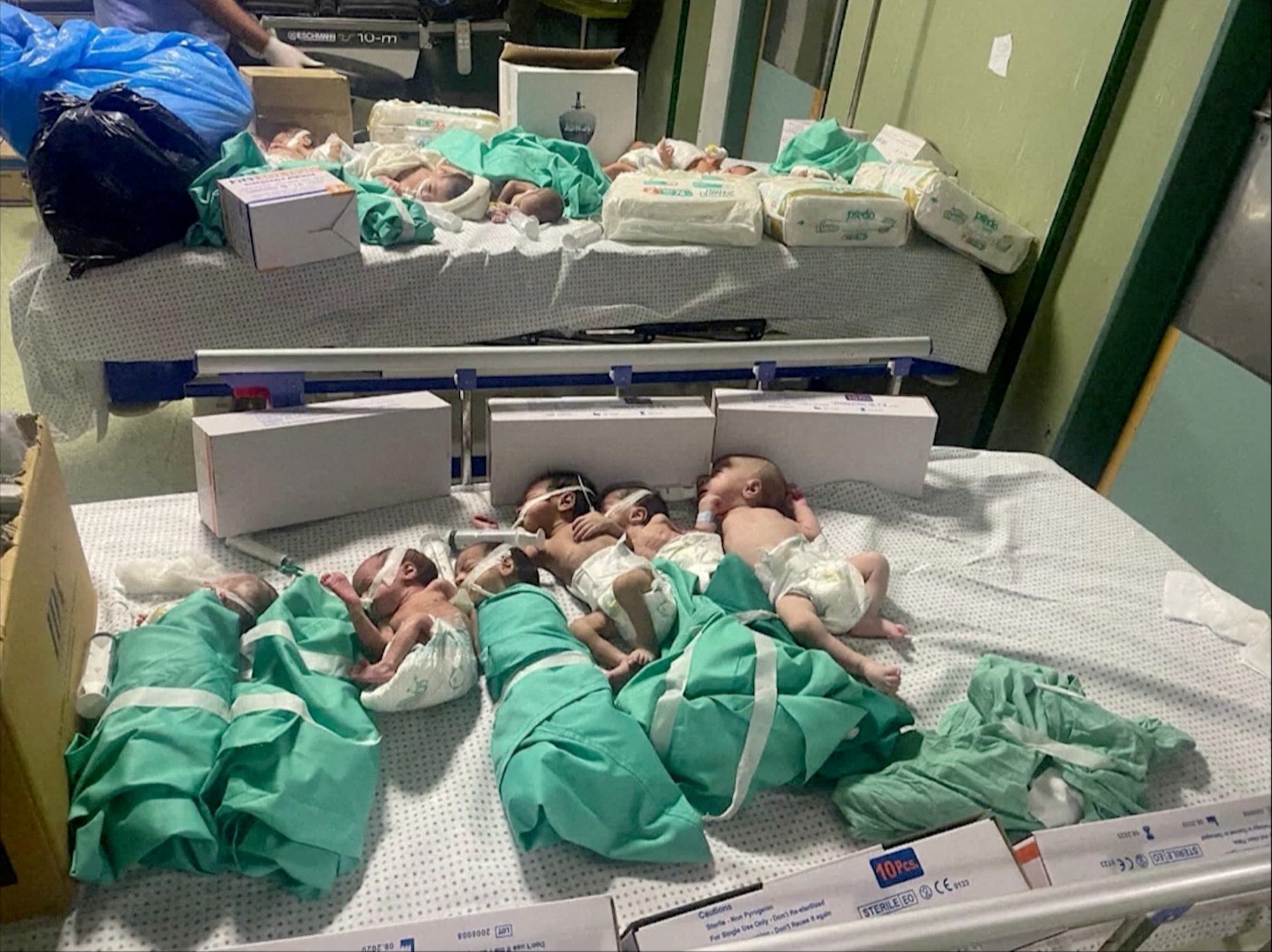
On October 10, 1990, a 15-year-old girl called 'Nayirah' testified to Congress that she witnessed Iraqi soldiers removing 312 babies from incubators in Kuwait. President Bush cited the story six times in speeches; seven senators cited it when voting for war. In 1992, it was revealed 'Nayirah' was actually the daughter of Kuwait's ambassador to the US. Her testimony was coached by PR firm Hill & Knowlton, hired by Kuwait's government-in-exile for $10.7 million. The story was completely fabricated.
“I volunteered at the al-Addan hospital. While I was there, I saw the Iraqi soldiers come into the hospital with guns. They took the babies out of the incubators, took the incubators, and left the babies on the cold floor to die.”
What they said vs. what the evidence shows
“Based on the testimony of hospital staff and patients, Iraqi forces removed infants from incubators in Kuwaiti hospitals, causing their deaths.”
— Amnesty International (initially corroborated the story) · Dec 1990
SourceFrom “crazy” to confirmed
The Claim Is Made
This is the moment they called it crazy.
On October 10, 1990, a teenage girl identified only as "Nayirah" sat before Congress and described a scene of horror. She claimed to have witnessed Iraqi soldiers in Kuwait systematically removing 312 newborn babies from hospital incubators and leaving them to die on cold floors. Her voice trembled as she recounted the atrocity. By the time she finished, her testimony had fundamentally shifted the American political conversation about military intervention in the Persian Gulf.
President George H.W. Bush seized on the story immediately. Over the following months, he cited Nayirah's account six times in public speeches to justify military action. The emotional weight of dead infants proved powerful—far more persuasive than abstract arguments about oil reserves or regional power dynamics. When Congress voted on authorizing the Gulf War in January 1991, at least seven senators explicitly referenced Nayirah's testimony as a factor in their decision to support combat operations.
The mainstream media initially treated the story as established fact. News outlets repeated the incubator claim without skepticism, amplifying its reach and lending it institutional credibility. Few journalists thought to question how a young Kuwaiti girl had gained access to Congressional testimony, or why her identity was being protected. The narrative fit neatly into the emerging portrait of Saddam Hussein as a regional villain willing to commit any atrocity.
Then, in 1992, the machinery behind the story began to unravel. Investigative reporters discovered that "Nayirah" was not a random refugee or hospital worker. She was the daughter of Saud al-Sabah, Kuwait's ambassador to the United States. More significantly, her testimony had not emerged spontaneously from her own experience. It had been carefully constructed and coached by Hill & Knowlton, one of the world's largest public relations firms. Kuwait's government-in-exile had paid the firm $10.7 million to manage its American public relations campaign—a contract that specifically included generating emotional narratives to sway political opinion.
Get the 5 biggest receipts every week, straight to your inbox — plus an exclusive PDF: The Top 10 Conspiracy Theories Proven True in 2025-2026. No spam. No agenda. Just the papers they couldn't hide.
You just read "The 'babies thrown from incubators' testimony that sold the …". We send ones like this every week.
No one's said anything yet. Be the first to drop your take.
Confirmed: They Were Right
The truth comes out. Officially documented.
Confirmed: They Were Right
The truth comes out. Officially documented.
Journalists and researchers subsequently discovered that Nayirah's incubator story had no credible evidence. Human rights organizations that investigated conditions in Kuwait found no documentation of the mass killing she described. The babies, the incubators, the systematic removal—all of it appears to have been fabricated by PR consultants designing maximum emotional impact.
What makes this case historically significant is not merely that one girl lied to Congress. Rather, it reveals how modern warfare increasingly depends on narrative management. A private corporation was essentially hired to manufacture consent for military action. The story worked because it operated at the intersection of visual horror, innocent victims, and clear moral authority. It bypassed rational analysis and went straight to American emotions about children.
The implications extend far beyond the 1991 Gulf War. This episode demonstrates that major foreign policy decisions affecting thousands of lives can rest on fabricated testimony, amplified by credulous media coverage, and packaged by professional propagandists. It raises uncomfortable questions about who shapes public understanding of distant conflicts and what mechanisms exist to verify extraordinary claims before they influence national decisions. Decades later, the Nayirah case remains a cautionary lesson in how easily institutional systems—Congress, media, government—can be manipulated when scrutiny is absent and emotional stakes run high.
Beat the odds
This had a 0.1% chance of leaking — someone talked anyway.
Conspirators
~100Network
Secret kept
1.3 years
Time to 95% exposure
500+ years