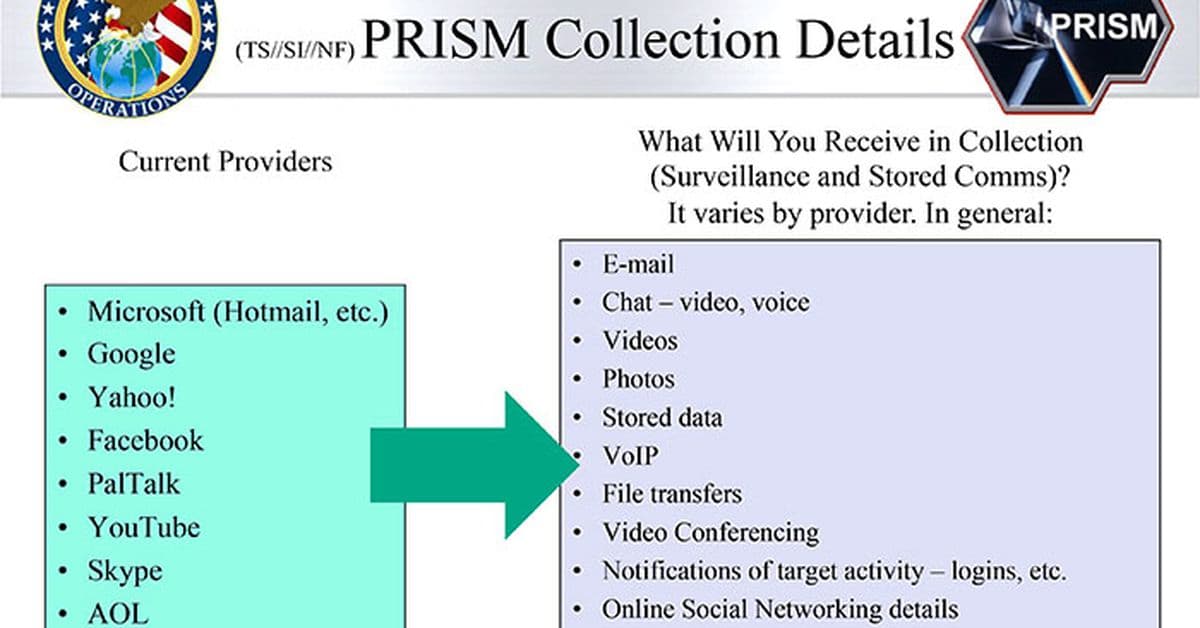
Edward Snowden revealed that the PRISM program gave the NSA direct access to the servers of nine major tech companies. PRISM was 'the number one source of raw intelligence used for NSA analytic reports,' accounting for 91% of internet traffic acquired under FISA Section 702. The Boundless Informant tool showed over 97 billion pieces of intelligence collected in a single 30-day period.
“They quite literally can watch your ideas form as you type.”
From “crazy” to confirmed
The Claim Is Made
This is the moment they called it crazy.
When Edward Snowden walked into a Hong Kong hotel room in 2013 with thousands of classified documents, he carried evidence of a surveillance operation so expansive that most Americans wouldn't believe it was real. The NSA, he revealed, had direct access to the servers of Google, Apple, Facebook, Microsoft, Yahoo, and five other major technology companies through a classified program called PRISM. This wasn't theoretical surveillance—it was an industrial-scale operation accounting for 91 percent of all internet intelligence the agency collected under legal authority.
The initial reaction from government officials was immediate dismissal. Intelligence leaders denied the allegations, suggesting that Snowden had misrepresented the program's scope and that the tech companies were not willing partners. Officials argued that PRISM was a carefully controlled operation, limited in scope and subject to judicial oversight. The narrative pushed by the government and echoed by supporters was that Snowden, despite his access, had not fully understood what he was revealing.
But the documents told a different story. The leaked materials showed that PRISM wasn't a minor surveillance tool—it was the NSA's primary source of raw intelligence for its analytical reports. An internal NSA tool called Boundless Informant tracked the agency's collection activities, showing that over 97 billion pieces of intelligence had been collected in a single 30-day period. These weren't abstract data points; they represented email communications, video chats, photographs, and files from millions of ordinary people, many of them American citizens.
What made Snowden's revelations verifiable was the specificity of the evidence. The documents included slides from NSA presentations, internal memoranda, and technical details that could not have been fabricated. Tech companies eventually acknowledged that they had received government requests for user data, though they maintained they did not provide "direct access" to their servers in the way Snowden described. However, the distinction proved semantic—the end result was the same: was systematically collecting vast quantities of private communications from Americans through technological back doors built into servers belonging to companies that billions of people trusted with their personal information.
Get the 5 biggest receipts every week, straight to your inbox — plus an exclusive PDF: The Top 10 Conspiracy Theories Proven True in 2025-2026. No spam. No agenda. Just the papers they couldn't hide.
You just read "The NSA had direct access to servers of Google, Apple, Faceb…". We send ones like this every week.
No one's said anything yet. Be the first to drop your take.
Confirmed: They Were Right
The truth comes out. Officially documented.
Confirmed: They Were Right
The truth comes out. Officially documented.
The PRISM program operated under Section 702 of the Foreign Intelligence Surveillance Act, a legal framework that allowed the NSA to target foreign intelligence subjects. The problem, as subsequent investigations revealed, was that the program inevitably swept up American communications in its net. The "minimization procedures" meant to protect American privacy were applied after the fact, making them largely ineffective as a safeguard.
This claim matters not because it represents a conspiracy in the traditional sense, but because it exposed a fundamental gap between public understanding and institutional reality. For years, tech companies had built their business models on claims of privacy and security. Millions of people relied on these platforms for sensitive communications. The revelation that intelligence agencies had direct access to their data suggested a level of surveillance that most democratic societies would have considered untenable if fully disclosed beforehand.
The verification of Snowden's claims forced a reckoning with questions that remain unresolved: How much surveillance is acceptable in a democracy? Can private companies be trusted to protect user data when government agencies demand access? And perhaps most importantly, how can citizens maintain trust in institutions when the gap between official statements and documented reality is this wide?
Beat the odds
This had a 0% chance of leaking — someone talked anyway.
Conspirators
~200Network
Secret kept
0.5 years
Time to 95% exposure
500+ years