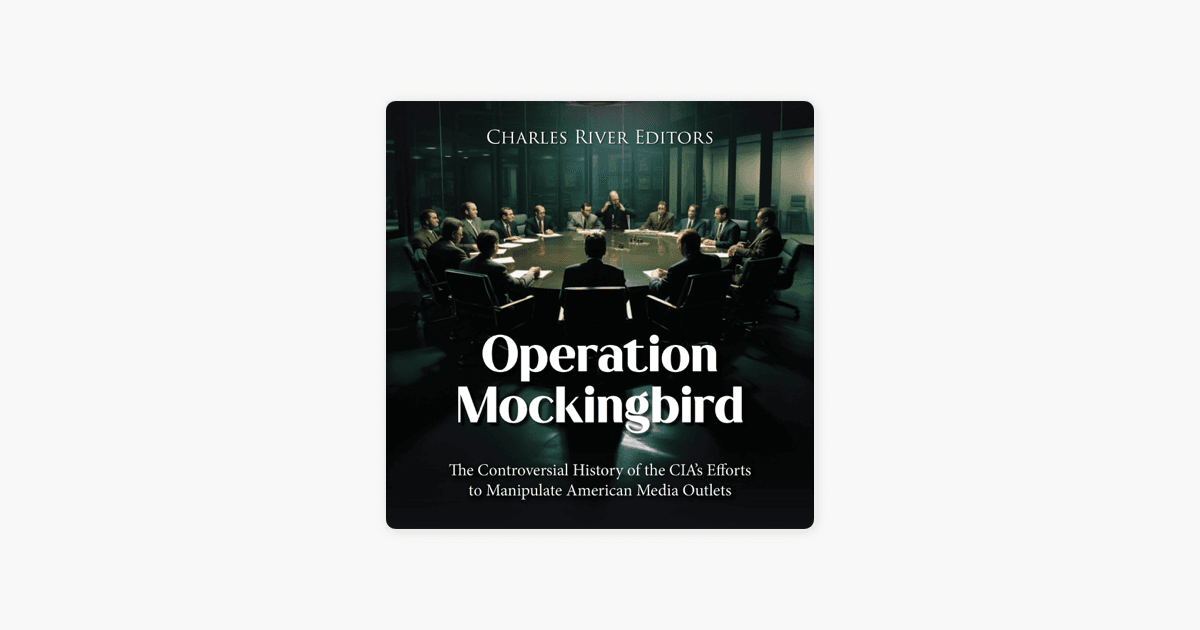
Church Committee investigations revealed the CIA recruited hundreds of journalists from major outlets like CBS, Time, and Newsweek to plant stories and shape public opinion during the Cold War.
“The CIA does not engage in domestic propaganda operations or recruit American journalists”
From “crazy” to confirmed
The Claim Is Made
This is the moment they called it crazy.
During the Cold War, the U.S. government faced a problem that money and military hardware couldn't solve: controlling what Americans believed. The solution wasn't new legislation or overt censorship. Instead, the Central Intelligence Agency quietly recruited journalists—lots of them—to plant stories in major American newspapers and magazines without the public's knowledge.
This program had a name: Operation Mockingbird.
The initial claims about CIA-journalist collaboration were dismissed for decades as conspiracy theory fodder. When journalists and researchers first alleged that the Agency was secretly coordinating with news organizations, officials flatly denied it. The CIA's standard response was dismissive: these were unfounded accusations from critics who didn't understand how journalism or intelligence work actually functioned. Major news outlets, some of which would later be revealed as complicit, helped amplify this dismissal.
The story changed dramatically in the mid-1970s when the Church Committee—a congressional investigation into CIA abuses—published its findings. What emerged from declassified documents was difficult to deny: the CIA had indeed recruited hundreds of journalists from major outlets including CBS, Time magazine, Newsweek, and the Associated Press. These weren't freelancers or basement bloggers. They worked at the most trusted news organizations in America.
Get the 5 biggest receipts every week, straight to your inbox — plus an exclusive PDF: The Top 10 Conspiracy Theories Proven True in 2025-2026. No spam. No agenda. Just the papers they couldn't hide.
You just read "Operation Mockingbird: CIA secretly recruited journalists to…". We send ones like this every week.
No one's said anything yet. Be the first to drop your take.
The documented scope was substantial. CIA operatives maintained relationships with these journalists, providing them with stories, angles, and sometimes outright false information designed to shape American public opinion. In some cases, the Agency didn't just influence coverage—it created it entirely. The goal was straightforward: advance CIA interests and Cold War messaging while maintaining the appearance of independent journalism.
What made Operation Mockingbird particularly insidious was its subtlety. Unlike propaganda from obviously state-controlled media in the Soviet Union, American readers believed they were consuming independent news. The trust readers placed in these institutions became a tool of the intelligence apparatus. When a story appeared in the New York Times or Time magazine, it carried automatic credibility. That credibility was weaponized.
The Church Committee's revelations included specific examples of how the program operated. The CIA would identify journalists sympathetic to Agency perspectives, cultivate relationships with them, and either provide story ideas or plant false information they wanted spread. Sometimes editors were aware and complicit. Other times, individual reporters were unknowingly used. The system was designed to be deniable at every level.
What's particularly striking is how long this arrangement persisted before exposure. Operation Mockingbird wasn't a brief aberration or a handful of isolated incidents. It was an extensive, systematic program that operated across decades and multiple administrations.
The implications extend far beyond Cold War history. The Church Committee investigation proved that major American news organizations had allowed their editorial independence to be compromised by a government agency. It demonstrated that the institutions meant to serve as checks on power had themselves been infiltrated and controlled. Readers had trusted these outlets precisely because they believed them to be independent monitors of government activity.
Today, Operation Mockingbird serves as a historical reminder that institutional credibility can be compromised in ways that aren't immediately visible to the public. It raises uncomfortable questions about whether such arrangements have truly ceased or simply become more sophisticated. For anyone trying to understand media trust and institutional integrity, this verified conspiracy reveals something essential: sometimes skepticism toward official narratives isn't paranoia—it's justified caution.
Beat the odds
This had a 2% chance of leaking — someone talked anyway.
Conspirators
~100Network
Secret kept
50.7 years
Time to 95% exposure
500+ years