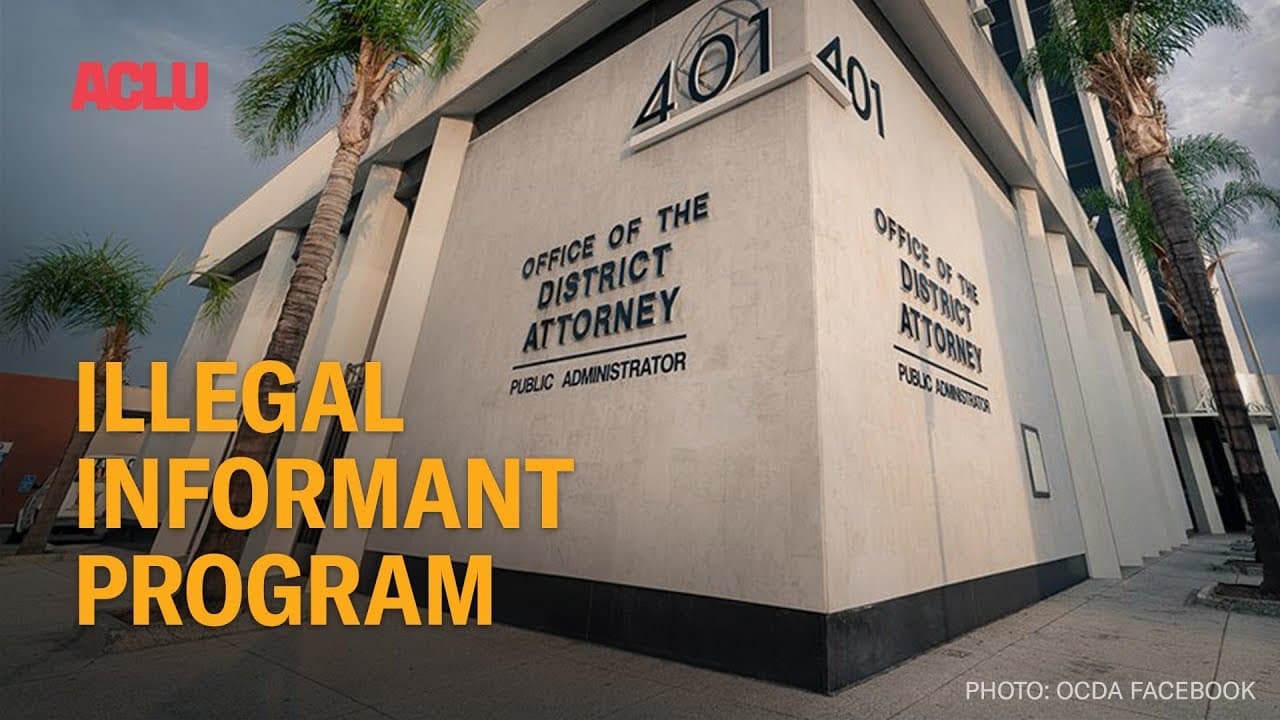
California prosecutors used a secret network of jailhouse informants to obtain confessions from represented defendants. The program operated for decades while officials denied its existence.
“We do not operate any systematic informant programs that violate defendants' rights to counsel”
From “crazy” to confirmed
The Claim Is Made
This is the moment they called it crazy.
For decades, Orange County prosecutors ran what amounted to a secret police operation inside the county jail. Undercover officers and paid informants were placed in cells with defendants who had already hired lawyers, extracting confessions that would later be used against them in court. The program was so deliberately concealed that prosecutors actively denied its existence when questioned.
What made this operation particularly corrosive to the justice system was its deliberate circumvention of constitutional protections. Once a defendant has legal representation, law enforcement is barred from interrogating them without their attorney present—a principle established in cases dating back to the 1960s. Yet Orange County found a workaround: if the confession came from an informant rather than a badge-carrying detective, perhaps the rules didn't apply. This wasn't a grey area of the law. It was a direct violation wrapped in bureaucratic silence.
The claim was straightforward enough: prosecutors and sheriff's officials had orchestrated an illegal informant program to undermine the right to counsel. When defense attorneys and civil rights organizations raised alarms about this practice, the official response was dismissive. Prosecutors denied the program existed in any organized fashion. They characterized it as routine jailhouse interactions, nothing more. Administrators claimed there were no special protocols, no training, no coordination—just inmates talking to inmates.
These denials persisted even as defense attorneys documented pattern after pattern of confessions obtained in jail cells, confessions that suspects claimed they never made, confessions that appeared in cases where informants had obvious incentives to fabricate (reduced sentences, money, protective custody). The system was working exactly as it was designed to work: quietly, deniably, effectively.
The evidence that finally broke through came from multiple directions. Internal Orange County Sheriff's Office documents revealed the existence of a formal confidential informant program with training protocols and performance metrics. Court records showed a pattern of confessions clustered around specific informants and specific time periods—a statistical signature of systematic misconduct rather than random conversation. Civil rights organizations compiled cases spanning two decades where the same informants appeared in multiple prosecutions, many of which ended in convictions later overturned.
What transformed this from allegation to verified fact was the sheer volume and consistency of documentation. Hundreds of cases were implicated. Multiple innocent people had been convicted based on these tainted confessions. When journalists and investigators finally pieced together the full timeline, the story became irrefutable: Orange County had operated an illegal interrogation program in plain sight, hidden not by technical sophistication but by the institutional authority to simply deny it was happening.
The significance extends beyond Orange County. This scandal reveals how easily constitutional protections can be eroded when there's institutional tolerance for rule-breaking. It shows why accountability matters—not as an abstract principle, but as the only mechanism that prevents government agencies from deciding which rules apply to them. The Orange County case demonstrates that citizens cannot rely solely on official denials or assurances. They require independent verification, transparency, and—crucially—the willingness to follow evidence wherever it leads, even when it implicates powerful institutions. When those conditions break down, people go to prison for crimes they didn't commit. That's not a conspiracy theory. That's what the records show.
Get the 5 biggest receipts every week, straight to your inbox — plus an exclusive PDF: The Top 10 Conspiracy Theories Proven True in 2025-2026. No spam. No agenda. Just the papers they couldn't hide.
You just read "Orange County Jailhouse Informant Program Violated Defendant…". We send ones like this every week.
No one's said anything yet. Be the first to drop your take.