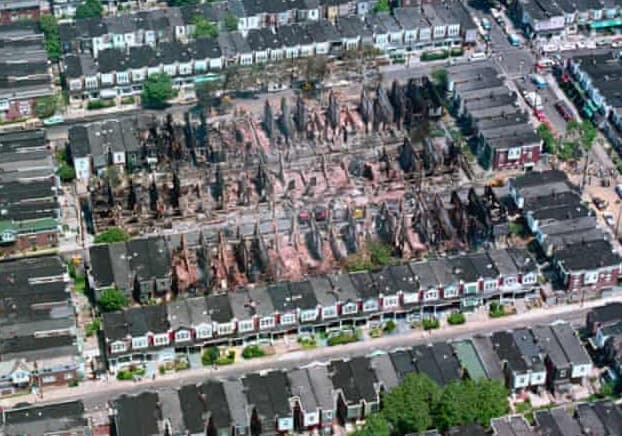
Philadelphia police dropped a bomb on MOVE headquarters in 1985, killing 11 people and destroying 61 homes. Officials covered up the extent of the planning and excessive force used.
“The use of the incendiary device was necessary and proportionate to the threat posed”
From “crazy” to confirmed
The Claim Is Made
This is the moment they called it crazy.
On May 13, 1985, Philadelphia police dropped a bomb on a rowhouse in the city's Osage Avenue neighborhood. The target was MOVE, a radical activist group that had barricaded itself inside. When the smoke cleared, eleven people lay dead—including five children. Sixty-one homes in the surrounding area had burned to the ground. For decades, what happened that day remained partially obscured by official narratives that minimized police planning and responsibility.
The MOVE organization had clashed with Philadelphia authorities for years. The group, which advocated for a back-to-nature lifestyle and animal rights, had staged a standoff with police in 1978 that left one officer dead. By 1985, tensions had escalated again, and city officials decided to forcibly remove the group from their headquarters. The decision to use explosives—a first in American police history against civilians—set in motion an event that would test the city's credibility for generations.
In the immediate aftermath, Philadelphia's police and city leadership offered explanations that emphasized restraint and necessity. They claimed the bomb was a last resort, that it was smaller than it actually was, and that the resulting fire was accidental. These accounts were presented to the public and media as the authoritative version of events. Many Americans had little reason to question the official story.
But investigative reporting and subsequent inquiries revealed a starkly different picture. Police had meticulously planned the bombing with knowledge that it would destroy the building. They had deliberately placed the bomb in a position that maximized explosive force. Most damning: officers positioned around the house had fired hundreds of rounds at residents attempting to escape the flames, preventing evacuation and ensuring deaths. The fire that officials claimed was unintended was in fact predictable—perhaps inevitable—given the method and location of detonation.
City investigations that followed acknowledged varying degrees of this reality, though the initial cover-up had already shaped public memory. The cover-up itself became part of the documented failure. Authorities had not immediately disclosed the full extent of police gunfire, the detailed planning involved, or the deliberate nature of the structure's destruction. Each of these facts emerged only through persistent questioning, not through official transparency.
The MOVE bombing matters today for a simple but critical reason: it demonstrates how institutional power can shape what the public believes about its own government's actions. When authorities control initial narratives about violent incidents, when they characterize excessive force as justified response, and when they omit inconvenient details, the public loses its ability to hold power accountable in real time.
The verified nature of this cover-up doesn't vindicate MOVE's ideology or suggest police shouldn't confront dangerous situations. It demonstrates something more fundamental: that official accounts of police violence cannot be assumed truthful simply because they come from authorities. Documentation, investigation, and skepticism are not cynicism—they are the tools citizens need when verifying what their government actually did.
The Philadelphia bombing exposed a gap between what authorities said happened and what actually happened. Closing that gap required years of work and the refusal of some to accept the initial official story. That pattern repeats itself in incident after incident, which is why institutions that resist accountability ultimately damage their own credibility far more than those that practice transparency from the start.
Get the 5 biggest receipts every week, straight to your inbox — plus an exclusive PDF: The Top 10 Conspiracy Theories Proven True in 2025-2026. No spam. No agenda. Just the papers they couldn't hide.
You just read "Philadelphia Police MOVE Bombing Covered Up Excessive Force …". We send ones like this every week.
No one's said anything yet. Be the first to drop your take.