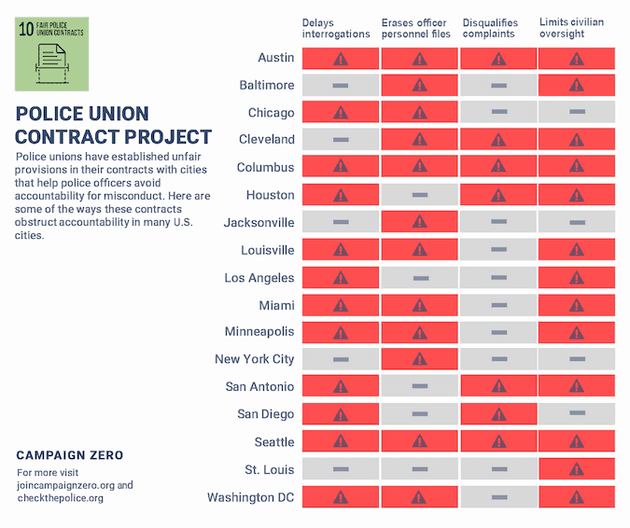
A study of 178 police union contracts found that 88% contained provisions that shield officers from accountability. These include: mandatory destruction of disciplinary records (often after 6-18 months), restrictions on civilian oversight, requirements that officers receive advance notice of misconduct investigations (allowing coordination of stories), and 'cooling off' periods before officers can be questioned after shootings. In some departments, officers fired for misconduct are reinstated up to 70% of the time through union arbitration.
“Police unions have negotiated contracts that make it almost impossible to fire bad cops. Records are destroyed, investigations are delayed, and fired officers get their jobs back.”
From “crazy” to confirmed
The Claim Is Made
This is the moment they called it crazy.
When a police officer is accused of misconduct, there's often an assumption that an investigation will be thorough, records will be preserved, and accountability will follow. That assumption collapses against the reality documented in police union contracts across America.
A comprehensive study of 178 police union contracts revealed that 88% contain provisions specifically designed to shield officers from accountability. These aren't vague protections buried in dense legal language. They're explicit, systematic barriers to transparency and discipline built directly into the agreements that govern how officers can be investigated, questioned, and punished.
The findings emerged from research conducted by Campaign Zero, a police accountability organization, and were corroborated by reporting from Reuters. What they uncovered wasn't speculative or theoretical. It was contractual language, negotiated and signed by police departments and union representatives, that fundamentally obstructs the disciplinary process.
The mechanisms are straightforward and effective. Many contracts mandate the automatic destruction of disciplinary records within 6 to 18 months. This means that patterns of misconduct—repeated complaints, excessive force incidents, dishonesty—literally disappear from official records. An officer with a history of problems can be treated as if they have none.
Other contracts require that officers receive advance notice before misconduct investigations begin. This isn't about due process fairness in the traditional sense. It's about coordination. It allows officers and their representatives to align their accounts, prepare defenses, and potentially influence witness testimony before official questioning occurs. Some departments even include 'cooling off' periods—mandatory delays of 24 hours or more before an officer can be questioned about a shooting or use of force incident. The stated rationale is to allow officers to calm down. The practical effect is to allow memories to adjust.
Get the 5 biggest receipts every week, straight to your inbox — plus an exclusive PDF: The Top 10 Conspiracy Theories Proven True in 2025-2026. No spam. No agenda. Just the papers they couldn't hide.
You just read "88% of police union contracts contain provisions that shield…". We send ones like this every week.
No one's said anything yet. Be the first to drop your take.
Confirmed: They Were Right
The truth comes out. Officially documented.
Confirmed: They Were Right
The truth comes out. Officially documented.
Civilian oversight is routinely restricted. Many contracts require that investigations be conducted by law enforcement rather than independent agencies. Others limit what civilians can access regarding investigation findings. Restrictions on public records mean that citizens often never learn what actually happened or why an officer was or wasn't disciplined.
When departments do move to fire officers for serious misconduct, union arbitration frequently overturns those decisions. Research shows that in some departments, officers fired for misconduct are reinstated approximately 70% of the time through arbitration. An officer can be deemed unfit for duty by their own department, only to have an arbitrator return them to work.
For years, union representatives defended these contract provisions as necessary protections for officers. They characterized challenges to these clauses as anti-police. Police departments sometimes claimed that such provisions were standard labor practice and not unique to law enforcement.
But the evidence is clear: these contractual shields don't exist in the same form across other professions. Schoolteachers, nurses, and firefighters operate under accountability systems that don't routinely erase disciplinary records or require advance notice of investigations. The provisions are extensive, deliberate, and effective at obstructing accountability.
What matters here isn't the theoretical debate about police unions. What matters is that documented contracts create systematic obstacles to holding officers accountable when they abuse authority. These aren't accusations. They're contractual requirements, publicly negotiated and legally binding. They represent an explicit choice, made repeatedly by departments and unions, to prioritize officer protection over public trust. That's a choice with consequences for every community these provisions serve.
Beat the odds
This had a 0.1% chance of leaking — someone talked anyway.
Conspirators
~50Network
Secret kept
2.9 years
Time to 95% exposure
500+ years