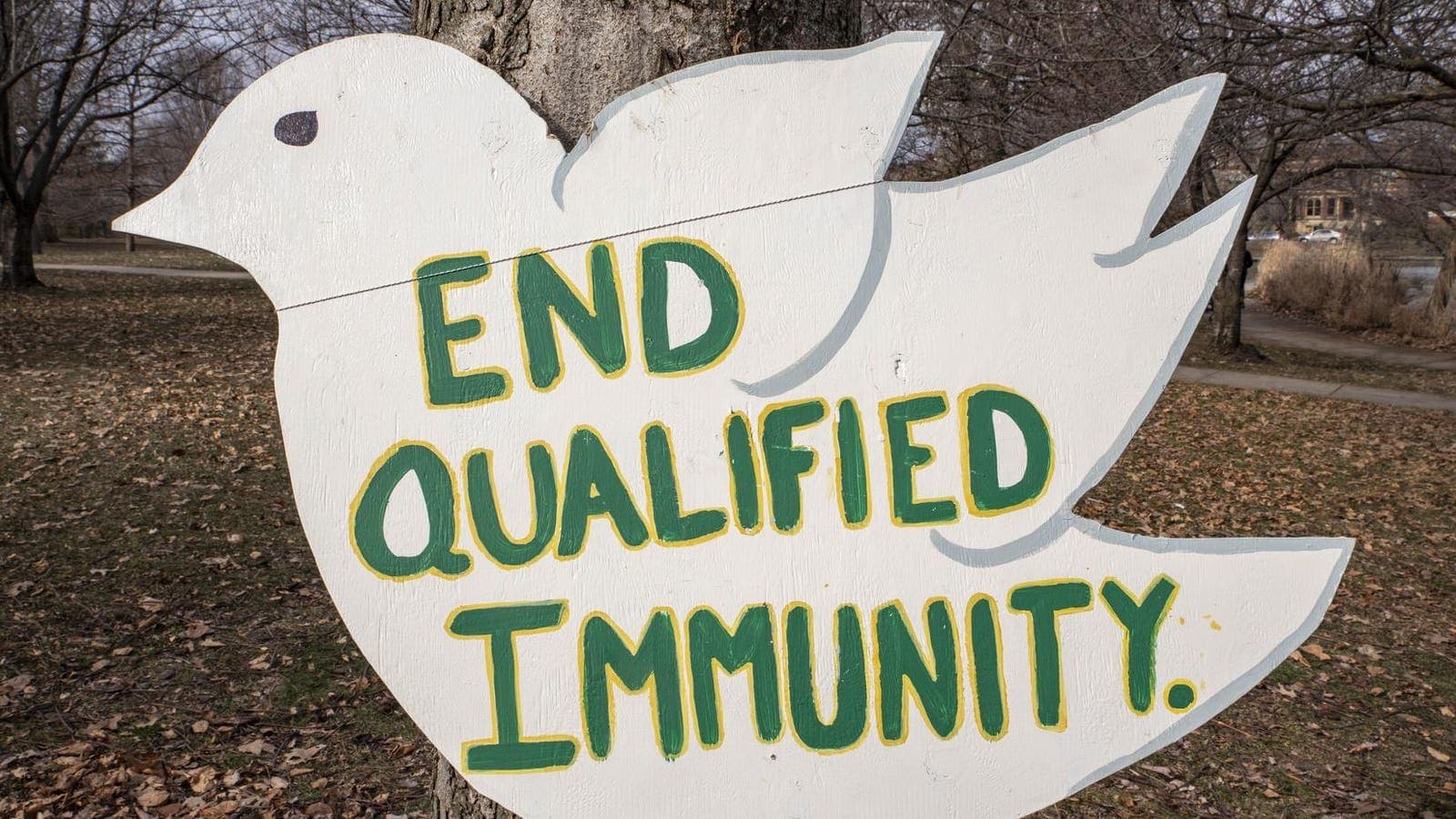
Qualified immunity, a judicially created doctrine with no basis in the text of Section 1983, shields government officials from civil lawsuits unless the plaintiff can show a 'clearly established' right was violated — meaning an almost identical prior case. A Reuters investigation found courts granted immunity in 54% of cases. Officers have been shielded after stealing $225,000, siccing a dog on a surrendering suspect, and shooting a child. The average excessive force lawsuit takes over 3 years, and victims face enormous legal costs even when they win.
“You can only sue a cop if another cop did the exact same unconstitutional thing before, and a court already said that specific thing was wrong. It's a Catch-22.”
From “crazy” to confirmed
The Claim Is Made
This is the moment they called it crazy.
A police officer steals a quarter-million dollars from a home he's supposed to be protecting. Another sicks a dog on a man who is already on the ground with his hands raised. A third shoots a child. In each case, a court was asked a simple question: Can the victim or their family sue? The answer, surprisingly often, was no. Not because the officers were found to have acted lawfully, but because of a legal doctrine so obscure that most Americans have never heard of it—yet it determines whether they can seek justice.
Qualified immunity has shielded government officials from civil lawsuits since the Supreme Court created it in 1982. The doctrine requires plaintiffs to prove not just that their rights were violated, but that the exact same violation had already been ruled unlawful in a prior case—a standard so restrictive that it functions as near-total protection for police conduct. When courts apply this test, they don't ask whether an officer's actions were clearly wrong. They ask whether a nearly identical abuse had previously been litigated and lost by another officer, in another case, in the same jurisdiction.
For decades, this standard existed mostly outside public awareness. Civil rights advocates criticized it, but their concerns seemed technical, buried in legal journals. Then Reuters investigated how often courts actually granted immunity in excessive force cases—and found something that transformed the debate from theoretical to concrete. In 54 percent of cases examined, judges granted immunity to officers accused of excessive force. That's more than half.
The Reuters report documented specific cases that illustrated what immunity meant in practice. An officer in New Mexico stole $225,000 from a house during a call; the court granted immunity because no prior case had established it was unconstitutional to steal that exact amount. A Tennessee officer released a dog on a surrendering suspect; immunity was granted because prior cases hadn't explicitly ruled against this specific scenario. A New Mexico officer shot a child; immunity followed because the circumstances didn't match previous rulings closely enough.
Get the 5 biggest receipts every week, straight to your inbox — plus an exclusive PDF: The Top 10 Conspiracy Theories Proven True in 2025-2026. No spam. No agenda. Just the papers they couldn't hide.
You just read "Courts grant qualified immunity to police in 54% of excessiv…". We send ones like this every week.
No one's said anything yet. Be the first to drop your take.
Law enforcement officials and some judges defended the doctrine as necessary protection for officers who must make split-second decisions. Without immunity, they argued, police would face endless lawsuits that would paralyze law enforcement. Yet the evidence suggested something different: victims were being paralyzed instead. The average excessive force lawsuit took over three years to resolve. Families had to hire lawyers, fund discovery, and spend years fighting even when they had clear evidence of wrongdoing. Many couldn't afford to pursue claims at all.
What made this partially verified rather than fully verified is important context. Qualified immunity itself is real—the Reuters figures are documented. But whether 54 percent is surprisingly high or expected requires judgment. Some legal scholars argue even one case of immunity for obvious wrongdoing is too many; others contend the percentage reflects appropriate caution about frivolous suits.
Yet the underlying claim endures: this judge-made doctrine, with no basis in the actual text of Section 1983 of the Civil Rights Act, has created a system where victims of documented abuse often cannot sue. Whether you believe officers need protection or victims need justice, the data shows something is broken. Courts are blocking lawsuits in more than half of excessive force cases not because officers were found to have acted lawfully, but because the law made it nearly impossible to hold them accountable.
Beat the odds
This had a 0.1% chance of leaking — someone talked anyway.
Conspirators
~50Network
Secret kept
5.9 years
Time to 95% exposure
500+ years