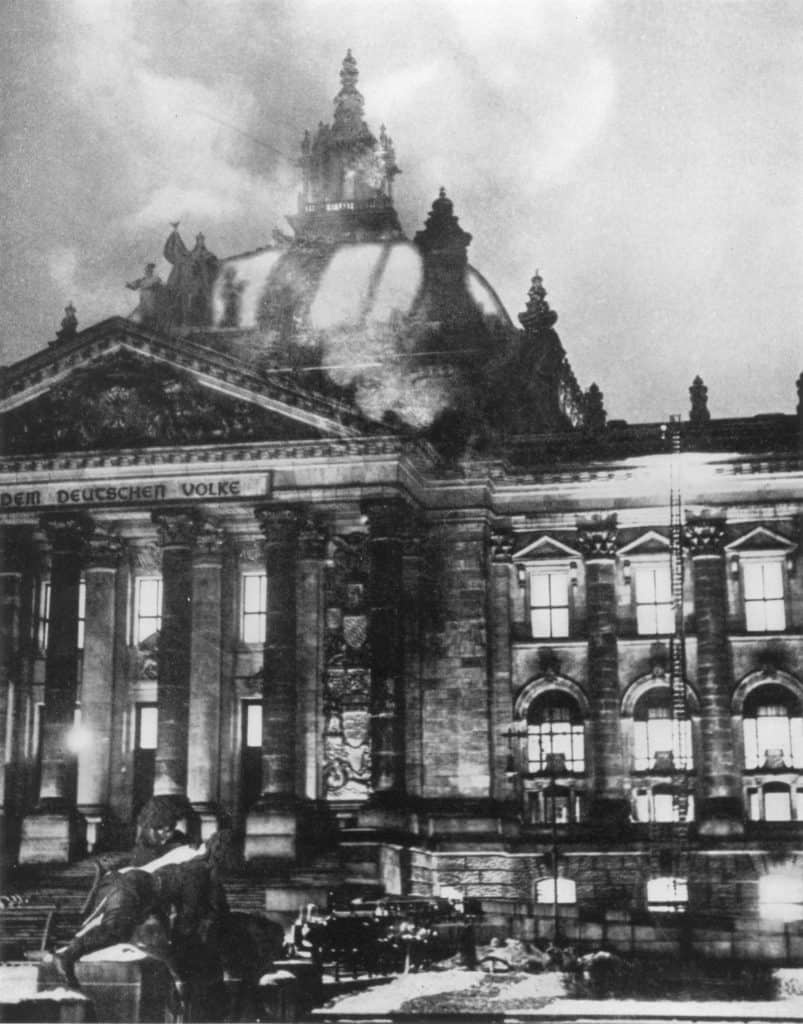
On February 27, 1933, the German parliament building was set ablaze. The Nazis blamed a Communist conspiracy and used it to push through the Reichstag Fire Decree the next day, suspending all civil liberties, enabling mass arrests of communists, and paving the way for the Enabling Act that gave Hitler dictatorial power. While Dutch communist Marinus van der Lubbe was convicted, historians continue to debate whether he acted alone or was a patsy. Evidence suggests van der Lubbe could not have started such a massive fire alone. The fire was the pivotal event enabling the Nazi seizure of total power.
“The Reichstag fire was orchestrated or exploited by the Nazi Party as a pretext to abolish civil liberties and establish dictatorial rule.”
What they said vs. what the evidence shows
From “crazy” to confirmed
The Claim Is Made
This is the moment they called it crazy.
Confirmed: They Were Right
The truth comes out. Officially documented.
Confirmed: They Were Right
The truth comes out. Officially documented.
On the night of February 27, 1933, flames consumed the Reichstag building in Berlin. Within hours, the Nazi Party had its explanation: communists had orchestrated an attack on Germany's parliament. Within a day, civil liberties were suspended. Within weeks, Hitler had become a dictator. The question historians still debate today is deceptively simple: did the Nazis tell the truth, or did they exploit—and possibly engineer—a catastrophe to seize absolute power?
The official story was straightforward. Dutch communist Marinus van der Lubbe was arrested at the scene, covered in accelerant and soot. The Nazis claimed he was part of a larger communist plot to overthrow the government. Van der Lubbe confessed, though under what circumstances remains unclear. He was convicted and executed in January 1934. Case closed, or so the narrative went.
But the physical evidence told a different story. Investigators found that the fire spread with unusual speed and intensity across multiple sections of the building simultaneously. Experts who examined the scene questioned whether a single individual, even with access to accelerants, could have ignited fires in distant parts of the complex and maintained control of such a massive, coordinated blaze. Van der Lubbe's clothes showed less burn damage than would be expected if he had personally started such an intense fire. The logistics simply didn't add up.
Historians have since examined police records and architectural evidence, finding what forensic analysis suggests: the fire required multiple starting points and likely multiple perpetrators. Some researchers have theorized that Nazi operatives, particularly those connected to Ernst Röhm's paramilitary SA, may have used van der Lubbe—a known communist sympathizer—as either a willing participant or an unwitting patsy. The Smithsonian's investigation into the historical record notes that contemporary accounts from eyewitnesses described suspicious activity and the presence of unfamiliar men in the building.
What cannot be disputed is what happened immediately after. The Reichstag Fire Decree, signed on February 28, suspended freedom of speech, press, and assembly. Thousands of communists and political opponents were arrested without trial. The decree essentially voided the constitutional protections of the Weimar Republic. Weeks later, the Enabling Act passed, giving Hitler the power to rule by decree without parliamentary approval. The fire had become the hinge upon which totalitarianism swung into place.
The Nazi regime's exploitation of the Reichstag fire—whether they started it or simply weaponized it—demonstrates a pattern that remains relevant today. A crisis, real or manufactured, creates an opportunity to suspend normal rules and consolidate power. The public, frightened and looking for answers, often accepts extraordinary measures presented as temporary necessities. The evidence suggests that in 1933, German citizens were told a simple, satisfying explanation for a complex event, one that justified eliminating the very institutions designed to check governmental power.
The lesson isn't just historical. It's about understanding how fear can be leveraged, how crises can be exploited, and how the public's trust in official narratives can be manipulated. The Reichstag fire remains disputed not because historians enjoy mystery, but because the truth matters. When governments control the narrative around catastrophic events, accountability becomes impossible. The fire that enabled the Third Reich teaches us to demand evidence, ask difficult questions, and resist accepting convenient explanations when the stakes are our freedom.
Get the 5 biggest receipts every week, straight to your inbox — plus an exclusive PDF: The Top 10 Conspiracy Theories Proven True in 2025-2026. No spam. No agenda. Just the papers they couldn't hide.
You just read "The Nazis exploited (and possibly orchestrated) the Reichsta…". We send ones like this every week.
No one's said anything yet. Be the first to drop your take.