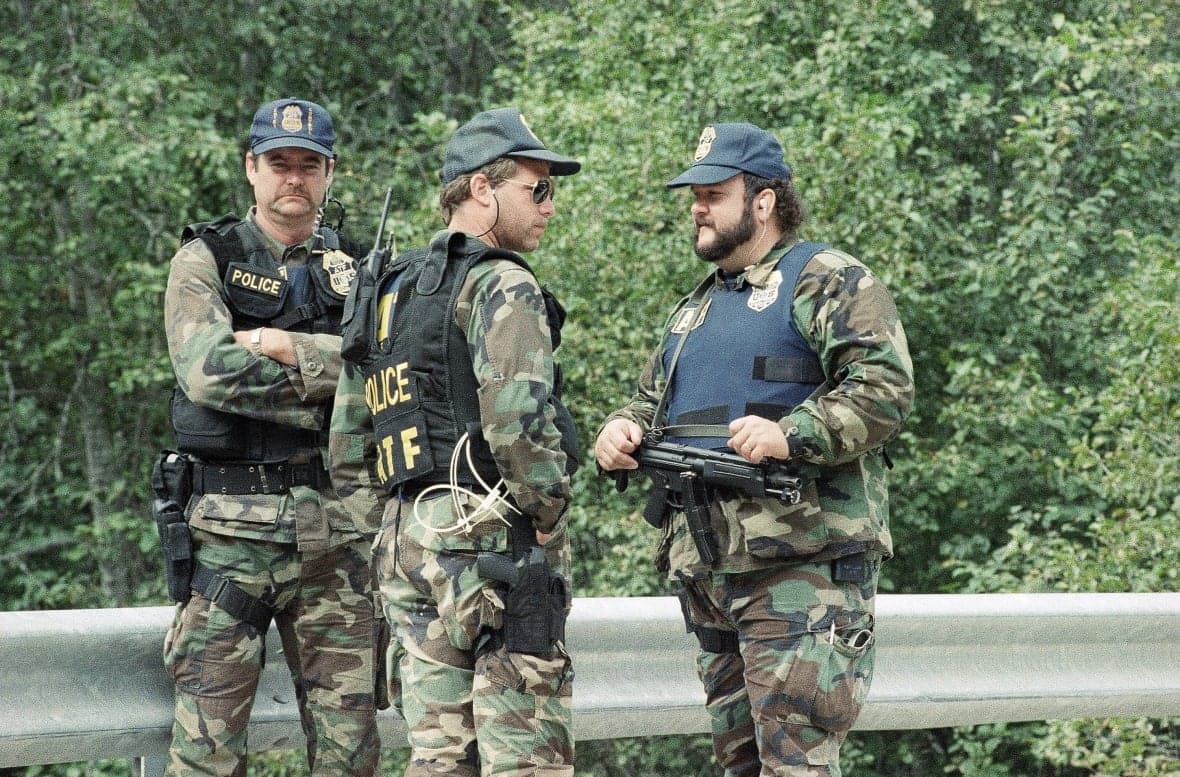
At Ruby Ridge in 1992, FBI official Richard Rogers changed the rules of engagement from 'can' to 'can and should' use deadly force against armed adults before even announcing FBI presence. Sniper Lon Horiuchi killed Vicki Weaver while she held her infant. No one admits to approving the unconstitutional rules. FBI Director Freeh promoted Larry Potts, who oversaw the operation, to Deputy Director.
“Deadly force can and should be employed against any armed adult male observed at the Ruby Ridge cabin.”
From “crazy” to confirmed
The Claim Is Made
This is the moment they called it crazy.
In August 1992, federal agents surrounded a remote cabin in northern Idaho where Randy Weaver, a white separatist, had failed to appear for a weapons trial. What unfolded over eleven days would become a defining example of government overreach—and a case where internal investigations confirmed that rules had been rewritten to make deadly force not just permissible, but encouraged.
The official narrative was straightforward: a dangerous fugitive resisted arrest, tragedy occurred, justice was served. Law enforcement presented the siege as a necessary response to an armed man who had already killed a U.S. Marshal. The details were presented as unfortunate but unavoidable consequences of serving a warrant on a compound occupied by an armed individual.
But internal documents tell a different story. Richard Rogers, the FBI's deputy tactical commander, drafted new rules of engagement on the morning of the second day of the siege. The original protocol allowed agents to use deadly force if they faced imminent danger. Rogers changed it. The revised rules authorized FBI snipers to "use deadly force... can and should" shoot armed adults on sight, without warning and before even announcing FBI presence.
This was not a minor clarification. This was explicit authorization to kill presumed suspects before attempting communication. The distinction matters legally and morally. Vicki Weaver, standing in her cabin doorway holding her ten-month-old daughter, was shot and killed by sniper Lon Horiuchi on the third day. She was not armed. She was not a threat. Under standard rules of engagement, she would have lived.
The DOJ Office of Inspector General investigation, documented in the Ruby Ridge Special Report, examined who approved these extraordinary rules. Their findings were remarkable for what they revealed through omission: no one ever took responsibility. Rogers drafted them. They were implemented. But according to official records, no superior officer explicitly approved them. This suggests either a catastrophic failure of command and control or a deliberate arrangement to leave no fingerprints on an unconstitutional order.
Get the 5 biggest receipts every week, straight to your inbox — plus an exclusive PDF: The Top 10 Conspiracy Theories Proven True in 2025-2026. No spam. No agenda. Just the papers they couldn't hide.
You just read "FBI changed rules of engagement at Ruby Ridge to 'can and sh…". We send ones like this every week.
No one's said anything yet. Be the first to drop your take.
Confirmed: They Were Right
The truth comes out. Officially documented.
Confirmed: They Were Right
The truth comes out. Officially documented.
The cover-up, in many ways, proved as damaging as the initial incident. FBI Director Louis Freeh promoted Larry Potts, the official who oversaw the operation, to Deputy Director of the entire FBI. This was not a reprimand. It was advancement. The message was clear: those responsible for establishing shoot-on-sight protocols would not be punished by the institution.
The Ruby Ridge case matters because it established a precedent that agencies could rewrite the rules governing lethal force during operations and distribute responsibility so thinly that no individual could be held accountable. It showed that internal investigations could document problems while the responsible parties received promotions. And it revealed a gap between constitutional limits on government power and what agencies would actually do when facing minimal consequences.
Twenty years later, congressional investigations and OIG reports confirmed the essential claims that had seemed conspiratorial at the time: rules were changed, deadly force was pre-authorized, and those responsible advanced their careers. The claim was not a theory. It was documented fact. The real question was why it took so long for anyone to care.
Beat the odds
This had a 0.5% chance of leaking — someone talked anyway.
Conspirators
~500Large op
Secret kept
2.4 years
Time to 95% exposure
500+ years