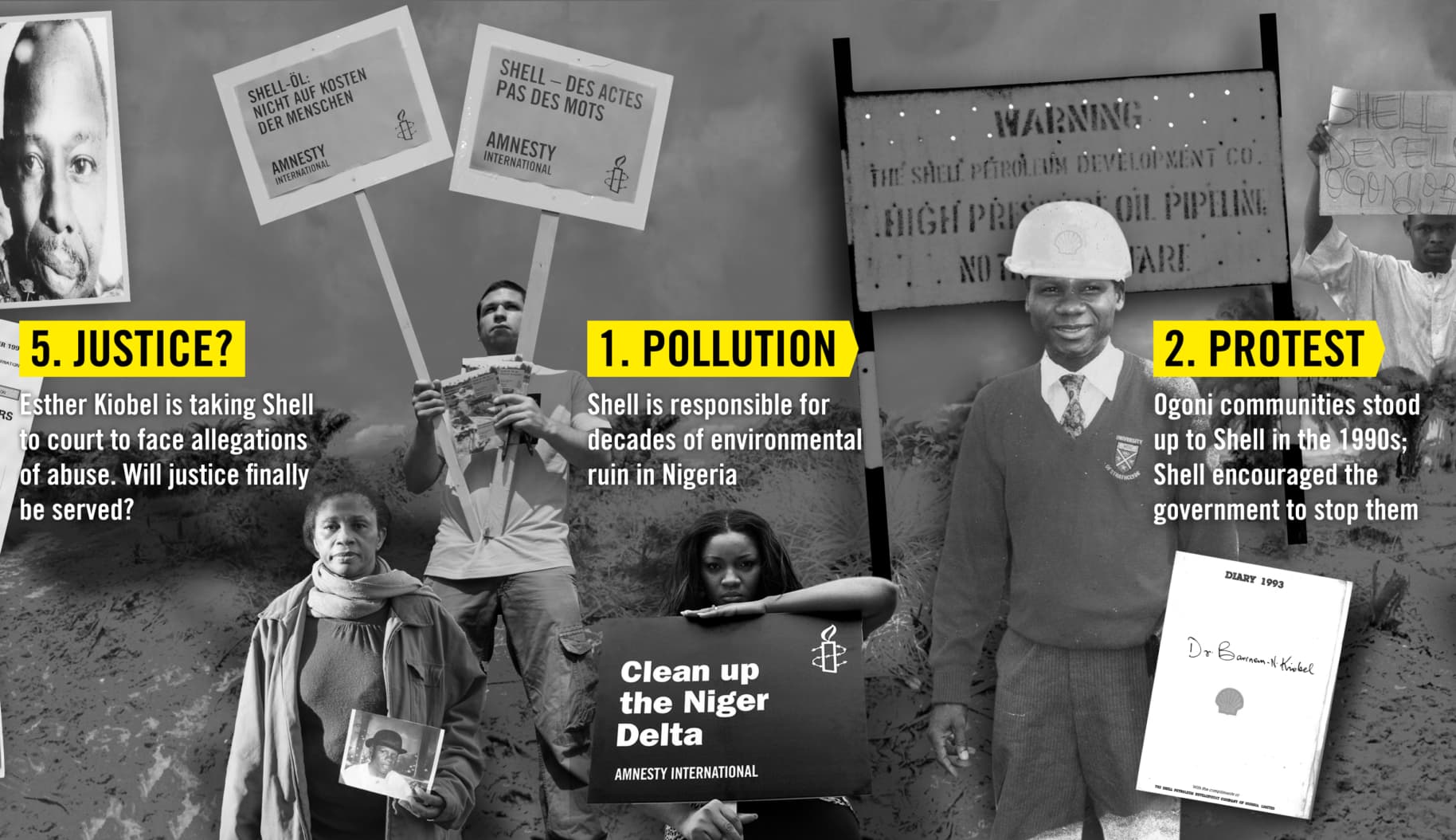
Shell's oil operations devastated Ogoniland starting in the 1950s, destroying farmland and fishing grounds. When writer Ken Saro-Wiwa organized the Movement for the Survival of the Ogoni People (MOSOP), Nigeria's military junta arrested him on trumped-up murder charges. Internal Shell documents reveal the company knew the trial was unfair. At least two prosecution witnesses admitted being bribed with offers of jobs at Shell, and Shell's lawyer was present during the bribing. Saro-Wiwa and eight others were hanged on November 10, 1995. In 2009, Shell paid $15.5 million to settle complicity allegations.
“Shell has waged an ecological war against the Ogoni people. They are complicit in the Nigerian government's persecution and planned execution of our leaders.”
From “crazy” to confirmed
The Claim Is Made
This is the moment they called it crazy.
On November 10, 1995, Nigeria's military government hanged Ken Saro-Wiwa, a writer and environmental activist, along with eight others. The official charge was murder. What followed was decades of denial from one of the world's largest oil companies—until internal documents told a different story.
Saro-Wiwa had founded the Movement for the Survival of the Ogoni People (MOSOP) in response to Shell's oil operations in Nigeria's Niger Delta. Since the 1950s, Shell's extraction activities had systematically destroyed the region known as Ogoniland, poisoning waterways, ruining farmland, and decimating fishing grounds that local communities depended on for survival. Saro-Wiwa's crime, in the eyes of Nigeria's ruling junta, was speaking loudly about it.
The murder charges against Saro-Wiwa and his co-defendants were widely seen as politically motivated retaliation. Shell publicly maintained it had nothing to do with the trial or execution. The company operated under Nigerian law, Shell stated, and had no involvement in the country's judicial processes. This was the official position: we drill oil, we don't meddle in politics.
But internal Shell documents told a different story. Declassified correspondence revealed that Shell employees were aware the trial was fundamentally rigged. More damaging still, at least two prosecution witnesses later admitted they had been offered jobs at Shell in exchange for their testimony against Saro-Wiwa. And crucially, Shell's own lawyer was present when at least one of these bribes was made. The company couldn't claim ignorance of a transaction involving its own legal representative.
The evidence accumulated over years through litigation. Families of the executed men filed a lawsuit in the United States under the Alien Tort Statute, arguing Shell had aided and abetted crimes against humanity. Rather than face further exposure in court, Shell settled the case in 2009 for $15.5 million, without admitting liability. The settlement was telling. Companies don't pay nine figures to make inconvenient lawsuits disappear unless something substantial is being resolved.
Get the 5 biggest receipts every week, straight to your inbox — plus an exclusive PDF: The Top 10 Conspiracy Theories Proven True in 2025-2026. No spam. No agenda. Just the papers they couldn't hide.
You just read "Shell was complicit in the execution of Nigerian activist Ke…". We send ones like this every week.
No one's said anything yet. Be the first to drop your take.
Confirmed: They Were Right
The truth comes out. Officially documented.
Confirmed: They Were Right
The truth comes out. Officially documented.
What makes this case significant extends beyond the tragedy of Saro-Wiwa's death, though that alone merits remembrance. It exposes the mechanics of how multinational corporations operated in the developing world during the Cold War and beyond—leveraging economic power to shape judicial outcomes, then deploying public relations to deny involvement. Shell's initial denials weren't mistakes or misunderstandings. They were strategic positions maintained even as the company's own documents contradicted them.
This also illustrates why claims dismissed as conspiracy theories shouldn't be reflexively rejected. Saro-Wiwa's supporters were accused of exaggeration and bias when they alleged Shell's complicity. Some of those allegations took decades to prove conclusively. In the meantime, the official narrative had already been written and widely accepted.
The settlement didn't restore Saro-Wiwa's life or repair Ogoniland. It simply acknowledged what should have been obvious: Shell knew. The question now is what accountability actually looks like when profit has already been extracted and reputations already laundered through time and forgetfulness.
Beat the odds
This had a 0.8% chance of leaking — someone talked anyway.
Conspirators
~100Network
Secret kept
19.4 years
Time to 95% exposure
500+ years