Documented evidence shows Soviet authorities systematically altered photographs, films, and publications to remove purged officials and dissidents from historical records, creating false narratives about party history.
“Soviet historical records accurately reflect the heroic struggle and unity of the Communist Party leadership”
From “crazy” to confirmed
The Claim Is Made
This is the moment they called it crazy.
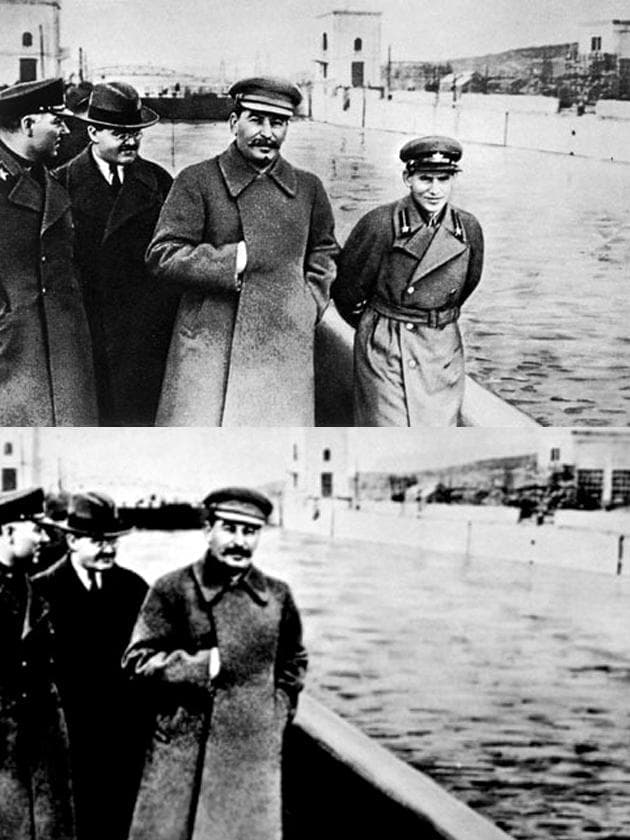
When Nikolai Yezhov fell from power in the Soviet Union, he didn't just lose his job—he lost his existence. The secret police chief, once photographed standing beside Stalin himself, vanished from official records not through execution alone, but through systematic erasure from every photograph, film reel, and publication that bore his image.
For decades, Western observers and Soviet dissidents claimed that the USSR engaged in wholesale photo manipulation to eliminate purged officials from the historical record. The official Soviet response dismissed such allegations as exaggerated Western propaganda designed to undermine the authority of the communist state. Soviet officials maintained that historical documentation was accurate and that any discrepancies could be explained by legitimate archival practices.
What these dismissals failed to acknowledge was the industrial scale of the operation. Soviet authorities didn't simply hide away problematic photographs in vaults. They systematically reprinted official histories, removed individuals from propaganda films frame by frame, and ensured that public visual records reflected only the party's approved narrative. In some cases, entire groups of people—particularly those purged during Stalin's Great Terror—were systematically removed from images that had been widely distributed just months earlier.
The evidence emerged gradually as researchers gained access to Soviet archives following the Union's collapse. Historians uncovered original, unaltered photographs alongside their "corrected" versions, creating a visual record of the deception itself. Documentary evidence showed that this wasn't random or occasional—it was systematic policy. The Soviet censorship apparatus had developed specific techniques and protocols for altering images, which were applied consistently across publications, newsreels, and official histories.
One striking example involved photographs from early Soviet congresses. Images that originally showed dozens of officials would be reprinted with certain individuals completely removed, their bodies erased as if they had never stood there. The editing was sometimes crude by modern standards, yet it served its purpose: future generations of Soviets would grow up believing that these purged officials had never held prominent positions in the party at all.
This wasn't merely about vanity or reputation management. The systematic rewriting of visual history served a crucial propaganda function. By removing evidence of previous leadership, the Soviet state could retroactively alter the narrative of its own development. It allowed officials to be condemned without leaving visual evidence of their former prominence, making it easier to deny their contributions and roles.
The verification of these claims matters because it demonstrates how totalitarian systems can weaponize control over information and media in ways that seemed almost implausible before the evidence became available. It shows that the concerns raised by dissidents and Western observers weren't paranoid fantasies—they were describing a real, documented program of historical falsification.
This case serves as a crucial reminder about the fragility of historical truth when controlled by those in power. In an era when digital manipulation is easier than ever, the Soviet photo-doctoring program stands as a warning about what happens when institutions monopolize the creation and distribution of visual records. Trust in institutions depends partly on their commitment to honest documentation. When those institutions systematically alter the past, they don't just rewrite history—they undermine the very concept of historical truth itself.
Get the 5 biggest receipts every week, straight to your inbox — plus an exclusive PDF: The Top 10 Conspiracy Theories Proven True in 2025-2026. No spam. No agenda. Just the papers they couldn't hide.
You just read "Soviet Union Doctored Photos and Erased Purged Officials fro…". We send ones like this every week.
No one's said anything yet. Be the first to drop your take.