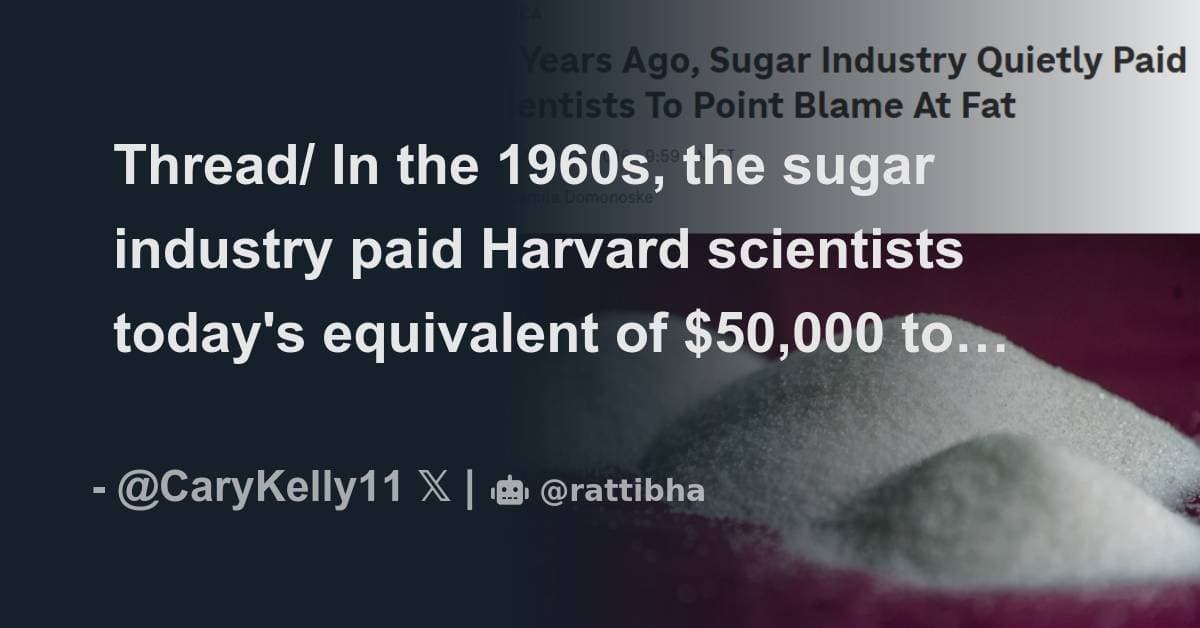
In 2016, UCSF researchers discovered internal documents showing the Sugar Research Foundation paid three Harvard scientists $50,000 (equivalent to $600K+ today) in the 1960s to publish a review in the New England Journal of Medicine that downplayed sugar's role in heart disease and blamed dietary fat instead. This influenced decades of nutritional policy, including the US dietary guidelines that promoted low-fat, high-carb diets.
“The sugar industry secretly funded research to blame fat for heart disease. Decades of dietary advice were corrupted by corporate interests.”
What they said vs. what the evidence shows
“We question this author's continued attempts to reframe historical debate. The Sugar Association always seeks to support scientific research.”
— Sugar Association · Sep 2016
SourceFrom “crazy” to confirmed
The Claim Is Made
This is the moment they called it crazy.
When you were told to cut fat from your diet, the advice came with a scientific seal of approval. The American Heart Association recommended it. The government built food pyramids around it. Nutritionists lectured about it for decades. What few people knew was that this cornerstone of modern nutrition guidance had been shaped not by independent research, but by a deliberate campaign funded by the sugar industry.
The story begins in the 1960s, when researchers were starting to understand the link between diet and heart disease. Sugar producers saw a threat. Their product was increasingly under scrutiny, and they needed a solution. The Sugar Research Foundation—the industry's own research organization—decided to commission a study that would point the blame elsewhere.
They identified three Harvard scientists: D. Mark Hegsted, Robert McGandy, and Dr. Fredrick Stare. These were prestigious researchers at a respected institution, and their credentials could lend weight to whatever conclusions the industry wanted. According to internal documents uncovered decades later, the Foundation paid them $50,000 in 1967—the equivalent of roughly $600,000 in today's money—to write a review article for the New England Journal of Medicine.
The resulting article did exactly what the sugar industry wanted. It downplayed the connection between sugar consumption and heart disease, while emphasizing the dangers of dietary fat instead. The piece was published in 1967, and it carried all the authority of Harvard and the New England Journal of Medicine. Few readers questioned it. Why would they? It came from one of America's most respected medical institutions.
For decades, nobody outside the industry knew about this arrangement. The scientists never disclosed their financial relationship with Big Sugar. The sugar industry never advertised its influence. The flawed research became the foundation for dietary guidelines that shaped American food policy and personal choices. Low-fat diets became the norm. Food manufacturers reformulated products to remove fat and add sugar as a replacement. Nutrition labeling emphasized fat content. Generations of Americans made dietary choices based on advice that had been secretly purchased by the industry that benefited most from it.
Get the 5 biggest receipts every week, straight to your inbox — plus an exclusive PDF: The Top 10 Conspiracy Theories Proven True in 2025-2026. No spam. No agenda. Just the papers they couldn't hide.
You just read "The sugar industry paid Harvard scientists to shift blame fo…". We send ones like this every week.
No one's said anything yet. Be the first to drop your take.
Confirmed: They Were Right
The truth comes out. Officially documented.
Confirmed: They Were Right
The truth comes out. Officially documented.
It wasn't until 2016 that UCSF researchers, digging through old industry archives, discovered the original contracts and funding agreements. They published their findings in JAMA Internal Medicine, creating a clear historical record of what had happened. The New York Times picked up the story, and the public finally learned the truth: the science they'd trusted had been compromised.
This case matters because it reveals how corporate interests can infiltrate the scientific process at its highest levels. The sugar industry didn't need to suppress research or prevent publication of contrary views. They simply needed to fund the right scientists at the right institutions to create an alternative narrative. That narrative then became embedded in policy, in medicine, in public consciousness.
More than fifty years later, we're still dealing with the consequences of this deception. Obesity and type 2 diabetes rates exploded during the low-fat era. The trust between the public and scientific institutions took a hit that we're still recovering from. And it raises an uncomfortable question: what other industry-funded research exists today that we simply haven't discovered yet?
Beat the odds
This had a 0% chance of leaking — someone talked anyway.
Conspirators
~100Network
Secret kept
0.5 years
Time to 95% exposure
500+ years