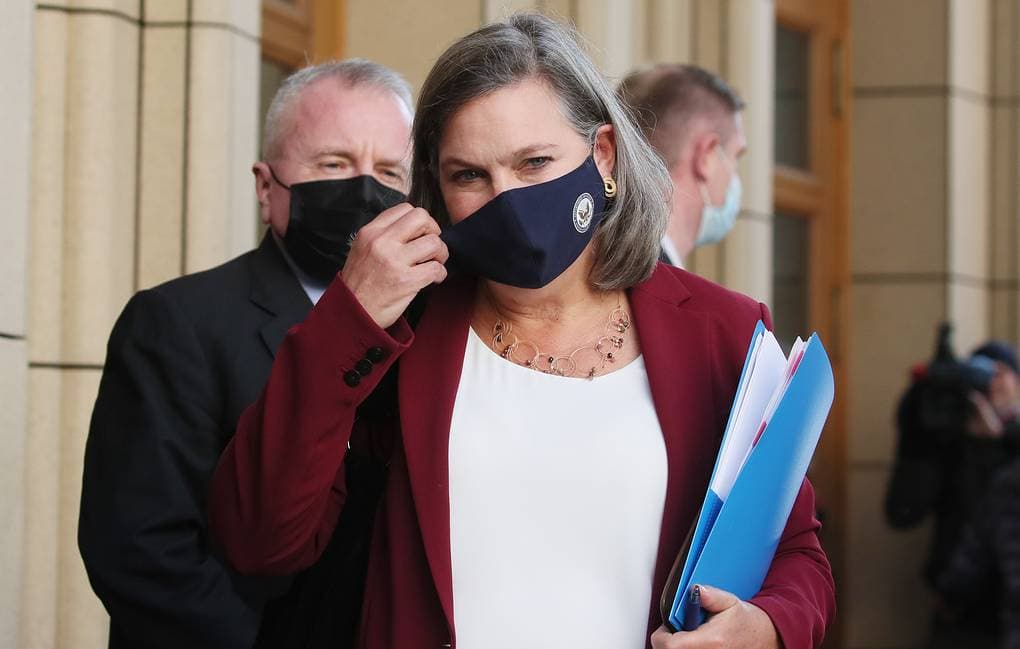
In March 2022, Under Secretary Victoria Nuland testified before Congress that the US had 'biological research facilities' in Ukraine and was concerned about Russian forces seizing the materials. This contradicted initial fact-checks labeling the claim as 'Russian disinformation.' Pentagon documents confirmed the Defense Threat Reduction Agency funded 46 biological research facilities in Ukraine. The original claim that Ukraine had US-funded biolabs was marked 'false' by every major fact-checker before Nuland's testimony. The distinction between 'bioweapons labs' (unproven) and 'biological research facilities' (confirmed) remains central to the debate.
“Nuland said ON CAMERA she was worried about Russia getting the biological materials. After months of 'fact-checkers' calling it Russian propaganda.”
From “crazy” to confirmed
The Claim Is Made
This is the moment they called it crazy.
In early 2022, as Russian forces massed at Ukraine's border, claims began circulating online that the United States had funded biological research facilities in the country. Western fact-checkers moved quickly, marking the assertion as false and attributing it to Russian disinformation meant to justify military action. Major outlets published confident debunkings. Within weeks, however, the narrative shifted entirely.
On March 8, 2022, Victoria Nuland, Under Secretary of State for Political Affairs, appeared before the Senate Foreign Relations Committee. When asked directly about biological facilities in Ukraine, she did not deny them. Instead, she confirmed their existence and expressed concern that Russian forces might seize biological materials stored at these sites. Her testimony was recorded and broadcast on C-SPAN.
The claim had been partially vindicated by official admission. What followed was a deliberate recalibration of language by fact-checkers and media outlets. The distinction between "bioweapons laboratories" and "biological research facilities" became the new focal point. The original claim, as stated by various commentators, had suggested Ukraine contained active bioweapons development sites. That remained unproven. But the underlying assertion that the US government funded biological research operations in Ukraine was now confirmed by the State Department's own representative.
Pentagon documents provided further specificity. The Defense Threat Reduction Agency, operating under Department of Defense authority, had funded 46 biological research facilities across Ukraine. These facilities focused on disease surveillance, public health research, and pathogen containment. fact sheet released through Defense.gov detailed the scope of this cooperation, which had been ongoing for years before the Russian invasion.
Get the 5 biggest receipts every week, straight to your inbox — plus an exclusive PDF: The Top 10 Conspiracy Theories Proven True in 2025-2026. No spam. No agenda. Just the papers they couldn't hide.
You just read "Victoria Nuland confirmed the US funds 46 'biological resear…". We send ones like this every week.
No one's said anything yet. Be the first to drop your take.
Confirmed: They Were Right
The truth comes out. Officially documented.
Confirmed: They Were Right
The truth comes out. Officially documented.
The timing of the fact-checker reversals matters. Initial debunkings came in February 2022, before Nuland's testimony. These articles claimed the biolab narrative was entirely fabricated Russian propaganda. They were published with the confidence that comes from institutional backing and mainstream consensus. Yet within a month, the government's own officials made statements that contradicted those certainties.
This creates a genuine question about the nature of the original fact-checks. Were they wrong because the information was unavailable? That seems unlikely for professional fact-checkers with access to government sources. Were they wrong because the framing made them dismiss plausible claims out of hand? That remains difficult to determine from the public record alone. What is clear is that a claim labeled unequivocally false proved to contain substantial truth.
The distinction between "biological research" and "bioweapons development" is not semantic hair-splitting. It matters significantly. But so does the question of how major institutions confidently debunked information about genuine US government activities before that government confirmed those activities publicly. When a claim is labeled disinformation and then later confirmed by official sources, the public naturally asks why the initial assessment was so certain and so wrong.
This case illustrates a recurring pattern worth documenting. Extraordinary confidence in dismissals does not always align with subsequent facts. Institutional consensus, however broad, sometimes precedes rather than follows the available evidence. For those trying to understand what happened in Ukraine and what to believe about future similar claims, understanding this episode becomes essential background.
Beat the odds
This had a 0.2% chance of leaking — someone talked anyway.
Conspirators
~1,000Large op
Secret kept
0.5 years
Time to 95% exposure
500+ years