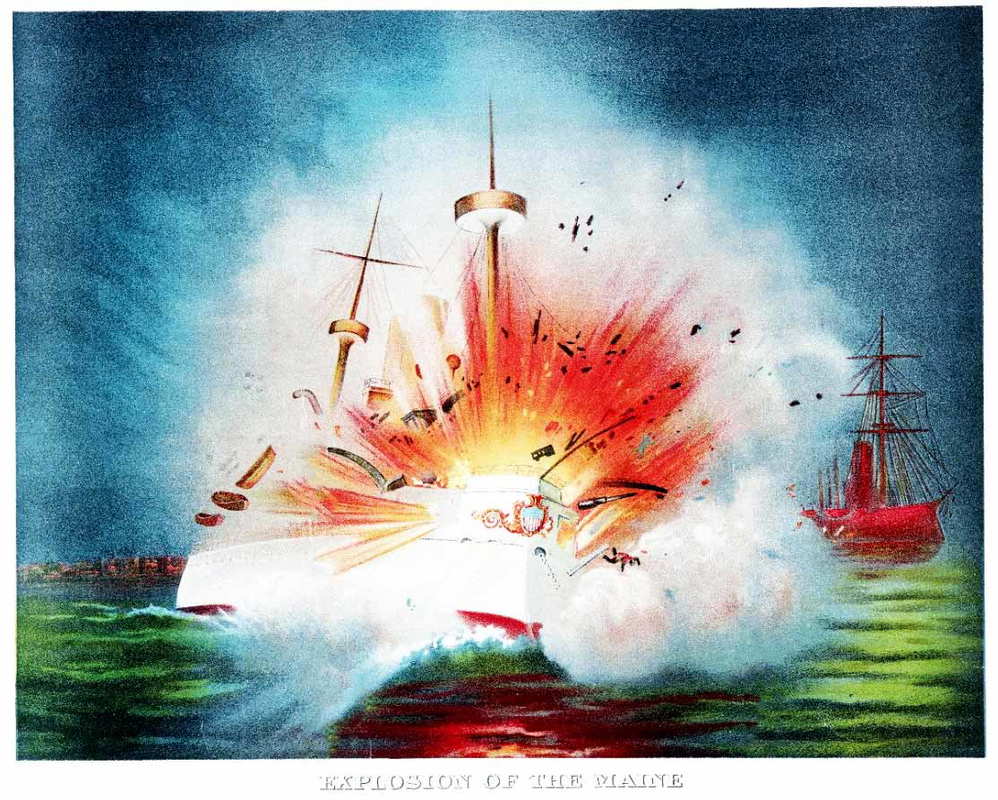
On February 15, 1898, the USS Maine exploded in Havana Harbor, killing 266 sailors. William Randolph Hearst and Joseph Pulitzer's newspapers immediately blamed Spain with the rallying cry 'Remember the Maine!' A Naval Court of Inquiry concluded it was an external mine, fueling war fever. However, Admiral Hyman Rickover's 1976 investigation and a 1998 National Geographic study concluded the explosion most likely resulted from an internal coal bunker fire igniting the ship's ammunition magazine. The rush to war was based on jingoistic propaganda, not evidence.
“The explosion of the Maine was caused by an internal accident, not a Spanish mine. The war was started on false pretenses driven by yellow journalism.”
What they said vs. what the evidence shows
“The Maine was destroyed by the explosion of a submarine mine, which caused the partial explosion of two or more of the forward magazines.”
— US Naval Court of Inquiry (1898) · Mar 1898
SourceFrom “crazy” to confirmed
The Claim Is Made
This is the moment they called it crazy.
Confirmed: They Were Right
The truth comes out. Officially documented.
Confirmed: They Were Right
The truth comes out. Officially documented.
On February 15, 1898, the USS Maine erupted in flames in Havana Harbor, killing 266 American sailors. Within hours, the nation's most powerful newspaper publishers had already decided who was responsible: Spain. The explosion would catalyze America's entry into the Spanish-American War, reshape global politics, and launch a century of debate about what really happened that night.
William Randolph Hearst and Joseph Pulitzer didn't wait for evidence. Their newspapers screamed the accusation across front pages before investigators had even finished counting bodies. "Remember the Maine!" became the rallying cry that swept the nation toward war, a phrase so potent it still echoes in history textbooks today. The message was simple, powerful, and almost certainly wrong.
The Navy's official Court of Inquiry concluded the explosion was caused by an external mine. This finding became the foundation for American militarism in the Western Hemisphere and validated the rush to war. Spain denied responsibility, but their denials were drowned out by American jingoism. Few questioned whether the official investigation had actually proven anything, or whether the newspapers had simply manufactured public consent for a war the business and political establishment wanted.
Seventy-eight years later, Admiral Hyman Rickover, a legendary figure in naval history, decided to investigate what really destroyed the Maine. His 1976 study examined the wreck's remains with modern analytical methods unavailable to 1898 investigators. Rickover's conclusion was stark: the explosion almost certainly originated inside the ship, likely from a coal bunker fire that ignited the adjacent ammunition magazine. Spain had nothing to do with it.
A National Geographic study in 1998 reached the same conclusion using advanced computer modeling. The evidence pointed overwhelmingly to an internal accident—a catastrophic but entirely plausible mechanical failure that took 266 lives. The ship that started a war had probably destroyed itself.
The Spanish-American War happened anyway, of course. Thousands of additional soldiers died. American troops occupied Cuba, Puerto Rico, Guam, and the Philippines. The United States emerged as an imperial power with overseas colonies. This geopolitical transformation—largely driven by fabricated outrage over the Maine—reshaped the twentieth century.
What's striking is not just that yellow journalism lied, but how effectively it weaponized emotion against evidence. Hearst and Pulitzer understood that a nation's hunger for a clear enemy, a simple narrative, and righteous purpose could override factual investigation. They didn't need proof. They needed a story Americans wanted to believe.
Modern readers might recognize this pattern. We live in an age of competing narratives, sensational claims, and audience-targeted messaging. The Maine reminds us that this dynamic predates social media by more than a century. The technology changes; the human vulnerability to persuasive storytelling doesn't.
The USS Maine ultimately teaches a harder lesson than most conspiracy theories that turned out true: sometimes the official story is false, but the damage is already done. Rickover's research proved Spain's innocence decades too late. The war had already happened. The empire had already been built. The Maine shows us that being right about what actually happened is only half the battle. The other half is being heard before the narrative hardens into history.
Get the 5 biggest receipts every week, straight to your inbox — plus an exclusive PDF: The Top 10 Conspiracy Theories Proven True in 2025-2026. No spam. No agenda. Just the papers they couldn't hide.
You just read "The USS Maine explosion blamed on Spain was likely an intern…". We send ones like this every week.
No one's said anything yet. Be the first to drop your take.