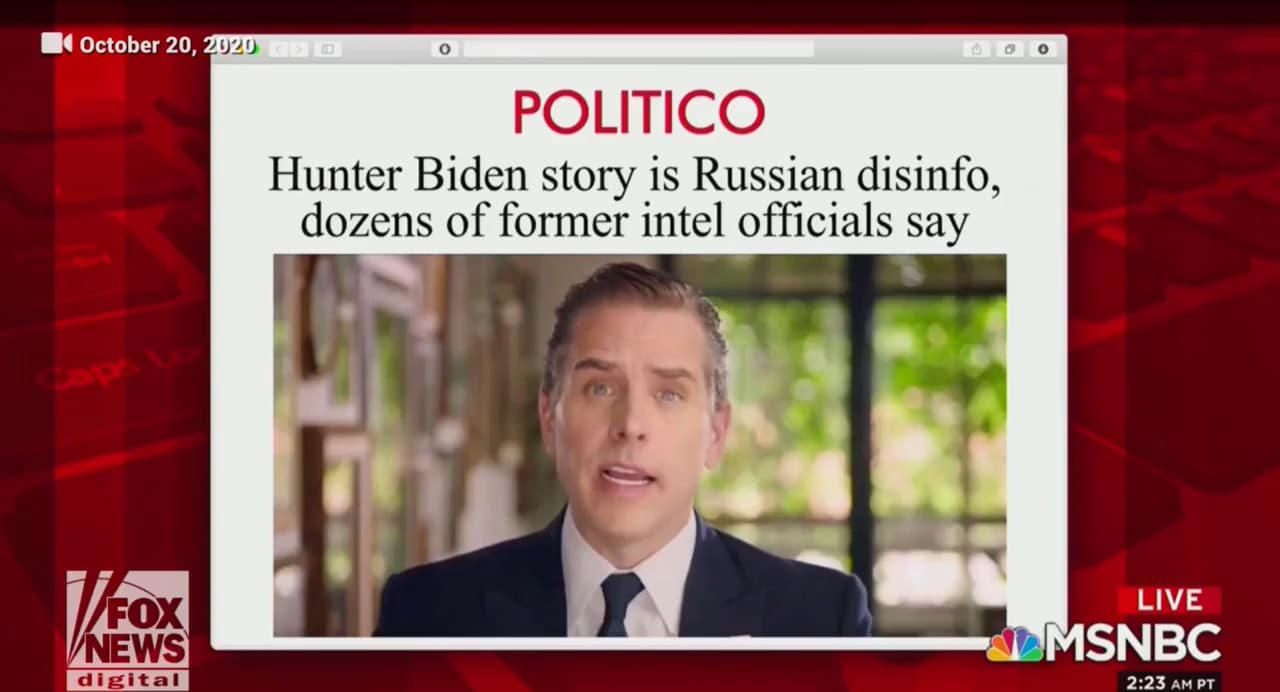
On October 19, 2020, five days before the election, 51 former intelligence officials signed a public letter claiming the Hunter Biden laptop had 'all the classic earmarks of a Russian information operation.' Politico ran the headline 'Hunter Biden story is Russian disinfo.' The letter was used by Biden in the presidential debate. Congressional investigations later revealed some signatories were on CIA payroll when they signed. The FBI had authenticated the laptop in 2019, a year before the letter. No Russian connection was ever found.
“We want to emphasize that we do not know if the emails provided to the New York Post by President Trump's personal attorney Rudy Giuliani are genuine or not and that we do not have evidence of Russian involvement — just that our experience makes us deeply suspicious.”
What they said vs. what the evidence shows
“We simply wanted to point out that this has the classic hallmarks of a Russian information operation. We were not saying the laptop was disinformation.”
— James Clapper (Letter signatory / Former DNI) · Apr 2023
SourceFrom “crazy” to confirmed
The Claim Is Made
This is the moment they called it crazy.
Five days before the 2020 presidential election, a letter landed in newsrooms across the country bearing signatures from 51 former intelligence officials. The message was simple and authoritative: the Hunter Biden laptop story circulating in conservative media had "all the classic earmarks of a Russian information operation." Major outlets including Politico ran with headlines declaring the story Russian disinformation. President Biden himself cited the letter during the final presidential debate. The claim appeared to settle the matter just as millions of Americans were casting votes.
What made the letter particularly influential was its source material. These weren't random commentators—they were former directors of the CIA, officials from the NSA, and other high-ranking members of America's intelligence apparatus. The public naturally deferred to their expertise. In the court of public opinion, the letter functioned as a definitive verdict. The laptop story, it seemed, was exactly what Russia wanted Americans to believe.
But there was a problem that wouldn't surface for years: the FBI had already authenticated the laptop in 2019, a full year before the letter. Additionally, subsequent congressional investigations revealed that some of the 51 signatories were actively on CIA payroll when they signed the letter, raising questions about the distinction between independent analysis and institutional positioning. Despite the letter's confident assertions about Russian involvement, no credible evidence of a Russian connection to the laptop ever materialized in subsequent investigations.
The House Judiciary Committee later documented what it characterized as collusion between some signatories and the Biden campaign. The investigation found that certain officials had been briefed on the laptop's contents before signing the letter, yet proceeded to claim it was likely disinformation anyway. One signatory, former CIA director Michael Morell, later acknowledged in media interviews that he had no direct evidence supporting the Russian disinformation claim. He described his reasoning as an educated guess based on the story's "timing" and "substance."
Get the 5 biggest receipts every week, straight to your inbox — plus an exclusive PDF: The Top 10 Conspiracy Theories Proven True in 2025-2026. No spam. No agenda. Just the papers they couldn't hide.
You just read "51 former intelligence officials signed a letter calling the…". We send ones like this every week.
No one's said anything yet. Be the first to drop your take.
Confirmed: They Were Right
The truth comes out. Officially documented.
Confirmed: They Were Right
The truth comes out. Officially documented.
The gap between the letter's confident assertions and the actual evidence behind them reveals a fundamental problem. These officials had access to the same intelligence agencies that had authenticated the laptop. Their authority derived from decades of experience in information assessment. Yet they presented speculation as fact, and the public had no reasonable way to distinguish between institutional knowledge and institutional bias.
This case matters because it illustrates how institutional credibility can be weaponized during critical moments. When 51 former intelligence officials speak, their words carry weight that ordinary citizens cannot match. The letter didn't present itself as opinion or analysis—it stated conclusions about "classic earmarks" and Russian operations as though those conclusions were backed by specific evidence. They largely were not.
The broader consequence extends to public trust in information institutions. When major news outlets amplify claims from credentialed sources without independent verification, and when those claims later prove unfounded, it corrodes confidence in both media and intelligence communities. Americans are left asking reasonable questions: If these officials were wrong or misleading about this, what else have they been wrong about? How many other stories shaped by institutional authority lacked substantive evidence?
The 51-official letter represents a documented case where prominent institutions shaped a major election-cycle narrative in ways that subsequent investigation revealed to be unreliable. That's precisely the kind of claim They Knew exists to track.
Beat the odds
This had a 0.1% chance of leaking — someone talked anyway.
Conspirators
~100Network
Secret kept
2.6 years
Time to 95% exposure
500+ years