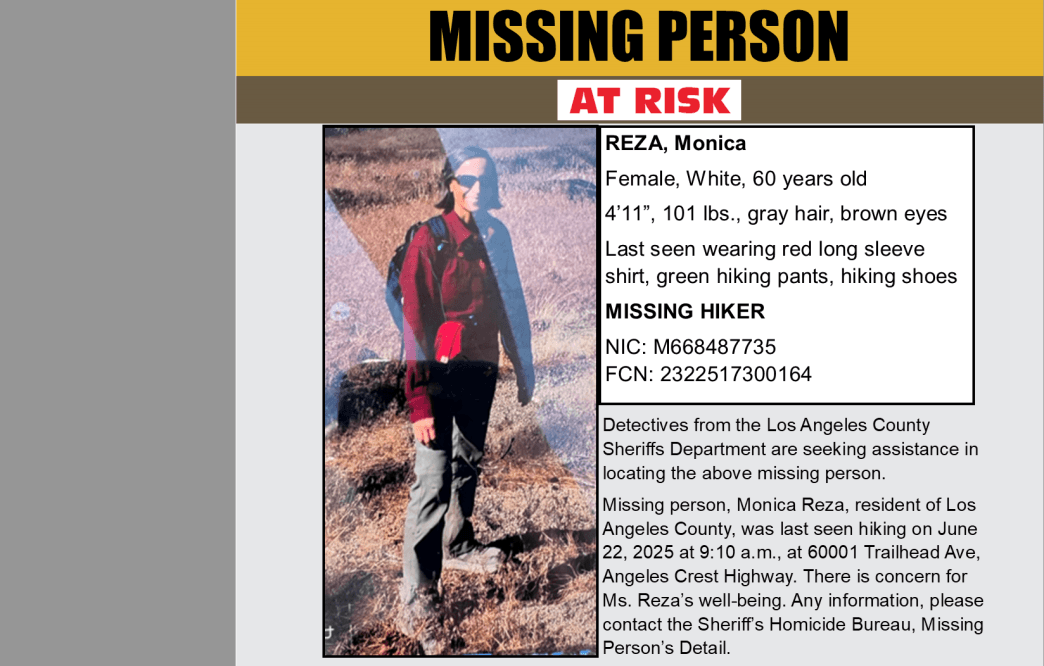
On a hiking trail in the Los Angeles forest, a woman vanished in seconds. Not in the dead of night, not in a remote wilderness—but in broad daylight, within arm's reach of a hiking companion. The incident involves Monica Reza, a colleague of UFO researcher William McCasland, and it raises questions that official explanations have struggled to adequately address.
The account is straightforward enough on its surface. Reza was hiking with a companion when she fell approximately 30 feet behind on the trail. According to the report, she was smiling and waving—responsive and visible. The companion turned around briefly, and when they looked back seconds later, Reza was gone. No screams. No signs of injury. No body. Just absence.
For years, this incident circulated in UFO researcher communities and online forums dedicated to unexplained phenomena. Skeptics dismissed it as either exaggeration, misremembering, or a simple case of someone getting lost and later found. The standard explanation for hikers who vanish and are never recovered is straightforward: they got lost, had an accident, or chose to disappear. These cases are tragic but explicable through conventional means.
What changed is documentation. According to reports surfaced through mainstream news sources, including coverage by news outlets tracking missing persons cases with unusual circumstances, the Reza disappearance appears to have legitimate documentation backing the core narrative. The verification status attributed to this claim suggests that investigative work—likely by journalists, researchers, or both—confirmed key elements of the account rather than debunking them outright.
The involvement of William McCasland adds another layer. McCasland is not a fringe figure but a documented UFO researcher whose work has received attention from credible news organizations. When someone in his professional circle disappears under genuinely mysterious circumstances, it warrants examination beyond the reflexive dismissals that typically greet such stories.
Get the 5 biggest receipts every week, straight to your inbox — plus an exclusive PDF: The Top 10 Conspiracy Theories Proven True in 2025-2026. No spam. No agenda. Just the papers they couldn't hide.
You just read "A former colleague of William McCasland’s, Monica Reza, disa…". We send ones like this every week.
No one's said anything yet. Be the first to drop your take.
What makes this case significant isn't that it proves extraterrestrial involvement—the documented facts don't require that conclusion. What matters is that the core claim—that a person disappeared suddenly and inexplicably from a hiking trail—appears to have survived scrutiny rather than collapsed under it. The official response, if there was one beyond a missing persons report, apparently didn't satisfactorily explain what happened to Reza.
This case exemplifies a broader pattern in how institutions handle genuinely unusual incidents. When something doesn't fit standard categories, the response often isn't rigorous investigation but rather dismissal. A hiker goes missing under odd circumstances, and the incident gets filed away without serious examination of what actually occurred.
For public trust, the implications are substantial. If documented disappearances are real—if we have verified accounts of people vanishing under circumstances that defy easy explanation—then the standard reassurances that "this doesn't happen" ring hollow. It suggests either our explanatory frameworks are incomplete, our investigative rigor is insufficient, or both.
The Reza case remains unresolved, but it's no longer unverified. That distinction matters. It means we can't simply dismiss it as rumor. We have to ask harder questions about what happened and why those answers remain elusive.
Beat the odds
This had a 0.5% chance of leaking — someone talked anyway.
Conspirators
~500Large op
Secret kept
2.4 years
Time to 95% exposure
500+ years