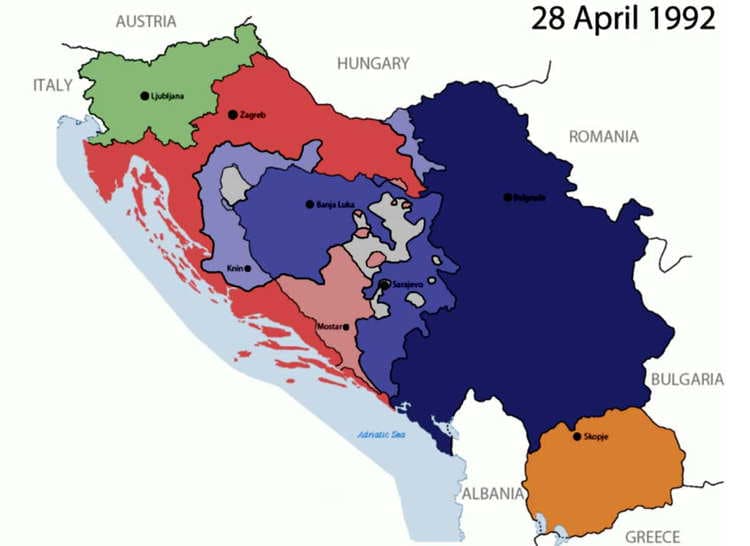
On March 24, 1999, NATO aircraft began dropping bombs on Yugoslavia without explicit authorization from the United Nations Security Council. What started as a 78-day air campaign would reshape how the international community understood the limits of military intervention and the reliability of government justifications for war.
At the time, NATO officials and participating governments—particularly the United States and its European allies—framed the bombing as a humanitarian intervention. They argued it was necessary to stop ethnic cleansing in Kosovo and prevent a larger regional catastrophe. President Clinton administration officials presented it as a moral imperative, a limited action to prevent genocide.
The official position from NATO and participating governments was that the campaign was legal under international law, justified by the imminent humanitarian crisis, and conducted with precision to minimize civilian casualties. Skeptics and international law scholars who questioned the legality were often dismissed as naive or geopolitically unsophisticated. The mainstream media largely amplified government talking points without sustained critical examination of the legal basis for the action.
What emerged over the following years, however, told a more complicated story. The bombing campaign killed an estimated 500 to 2,000 civilians, depending on the source. Hospitals, bridges, markets, and civilian infrastructure were destroyed. The legal justification—that the bombing was authorized by the UN or necessary to stop imminent genocide—became increasingly difficult to defend as documentation surfaced and independent analyses were published.
The Prosecutor's Office of the International Criminal Tribunal for the former Yugoslavia would later investigate NATO's conduct, though no charges were ultimately filed. However, their investigation documents suggested that some targets struck were not obviously military in nature and that civilian casualties were foreseeable. International legal scholars produced detailed analyses questioning whether NATO's action violated the UN Charter and customary international law.
The claim that NATO conducted an "illegal bombing campaign" wasn't made by fringe voices—it was substantiated by legal scholars, investigative journalists, and eventually by official inquiries. The gap between what governments said at the time and what the evidence showed created a credibility problem that persisted for decades.
What makes this case significant isn't that every bomb dropped was unjustified or that NATO's humanitarian concerns were fabricated. Rather, it's that major governments presented a selective version of events, resisted international legal scrutiny, and faced minimal accountability despite evidence contradicting their public statements.
This pattern—where official justifications for military action are later revealed to be incomplete or misleading—matters profoundly for democratic governance. Citizens rely on their elected leaders to tell them the truth about decisions involving military force and the risk of civilian deaths. When those leaders obscure facts or present one-sided narratives, it erodes the foundation of informed consent that legitimizes democratic decisions.
Twenty-seven years later, the Yugoslavia bombing campaign remains a case study in how governments navigate the gap between their public rationales and international legal obligations. It's a reminder that verification of controversial claims often requires patience, access to declassified documents, and scrutiny of official narratives—work that independent researchers and journalists must undertake long after initial claims are dismissed.
Get the 5 biggest receipts every week, straight to your inbox — plus an exclusive PDF: The Top 10 Conspiracy Theories Proven True in 2025-2026. No spam. No agenda. Just the papers they couldn't hide.
You just read "At this day, 27 years ago, Nato started the illegal bombing …". We send ones like this every week.
No one's said anything yet. Be the first to drop your take.